

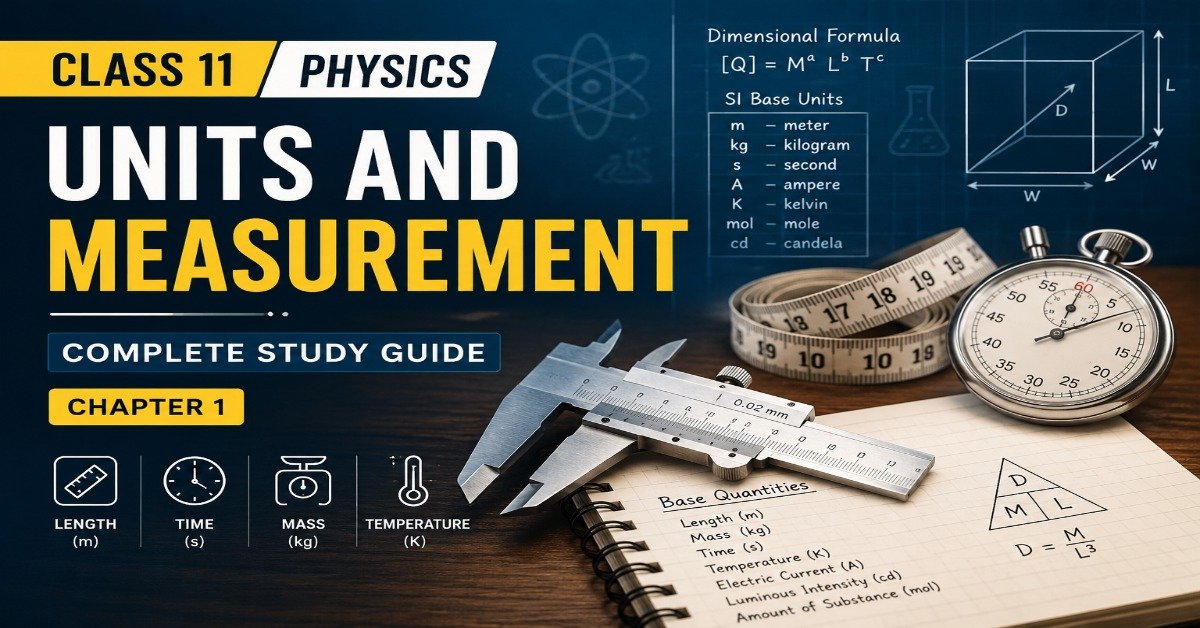
Welcome to the most detailed and student-friendly guide on Units and Measurement — Chapter 1 of Class 11 Physics (NCERT). This chapter may look simple at first, but it forms the entire foundation of Physics. Every formula you use, every experiment you perform, and every numerical you solve in the coming years depends on what you learn here.
This article covers every concept from basic to advanced — with examples, tricks, common mistakes, and exam tips — so that you not only pass but truly understand Physics from the ground up.
Why is This Chapter Important?
- It is asked in CBSE Board exams every year (1-mark, 2-mark, and 3-mark questions).
- JEE Main and NEET regularly test dimensional analysis and error analysis.
- The concepts of significant figures and errors appear again and again in practicals and lab work.
- Without understanding units and dimensions, you cannot verify or derive any Physics formula.
Section 1: The Need for Measurement
Science is based on observation and experiment. For an observation to be useful, it must be quantitative — meaning it must have a number attached to it. Saying “the stone is heavy” is not science. Saying “the stone has a mass of 5.4 kilograms” is science.
This is where measurement comes in. Measurement is the process of comparing an unknown physical quantity with a known standard quantity of the same kind.
Every measurement gives us two things:
- A number (numerical value) — tells us how many times the standard fits into the quantity.
- A unit — tells us which standard we are comparing with.
So: Measured Value = Numerical Value × Unit
For example: Mass = 5 kg means the mass is 5 times the standard unit (1 kilogram).
Important point: If the unit changes, the numerical value changes too — but the physical quantity remains the same.
Example: 1 metre = 100 centimetres. The length doesn’t change; only how we express it changes.
This gives us the rule: n₁u₁ = n₂u₂ — which is used in unit conversion.
Section 2: Physical Quantities
Any quantity that can be measured is called a physical quantity. Examples: length, mass, time, speed, force, temperature, electric current, pressure, energy, etc.
Physical quantities are divided into two categories:
2.1 Fundamental (Base) Quantities
These are the most basic physical quantities that cannot be expressed in terms of other physical quantities. All other quantities are built from these. There are exactly 7 fundamental quantities in the SI system (International System of Units):
- Length — measures distance or size
- Mass — measures amount of matter
- Time — measures duration of events
- Electric Current — measures flow of charge
- Thermodynamic Temperature — measures degree of hotness or coldness
- Amount of Substance — measures number of particles (atoms, molecules)
- Luminous Intensity — measures power of a light source in a particular direction
2.2 Derived Quantities
These are obtained by combining two or more fundamental quantities using multiplication or division. Examples:
- Area = Length × Length = L²
- Volume = Length × Length × Length = L³
- Speed = Length ÷ Time = LT⁻¹
- Acceleration = Speed ÷ Time = LT⁻²
- Force = Mass × Acceleration = MLT⁻²
- Pressure = Force ÷ Area = ML⁻¹T⁻²
- Energy = Force × Distance = ML²T⁻²
- Power = Energy ÷ Time = ML²T⁻³
2.3 Supplementary Quantities
Two quantities are classified as supplementary (neither purely fundamental nor derived):
- Plane angle — unit: radian (rad)
- Solid angle — unit: steradian (sr)
Section 3: Systems of Units
Different countries historically used different measurement systems. The four major systems are:
- CGS System (Gaussian System): centimetre (length), gram (mass), second (time). Used in older science books.
- FPS System (British System): foot (length), pound (mass), second (time). Used in the UK and USA in daily life.
- MKS System: metre (length), kilogram (mass), second (time). The predecessor to SI.
- SI System (Système International d’Unités): the modern, internationally accepted system. We use this in all of Class 11 and 12 Physics.
The SI system was established by the General Conference on Weights and Measures (CGPM) and is maintained by the International Bureau of Weights and Measures (BIPM) in France.
Section 4: The SI System in Detail
4.1 The 7 Base Units of SI
- Metre (m) — unit of length. 1 metre is defined as the distance light travels in vacuum in 1/299,792,458 of a second.
- Kilogram (kg) — unit of mass. Defined in terms of Planck’s constant (h = 6.626 × 10⁻³⁴ J·s). Earlier, it was the mass of the International Prototype of the Kilogram (IPK) kept in France.
- Second (s) — unit of time. Defined as 9,192,631,770 periods of radiation emitted by caesium-133 atoms.
- Ampere (A) — unit of electric current. Defined in terms of the elementary charge e.
- Kelvin (K) — unit of thermodynamic temperature. 0 K = absolute zero = −273.15°C. Note: degree symbol is NOT used with kelvin.
- Mole (mol) — unit of amount of substance. 1 mole = 6.022 × 10²³ particles (Avogadro’s number).
- Candela (cd) — unit of luminous intensity. Measures brightness of a light source.
4.2 Advantages of SI System
- It is a coherent system — all derived units are formed by multiplying or dividing base units without any conversion factor.
- It is a decimal system — all units are related by powers of 10.
- It is universally accepted — used in science all over the world.
- It has a single unit for each physical quantity — no confusion between different units.
4.3 SI Prefixes (Multipliers)
To express very large or very small quantities conveniently, SI uses prefixes:
- tera (T) = 10¹²
- giga (G) = 10⁹
- mega (M) = 10⁶
- kilo (k) = 10³
- hecto (h) = 10²
- deca (da) = 10¹
- deci (d) = 10⁻¹
- centi (c) = 10⁻²
- milli (m) = 10⁻³
- micro (μ) = 10⁻⁶
- nano (n) = 10⁻⁹
- pico (p) = 10⁻¹²
- femto (f) = 10⁻¹⁵
Memory trick for prefixes: “The Great Man King Henry Died By Drinking Cold Milk Monday Night Probably” — Tera, Giga, Mega, Kilo, Hecto, Deca, Base, Deci, Centi, Milli, Micro, Nano, Pico
Section 5: Measurement of Length
Length is one of the most fundamental things we measure. Depending on the scale, different methods and instruments are used.
5.1 Instruments for Direct Measurement
- Metre Scale — used for lengths from a few cm to about 1–2 m. Least count = 1 mm = 0.1 cm.
- Vernier Callipers — can measure diameters, depths, and short lengths. Least count = 0.1 mm = 0.01 cm. Uses the principle of vernier scale.
- Screw Gauge (Micrometer Screw Gauge) — measures very small lengths like thickness of a wire. Least count = 0.01 mm = 0.001 cm.
- Spherometer — measures the radius of curvature of a curved surface (e.g., lens or mirror).
5.2 Vernier Callipers — How It Works
A vernier callipers has two scales — the main scale and the vernier scale. The vernier scale slides along the main scale.
- Least Count (LC) = 1 Main Scale Division (MSD) − 1 Vernier Scale Division (VSD)
- Typically, 10 VSD = 9 MSD, so LC = 1 MSD / 10 = 0.1 mm
- Reading = Main Scale Reading + (Vernier Coincidence × Least Count)
- Zero Error: If jaws are closed and the zero of the vernier scale doesn’t coincide with the zero of the main scale, a zero error exists. Positive zero error is subtracted; negative zero error is added.
5.3 Screw Gauge — How It Works
- Based on the principle of a screw — one complete rotation of the thimble moves it forward by the pitch of the screw.
- Pitch = distance moved in one complete rotation = usually 0.5 mm or 1 mm
- Least Count = Pitch / Number of divisions on circular scale = 0.5 / 50 = 0.01 mm (typically)
- Reading = Linear Scale Reading + (Circular Scale Reading × Least Count)
- Zero Error: If the flat face of the thimble doesn’t coincide with the zero of the sleeve when the gap is zero, a zero error exists.
5.4 Measurement of Very Large Distances
a) Parallax Method
Parallax is the apparent change in the position of an object when viewed from two different positions. Hold your finger in front of your nose and close alternate eyes — your finger appears to shift. That shift is parallax.
How it is used to measure astronomical distances:
- Observe a heavenly body (like a planet or nearby star) from two ends of a known base (e.g., two positions of Earth 6 months apart).
- The base (b) = distance between the two observation points.
- The parallax angle (θ) = half the total angle subtended.
- Distance D = b / θ (θ must be in radians)
Note: This works for nearby stars. For very distant stars (thousands of light-years away), other methods like spectroscopic parallax and Cepheid variables are used.
b) RADAR Method
A radio wave (or radar pulse) is sent towards the object. The time taken for the reflected wave to return is measured.
Distance = (Speed of light × Time taken) / 2
Example: To find the distance of the Moon, LASER pulses are used.
c) SONAR Method
Used to measure depth of the ocean. Sound pulses are sent downward and the echo is detected.
Depth = (Speed of sound in water × Time) / 2
d) Angular Method for Size of Moon/Sun
If a heavenly body subtends an angle θ at the observer and its distance D is known:
Diameter = D × θ (θ in radians)
5.5 Special Units for Length
- Fermi (fm) = 10⁻¹⁵ m — size of atomic nucleus (~1–10 fm)
- Angstrom (Å) = 10⁻¹⁰ m — size of an atom (~1 Å)
- Nanometre (nm) = 10⁻⁹ m — size of molecules, used in nanotechnology
- Micron (μm) = 10⁻⁶ m — size of bacteria
- Astronomical Unit (AU) = 1.496 × 10¹¹ m — average Earth-Sun distance
- Light Year (ly) = 9.46 × 10¹⁵ m — distance light travels in 1 year
- Parsec (pc) = 3.08 × 10¹⁶ m = 3.26 light years — used in stellar astronomy
Range of lengths in the universe: From the size of a proton (~10⁻¹⁵ m) to the size of the observable universe (~10²⁶ m) — a range of about 41 orders of magnitude!
Section 6: Measurement of Mass
Mass is the amount of matter in a body. It is different from weight (weight = mg, which depends on gravity; mass does not).
Instruments and Methods:
- Physical balance (beam balance) — compares unknown mass with standard masses. Very accurate. Used in labs.
- Spring balance — measures weight (force of gravity). Mass = Weight / g. Less accurate but convenient.
- Electronic balance — digital, very precise. Used in modern labs and pharmacies.
- Mass spectrograph — used to measure masses of ions and atomic particles.
- Inertial mass measurement — done by observing acceleration under a known force (F = ma).
Special Units for Mass:
- Atomic Mass Unit (u or amu) = 1.66054 × 10⁻²⁷ kg — mass of 1/12th of a carbon-12 atom
- Electron mass = 9.11 × 10⁻³¹ kg
- Proton mass = 1.67 × 10⁻²⁷ kg
- Solar Mass (M☉) = 2 × 10³⁰ kg — mass of the Sun
- Chandrasekhar limit = 1.4 Solar Masses — maximum mass of a stable white dwarf star
Range of masses in the universe: From mass of electron (~10⁻³⁰ kg) to mass of observable universe (~10⁵⁵ kg) — about 85 orders of magnitude!
Section 7: Measurement of Time
Time is measured by counting repeating events (oscillations, vibrations, rotations).
Historical clocks:
- Sundials (shadows of the sun)
- Water clocks (clepsydra)
- Pendulum clocks (Galileo’s discovery)
- Quartz clocks (vibrations of quartz crystal)
Modern standard:
- Atomic clock (Caesium clock) — most accurate clock. Based on 9,192,631,770 vibrations of caesium-133 atom per second. Accurate to 1 second in 10¹³ seconds (about 3,00,000 years!).
- GPS timing uses atomic clocks.
Special Units for Time:
- Shake = 10⁻⁸ s (used in nuclear physics)
- Millisecond = 10⁻³ s
- Microsecond = 10⁻⁶ s
- Nanosecond = 10⁻⁹ s (used in computing)
- 1 year ≈ 3.156 × 10⁷ s
- Age of universe ≈ 4.32 × 10¹⁷ s (~13.8 billion years)
Section 8: Significant Figures
When we measure something, our result is only as good as our instrument allows. Significant figures (SF) represent the digits that carry meaningful information about the precision of a measurement.
Think of it this way: If you measure a table with a ruler that has markings every 1 cm, you can be sure only up to 1 cm. Saying the table is 152.3456 cm long is dishonest — you don’t actually know that! Significant figures prevent us from lying about our precision.
8.1 Rules to Identify Significant Figures
Rule 1: All non-zero digits are significant.
Example: 4567 → 4 SF; 89.2 → 3 SF
Rule 2: Zeros between non-zero digits are significant (captive zeros).
Example: 4052 → 4 SF; 1.003 → 4 SF
Rule 3: Leading zeros (zeros to the left of the first non-zero digit) are NOT significant.
Example: 0.0052 → 2 SF; 0.074 → 2 SF
These zeros just show the position of the decimal point.
Rule 4: Trailing zeros AFTER the decimal point ARE significant.
Example: 3.500 → 4 SF; 12.00 → 4 SF
These zeros indicate the precision of the instrument.
Rule 5: Trailing zeros in a whole number WITHOUT a decimal point are ambiguous and generally NOT significant.
Example: 1500 → ambiguous (could be 2, 3, or 4 SF).
To remove ambiguity, use scientific notation: 1.5 × 10³ (2 SF), 1.50 × 10³ (3 SF), 1.500 × 10³ (4 SF).
Rule 6: Exact numbers (counted quantities or defined constants) have infinite significant figures.
Example: 12 students (exactly 12), 1 m = 100 cm (exactly 100)
8.2 Practice Examples
- 0.00307 → 3 SF (3, 0, 7)
- 4500 → 2 SF
- 4500. → 4 SF (the decimal point makes trailing zeros significant)
- 1.0080 → 5 SF
- 3.40 × 10⁵ → 3 SF
8.3 Significant Figures in Calculations
Addition and Subtraction:
The result should have the same number of decimal places as the measurement with the fewest decimal places.
Example: 12.11 + 18.0 + 1.124
= 31.234 → round to 1 decimal place → 31.2
(because 18.0 has only 1 decimal place)
Multiplication and Division:
The result should have the same number of significant figures as the measurement with the fewest significant figures.
Example: 4.56 × 1.4
= 6.384 → round to 2 SF → 6.4
(because 1.4 has only 2 SF)
8.4 Rounding Off Rules
- If the digit to be dropped is less than 5 → previous digit stays the same.
Example: 4.63 → 4.6 - If the digit to be dropped is more than 5 → previous digit increases by 1.
Example: 4.67 → 4.7 - If the digit to be dropped is exactly 5:
— If the preceding digit is even → leave it unchanged (round down).
— If the preceding digit is odd → increase it by 1 (round up).
This is called round-half-to-even or banker’s rounding.
Example: 4.65 → 4.6 (6 is even, so stays); 4.75 → 4.8 (7 is odd, rounds up)
Common exam mistake: Many students always round 5 up (4.65 → 4.7). That is wrong as per NCERT. Always follow the round-half-to-even rule.
Section 9: Accuracy, Precision, and Errors
9.1 Accuracy vs Precision
Accuracy means how close your measurement is to the true (accepted) value.
Precision means how close your repeated measurements are to each other (reproducibility).
Think of a dartboard:
- Darts clustered near the bullseye = accurate AND precise (best case)
- Darts clustered together but away from bullseye = precise but NOT accurate (systematic error)
- Darts scattered around the bullseye = accurate but NOT precise (random errors, average is good)
- Darts scattered everywhere = neither accurate nor precise (worst case)
Key insight: A highly precise instrument may not be accurate if it has a systematic error (like a biased scale). A measurement can be precise (consistent) but consistently wrong.
9.2 Types of Errors
a) Systematic Errors
These errors follow a pattern — they consistently make all measurements too high or too low. They can be identified and corrected.
Causes:
- Instrumental errors: Faulty calibration of the instrument. Example: A scale that starts from 0.2 cm instead of 0 cm → every measurement is 0.2 cm too high (zero error).
- Environmental errors: Changes in temperature, pressure, humidity affect the instrument or the quantity being measured. Example: A metal scale expands slightly on a hot day, giving slightly larger readings.
- Personal errors (observer bias): Due to habits of the observer. Example: Parallax error — reading a scale while looking at it from an angle instead of straight on.
- Errors due to imperfect technique: Using an incorrect method. Example: Not allowing an instrument to reach thermal equilibrium before taking a reading.
How to reduce: Calibrate instruments regularly, use correct technique, control the environment, average out personal errors.
b) Random Errors
These errors are unpredictable and vary randomly from one measurement to the next. They can be caused by small fluctuations in conditions, vibrations, limitations in reading the scale, etc.
How to reduce: Take many readings and calculate their average. Random errors cancel out when you average a large number of measurements.
c) Gross Errors (Blunders)
These are mistakes — misreading an instrument, writing down the wrong number, pressing the wrong button, etc. They are not really “errors” in the scientific sense — they are human blunders.
How to avoid: Be careful, double-check readings, have someone else verify measurements.
9.3 Representation of Errors
Suppose we measure a quantity ‘a’ multiple times and get values a₁, a₂, a₃, …, aₙ.
Step 1 — Mean (True) Value:
ā = (a₁ + a₂ + a₃ + … + aₙ) / n
The mean is our best estimate of the true value.
Step 2 — Absolute Errors:
Δa₁ = |ā − a₁|
Δa₂ = |ā − a₂|
… and so on for each measurement.
The absolute error of each measurement is its deviation from the mean. We always take the magnitude (always positive).
Step 3 — Mean Absolute Error:
Δā = (Δa₁ + Δa₂ + … + Δaₙ) / n
This is the average uncertainty in a single measurement. We write the result as: a = ā ± Δā
This means the true value lies between (ā − Δā) and (ā + Δā).
Step 4 — Relative (Fractional) Error:
Relative error = Δā / ā
This is dimensionless and shows the error relative to the size of the measurement.
Step 5 — Percentage Error:
Percentage error = (Δā / ā) × 100%
Example: If ā = 5.0 cm and Δā = 0.1 cm:
Relative error = 0.1 / 5.0 = 0.02
Percentage error = 2%
Result: 5.0 ± 0.1 cm (or 5.0 cm ± 2%)
9.4 Propagation of Errors (Combination of Errors)
When a derived quantity Z is calculated from measured quantities A and B (each with their own errors), how does the error in Z relate to the errors in A and B?
Case 1: Z = A + B (Addition)
If Z = A + B, then: ΔZ = ΔA + ΔB
The absolute errors ADD UP. The maximum possible error in Z is the sum of maximum possible errors in A and B.
Case 2: Z = A − B (Subtraction)
If Z = A − B, then: ΔZ = ΔA + ΔB
Absolute errors still ADD UP (not subtract). This is important — subtracting two nearly equal quantities can give a very large relative error!
Warning: This is why subtraction of nearly equal quantities is problematic in Physics. If A = 10.0 ± 0.5 and B = 9.5 ± 0.5, then Z = 0.5 ± 1.0 — a 200% error! This is called catastrophic cancellation.
Case 3: Z = A × B (Multiplication)
If Z = A × B, then: ΔZ/Z = ΔA/A + ΔB/B
Relative errors ADD UP.
Case 4: Z = A/B (Division)
If Z = A/B, then: ΔZ/Z = ΔA/A + ΔB/B
Same rule — relative errors add.
Case 5: Z = Aⁿ (Power)
If Z = Aⁿ, then: ΔZ/Z = n × (ΔA/A)
The power multiplies the relative error. If the power is large, even a small error gets amplified greatly.
General Case: Z = (Aᵖ × Bq) / Cʳ
ΔZ/Z = p(ΔA/A) + q(ΔB/B) + r(ΔC/C)
Worked Example:
Find the percentage error in the area of a rectangle if length L = 5.0 ± 0.2 cm and breadth B = 3.0 ± 0.1 cm.
Area A = L × B
ΔA/A = ΔL/L + ΔB/B = 0.2/5.0 + 0.1/3.0 = 0.04 + 0.033 = 0.073
Percentage error = 7.3%
A = 15.0 cm² ± 7.3% = 15.0 ± 1.1 cm²
Section 10: Dimensions and Dimensional Analysis
This is the most powerful and examinable part of Chapter 1. Understand it deeply.
10.1 What are Dimensions?
The dimensions of a physical quantity are the powers to which the fundamental quantities (M, L, T, I, θ, N, J) must be raised to express that quantity.
We use square brackets [ ] to denote dimensions.
The 7 fundamental dimensions are:
- M — Mass
- L — Length
- T — Time
- I (or A) — Electric Current
- θ (or K) — Temperature
- N (or mol) — Amount of Substance
- J (or cd) — Luminous Intensity
In Class 11 and 12, we mostly deal with M, L, T, and sometimes I (current).
10.2 Dimensional Formulas of Common Quantities
Mechanics:
- Length = [L]
- Area = [L²]
- Volume = [L³]
- Velocity / Speed = [LT⁻¹]
- Acceleration = [LT⁻²]
- Mass = [M]
- Density = [ML⁻³]
- Linear Momentum = [MLT⁻¹]
- Force = [MLT⁻²]
- Impulse = [MLT⁻¹]
- Work / Energy / Heat = [ML²T⁻²]
- Kinetic Energy = [ML²T⁻²]
- Power = [ML²T⁻³]
- Pressure / Stress = [ML⁻¹T⁻²]
- Torque = [ML²T⁻²]
- Angular Velocity = [T⁻¹]
- Angular Momentum = [ML²T⁻¹]
- Moment of Inertia = [ML²]
- Gravitational Constant G = [M⁻¹L³T⁻²]
- Surface Tension = [MT⁻²]
- Coefficient of Viscosity = [ML⁻¹T⁻¹]
- Frequency = [T⁻¹]
- Spring Constant (k) = [MT⁻²]
- Planck’s Constant (h) = [ML²T⁻¹]
- Strain = dimensionless [M⁰L⁰T⁰]
- Angle = dimensionless [M⁰L⁰T⁰]
Electricity (for reference):
- Charge = [IT] (Ampere × second = Coulomb)
- Electric Potential = [ML²T⁻³I⁻¹]
- Resistance = [ML²T⁻³I⁻²]
- Capacitance = [M⁻¹L⁻²T⁴I²]
10.3 Dimensionless Quantities
Some quantities have no dimensions — they are pure numbers. Examples:
- Strain = change in length / original length = L/L = 1
- Refractive index = speed in vacuum / speed in medium = LT⁻¹ / LT⁻¹ = 1
- Relative density (specific gravity)
- All angles (radian = arc length / radius = L/L)
- Trigonometric functions (sin, cos, tan)
- All logarithmic and exponential functions
- Mathematical constants like π, e
10.4 Applications of Dimensional Analysis
Application 1: Checking Dimensional Consistency (Correctness) of an Equation
The Principle of Homogeneity: In any physically valid equation, the dimensions of every term on both sides must be identical. You cannot add metres to kilograms — that’s like adding apples to oranges.
Method: Replace each physical quantity with its dimensional formula and check if both sides match.
Example 1: Check if v = u + at is dimensionally correct.
- [v] = [LT⁻¹]
- [u] = [LT⁻¹]
- [at] = [LT⁻²][T] = [LT⁻¹]
All three terms have the same dimension [LT⁻¹]. ✓ Equation is dimensionally correct.
Example 2: Check if s = ut + ½at² is dimensionally correct.
- [s] = [L]
- [ut] = [LT⁻¹][T] = [L]
- [at²] = [LT⁻²][T²] = [L]
All terms have dimension [L]. ✓ Dimensionally correct.
Important Limitation: Dimensional correctness does NOT guarantee the equation is actually correct. The equation could be wrong by a dimensionless constant. For example, s = 2ut + 3at² is also dimensionally correct but physically wrong!
Application 2: Converting Units from One System to Another
Since n₁u₁ = n₂u₂ (the physical quantity is the same regardless of unit), we can convert units using dimensional analysis.
If a quantity has dimensional formula [MᵃLᵇTᶜ], then:
n₂ = n₁ × (M₁/M₂)ᵃ × (L₁/L₂)ᵇ × (T₁/T₂)ᶜ
Example: Convert 1 Joule (SI) to CGS units (erg).
[Energy] = [ML²T⁻²]
n₂ = 1 × (1 kg / 1 g)¹ × (1 m / 1 cm)² × (1 s / 1 s)⁻²
= 1 × (1000 g / 1 g) × (100 cm / 1 cm)² × 1
= 1 × 1000 × 10000 = 10⁷
So, 1 Joule = 10⁷ ergs. ✓
Application 3: Deriving Formulas Using Dimensional Analysis
If we know what factors a physical quantity depends on, we can derive the formula up to a dimensionless constant.
Example: Time period of a simple pendulum
The time period T might depend on: mass m, length l, and acceleration due to gravity g.
Assume: T = k × mᵃ × lᵇ × gᶜ
Write dimensions on both sides:
[T] = [M]ᵃ [L]ᵇ [LT⁻²]ᶜ
[M⁰L⁰T¹] = [Mᵃ Lᵇ⁺ᶜ T⁻²ᶜ]
Comparing powers:
- M: a = 0 → mass doesn’t matter (Galileo’s discovery!)
- T: −2c = 1 → c = −1/2
- L: b + c = 0 → b = 1/2
So: T = k × m⁰ × l^(1/2) × g^(−1/2) = k√(l/g)
The actual formula is T = 2π√(l/g), so k = 2π (which dimensional analysis cannot give us).
Another Example: Speed of sound in a medium
Speed v might depend on: density ρ and bulk modulus B (pressure type quantity).
Assume: v = k × ρᵃ × Bᵇ
[LT⁻¹] = [ML⁻³]ᵃ × [ML⁻¹T⁻²]ᵇ
Comparing: a = −1/2, b = 1/2
v = k√(B/ρ) — correct! (Newton’s formula for speed of sound)
10.5 Limitations of Dimensional Analysis
- Cannot determine dimensionless constants — the value of k (like 2π) cannot be found.
- Cannot be used when a quantity depends on more than 3 unknowns — we only have 3 equations (for M, L, T) so we can solve only 3 unknowns.
- Cannot handle trigonometric, logarithmic, or exponential functions — sin(x) requires x to be dimensionless, and the function itself is dimensionless. Equations like y = A sin(ωt) need special treatment.
- Cannot distinguish between quantities with the same dimensions — Work and Torque both have [ML²T⁻²] but are physically very different.
- Cannot verify equations involving sums/differences within a function — e.g., cannot check if a formula should have (A + B) or (A − B) inside.
Section 11: Order of Magnitude
In science, we often need a rough idea of the size of a quantity — not the exact value, but an estimate correct to the nearest power of 10. This is the order of magnitude.
How to Find Order of Magnitude:
Write the number in the form: a × 10ⁿ where 1 ≤ a < 10.
- If a < √10 ≈ 3.16 → order of magnitude = 10ⁿ
- If a ≥ √10 ≈ 3.16 → order of magnitude = 10ⁿ⁺¹
Examples:
- Speed of light = 3 × 10⁸ m/s → a = 3 < 3.16 → order = 10⁸
- Charge of electron = 1.6 × 10⁻¹⁹ C → a = 1.6 < 3.16 → order = 10⁻¹⁹
- Mass of Earth = 6 × 10²⁴ kg → a = 6 > 3.16 → order = 10²⁵
- 49,000 = 4.9 × 10⁴ → a = 4.9 > 3.16 → order = 10⁵
Why is Order of Magnitude Useful?
- Quick sanity checks on calculations
- Estimating the scale of a problem before solving it
- Comparing very different quantities (mass of proton vs mass of Earth)
- Fermi estimation problems in physics (e.g., “How many piano tuners are in Chicago?”)
Section 12: Common Mistakes Students Make
- Confusing accuracy and precision — Remember: accurate = close to true value; precise = close to each other.
- Wrong significant figures in calculations — For multiplication/division, count SF; for addition/subtraction, count decimal places.
- Always rounding 5 upward — Use round-half-to-even as per NCERT.
- Adding errors when subtracting quantities — ΔZ = ΔA + ΔB even for Z = A − B.
- Forgetting that dimensional analysis cannot give constants — Always state this limitation in exams.
- Mixing up relative error and percentage error — Percentage error = relative error × 100.
- Assuming dimensionally correct = physically correct — It is a necessary but NOT sufficient condition.
- Forgetting to convert units before using error propagation — All quantities should be in consistent units.
- Counting leading zeros as significant — 0.005 has only 1 SF.
- Forgetting that power amplifies relative error — In Z = A³, relative error in Z = 3 × relative error in A.
Section 13: Solved Numericals (Step-by-Step)
Numerical 1 — Significant Figures
Q: The mass of an object is measured as 4.237 g, 4.241 g, 4.240 g, 4.239 g, and 4.238 g. Find the mean, mean absolute error, relative error, and percentage error.
Solution:
Mean = (4.237 + 4.241 + 4.240 + 4.239 + 4.238) / 5 = 21.195 / 5 = 4.239 g
Absolute errors:
- |4.239 − 4.237| = 0.002
- |4.239 − 4.241| = 0.002
- |4.239 − 4.240| = 0.001
- |4.239 − 4.239| = 0.000
- |4.239 − 4.238| = 0.001
Mean absolute error = (0.002 + 0.002 + 0.001 + 0.000 + 0.001) / 5 = 0.006 / 5 = 0.0012 ≈ 0.001 g
Relative error = 0.001 / 4.239 = 0.000236
Percentage error = 0.0236% ≈ 0.024%
Result: Mass = 4.239 ± 0.001 g
Numerical 2 — Error Propagation
Q: The period of oscillation of a simple pendulum is T = 2π√(L/g). The values are: L = 20.0 ± 0.1 cm, T = 0.90 ± 0.01 s. Find the percentage error in g.
Solution:
From T = 2π√(L/g), we get g = 4π²L/T²
Δg/g = ΔL/L + 2(ΔT/T)
= 0.1/20.0 + 2 × (0.01/0.90)
= 0.005 + 0.0222
= 0.0272
Percentage error in g = 2.72% ≈ 2.7%
Numerical 3 — Unit Conversion Using Dimensions
Q: Convert 1 Newton into dynes (CGS unit of force).
[Force] = [MLT⁻²]
n₂ = 1 × (1 kg / 1 g)¹ × (1 m / 1 cm)¹ × (1 s / 1 s)⁻²
= 1 × 1000 × 100 × 1 = 10⁵
1 Newton = 10⁵ dynes
Numerical 4 — Deriving Formula
Q: Using dimensional analysis, derive the formula for the escape velocity from the surface of Earth. It depends on mass of Earth M, radius of Earth R, and gravitational constant G.
Assume: v = k × Mᵃ × Rᵇ × Gᶜ
[LT⁻¹] = [M]ᵃ [L]ᵇ [M⁻¹L³T⁻²]ᶜ
Comparing:
- M: a − c = 0 → a = c
- T: −2c = −1 → c = 1/2
- L: b + 3c = 1 → b = 1 − 3/2 = −1/2
v = k × M^(1/2) × R^(−1/2) × G^(1/2) = k√(GM/R)
The actual formula is v = √(2GM/R), so k = √2.
Section 14: Quick Revision — Key Points at a Glance
The 7 SI Base Quantities and Units:
- Length → metre (m)
- Mass → kilogram (kg)
- Time → second (s)
- Electric Current → ampere (A)
- Temperature → kelvin (K)
- Amount of Substance → mole (mol)
- Luminous Intensity → candela (cd)
Error Formulas:
- Mean: ā = Σaᵢ / n
- Absolute error: Δaᵢ = |ā − aᵢ|
- Mean absolute error: Δā = Σ|Δaᵢ| / n
- Percentage error: (Δā/ā) × 100%
- Z = A ± B → ΔZ = ΔA + ΔB
- Z = A × B or A/B → ΔZ/Z = ΔA/A + ΔB/B
- Z = Aⁿ → ΔZ/Z = n(ΔA/A)
Must-Know Dimensional Formulas:
- Force = [MLT⁻²]
- Energy/Work = [ML²T⁻²]
- Power = [ML²T⁻³]
- Pressure = [ML⁻¹T⁻²]
- Momentum = [MLT⁻¹]
- Gravitational Constant = [M⁻¹L³T⁻²]
- Planck’s Constant = [ML²T⁻¹]
- Coefficient of Viscosity = [ML⁻¹T⁻¹]
- Surface Tension = [MT⁻²]
Limitations of Dimensional Analysis (Write these in exams!):
- Cannot find dimensionless constants (like π, 2, ½)
- Cannot be applied to trigonometric/logarithmic/exponential equations
- Cannot distinguish between quantities with the same dimensions (work vs torque)
- Cannot verify correctness when a formula has a sum or difference
- Fails when more than 3 unknowns are involved (only 3 equations available for M, L, T)
Section 15: Previous Year Exam Questions (CBSE / JEE Style)
- Q1 (1 mark): Write the SI unit and dimensional formula of (a) Pressure (b) Power.
- Q2 (1 mark): How many significant figures are in 6.020 × 10³?
- Q3 (2 marks): The percentage error in the measurement of mass and speed are 2% and 3%. What is the percentage error in kinetic energy (KE = ½mv²)?
- Q4 (2 marks): Using dimensional analysis, check whether the equation v² = u² + 2as is dimensionally correct.
- Q5 (3 marks): Find the dimensions of (a/b) in the equation F = a√x + bt², where F is force and x is distance.
- Q6 (3 marks): The refractive index μ = 1.65. Light travels through a glass slab of thickness t = 2.50 cm and refractive index n = 1.65. Calculate the apparent depth if real depth is 2.50 cm. (Tests significant figures and calculation rules.)
Answers to Q3:
KE = ½mv² → ΔKE/KE = Δm/m + 2(Δv/v) = 2% + 2 × 3% = 2% + 6% = 8%
Answer to Q5:
F = a√x → [a] = [F]/[√x] = [MLT⁻²]/[L^(1/2)] = [ML^(1/2)T⁻²]
bt² → [b] = [F]/[t²] = [MLT⁻²]/[T²] = [MLT⁻⁴]
[a/b] = [ML^(1/2)T⁻²] / [MLT⁻⁴] = [L^(−1/2)T²]
Conclusion: Why This Chapter is the Gateway to Physics
Units and Measurement is the chapter that separates students who memorise Physics from students who understand Physics. When you deeply understand this chapter, you gain three superpowers:
- Superpower 1 — Self-checking: With dimensional analysis, you can always verify whether a formula you derived or remember is at least dimensionally correct. This saves you in exams.
- Superpower 2 — Honest reporting: Understanding significant figures and errors means you report results honestly — not claiming more precision than your instruments allow. This is fundamental to science.
- Superpower 3 — Scale intuition: Understanding orders of magnitude gives you a feel for the physical world — from the incredibly small (atoms, nuclei) to the incredibly large (galaxies, the universe). This intuition will serve you throughout your scientific life.
Take your time with this chapter. Do every NCERT exercise. Understand every example. Then do past year questions. Build your foundation strong here — everything in Physics, from Newton’s Laws to Quantum Mechanics, rests on the ideas of measurement, units, and dimensions.
Good luck, and keep asking “why?” — that’s what physicists do.


)