

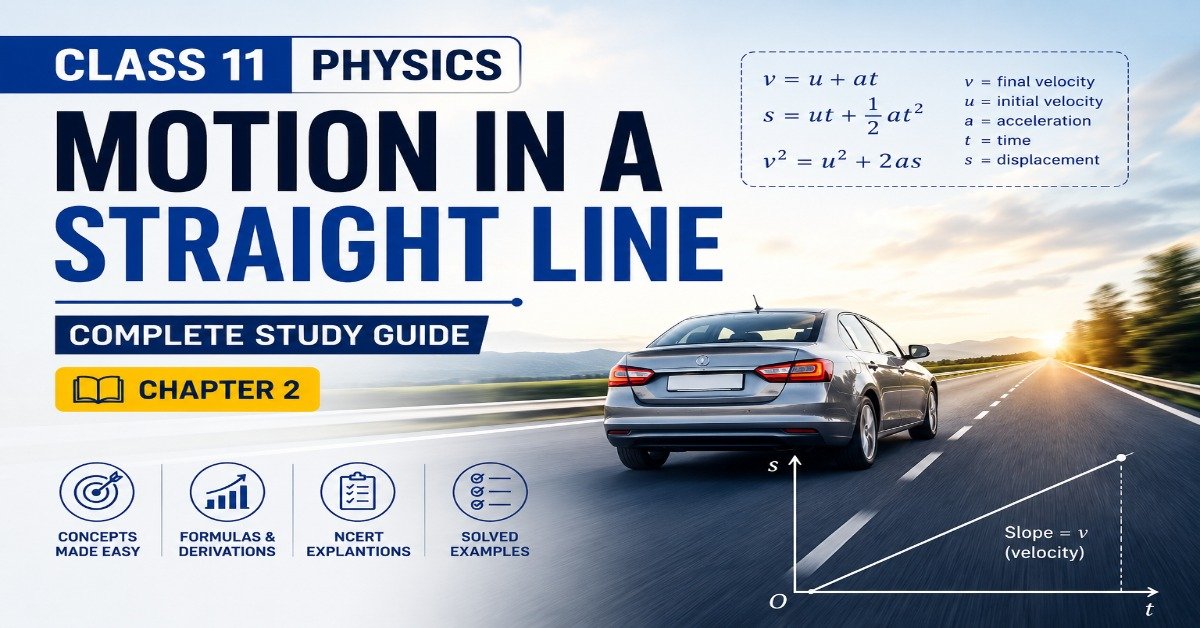
Chapter 2 of Class 11 Physics — Motion in a Straight Line — is where your Physics journey truly begins. This chapter introduces the science of kinematics: the study of how objects move, without asking why they move (that comes in Chapter 3 and 4 with Newton’s Laws).
Every concept here — distance, displacement, speed, velocity, acceleration — is something you experience every day. This chapter gives you the scientific language and mathematical tools to describe motion precisely. Master this chapter and you’ll find Chapters 3, 4, and 5 much easier.
Why This Chapter is Important
- Kinematics is asked in every CBSE Board exam — numericals, derivations, and conceptual questions.
- JEE Main and Advanced have 2–4 questions from motion, graphs, and relative velocity every year.
- NEET regularly tests equations of motion and free fall numericals.
- This chapter is the foundation for projectile motion, circular motion, and Newton’s Laws in later chapters.
- Velocity-time graphs and position-time graphs are asked both in theory and numericals.
Section 1: What is Motion?
An object is said to be in motion if its position changes with time with respect to a reference point (called the origin or reference frame).
An object is said to be at rest if its position does NOT change with time with respect to the reference frame.
Important: Rest and motion are relative. A person sitting in a moving train is at rest relative to the train but in motion relative to the ground. There is no such thing as absolute rest or absolute motion in classical physics.
Types of Motion:
- Rectilinear (Linear) Motion — motion along a straight line. Example: a car on a straight road, a freely falling stone.
- Circular Motion — motion along a circular path. Example: a fan blade, Earth around the Sun.
- Oscillatory (Periodic) Motion — back and forth motion. Example: pendulum, vibrating string.
- Random Motion — irregular, unpredictable. Example: Brownian motion of pollen grains in water.
In this chapter, we study only motion along a straight line (1D motion).
Point Object Approximation:
When the size of the object is much smaller than the distance it travels, we can treat it as a point object. Example: A car travelling from Delhi to Mumbai (1400 km) — the 4-metre car can be treated as a point. But when parking the same car, we cannot ignore its size.
Section 2: Position, Path Length, and Displacement
2.1 Position and the Number Line
To describe the position of an object on a straight line, we choose a reference point (origin O) and a positive direction. The position is then given by a signed number:
- Positive value → object is on the positive side of origin
- Negative value → object is on the negative side of origin
Example: If you take your home as origin, and East as positive: a shop 3 km East is at position +3 km; a park 2 km West is at position −2 km.
2.2 Path Length (Distance)
Path length (also called distance) is the total length of the actual path travelled by the object, regardless of direction.
- It is a scalar quantity (only magnitude, no direction).
- It is always positive or zero — never negative.
- It can only increase with time — it never decreases.
- SI unit: metre (m)
2.3 Displacement
Displacement is the change in position of the object. It is the straight-line distance from the initial position to the final position, with direction.
Displacement = Final position − Initial position = x₂ − x₁ = Δx
- It is a vector quantity (has both magnitude and direction).
- It can be positive, negative, or zero.
- Its magnitude can be less than or equal to the path length — never greater.
- SI unit: metre (m)
Key Differences Between Distance and Displacement:
- Distance is the total path length; Displacement is the shortest path (straight line) between start and end.
- Distance ≥ |Displacement| always.
- Distance = |Displacement| only when motion is in a straight line in one direction without turning back.
- If you walk in a circle and return to start: Distance = circumference, Displacement = 0.
- If you walk 5 m East and then 3 m West: Distance = 8 m, Displacement = 2 m East.
Exam trick: When an object returns to its starting point, displacement = 0, but distance > 0.
Section 3: Speed and Velocity
3.1 Speed
Speed is the rate at which an object covers distance.
Speed = Distance / Time
- Scalar quantity (no direction)
- Always positive or zero, never negative
- SI unit: m/s
- Other common units: km/h (1 km/h = 5/18 m/s)
3.2 Velocity
Velocity is the rate of change of displacement.
Velocity = Displacement / Time = Δx / Δt
- Vector quantity (has direction)
- Can be positive, negative, or zero
- SI unit: m/s
- Positive velocity → moving in positive direction
- Negative velocity → moving in negative direction
3.3 Average Speed and Average Velocity
Average Speed = Total Distance / Total Time
Average Velocity = Total Displacement / Total Time = (x₂ − x₁) / (t₂ − t₁)
Important: Average speed ≠ average velocity in general. Average speed is always ≥ |Average velocity|.
Example: A person walks 60 m East in 1 minute, then 20 m West in 30 seconds. Find average speed and average velocity.
- Total distance = 60 + 20 = 80 m
- Total time = 60 + 30 = 90 s
- Displacement = 60 − 20 = 40 m (East)
- Average speed = 80/90 = 0.89 m/s
- Average velocity = 40/90 = 0.44 m/s (East)
3.4 Special Case — Equal Distance at Two Speeds
If an object travels the first half of distance at speed v₁ and the second half at speed v₂:
Average speed = 2v₁v₂ / (v₁ + v₂) (Harmonic mean)
This is NOT (v₁ + v₂)/2.
Example: Car goes 60 km at 60 km/h and returns 60 km at 40 km/h.
Average speed = 2 × 60 × 40 / (60 + 40) = 4800 / 100 = 48 km/h (NOT 50 km/h!)
3.5 Instantaneous Speed and Velocity
When the time interval Δt → 0, we get the instantaneous values:
Instantaneous velocity v = lim(Δt→0) Δx/Δt = dx/dt
This is the derivative of position with respect to time.
Instantaneous speed = magnitude of instantaneous velocity = |dx/dt|
The speedometer of a car shows instantaneous speed.
Section 4: Acceleration
4.1 What is Acceleration?
Acceleration is the rate of change of velocity.
Average acceleration = Δv / Δt = (v₂ − v₁) / (t₂ − t₁)
Instantaneous acceleration = dv/dt = d²x/dt²
- Vector quantity
- Can be positive, negative, or zero
- SI unit: m/s²
- Positive acceleration → velocity increasing in positive direction
- Negative acceleration → velocity decreasing (deceleration/retardation)
4.2 Acceleration and Velocity Direction — Important Cases
- Velocity positive, Acceleration positive → object speeds up in positive direction
- Velocity positive, Acceleration negative → object slows down (decelerating), moving in positive direction
- Velocity negative, Acceleration negative → object speeds up in negative direction
- Velocity negative, Acceleration positive → object slows down, moving in negative direction
- Velocity = 0, Acceleration ≠ 0 → object is momentarily at rest but about to move (like a ball thrown upward at the top)
Common mistake: Many students think acceleration = 0 when velocity = 0. This is WRONG. A ball thrown upward has zero velocity at the top, but its acceleration is still g = 9.8 m/s² downward.
4.3 Retardation (Deceleration)
When the magnitude of velocity decreases with time, the object is said to be decelerating or retarding. Retardation is NOT a separate quantity — it simply means the acceleration is in the opposite direction to velocity.
Section 5: Kinematic Equations of Motion (Equations for Uniform Acceleration)
When an object moves in a straight line with uniform (constant) acceleration, three powerful equations relate displacement, velocity, acceleration, and time. These are called the equations of kinematics or equations of uniformly accelerated motion.
The Three Equations:
Let: u = initial velocity, v = final velocity, a = uniform acceleration, t = time, s = displacement
First Equation: v = u + at
Derivation: Acceleration = (v − u)/t → v = u + at
This relates velocity, initial velocity, acceleration, and time.
Second Equation: s = ut + ½at²
Derivation: Displacement = average velocity × time = ((u + v)/2) × t = ((u + u + at)/2) × t = ut + ½at²
This relates displacement, initial velocity, acceleration, and time.
Third Equation: v² = u² + 2as
Derivation: From first equation t = (v − u)/a. Substitute into second equation and simplify to get v² − u² = 2as.
This relates velocity, initial velocity, acceleration, and displacement (no time!).
Useful Derived Formula — Average Velocity:
For uniform acceleration: Average velocity = (u + v)/2
Also: s = ((u + v)/2) × t (this is sometimes called the 4th equation)
Important Conditions:
- These equations are valid ONLY for uniform (constant) acceleration.
- All quantities (u, v, a, s) must use consistent signs (choose positive direction first).
- If a = 0 (uniform velocity), then v = u, and s = ut.
Which Equation to Use?
- Given u, a, t → find v: use v = u + at
- Given u, a, t → find s: use s = ut + ½at²
- Given u, v, a → find s: use v² = u² + 2as
- Given u, v, s → find a: use v² = u² + 2as
- Given u, v, t → find s: use s = ((u+v)/2) × t
Distance Travelled in the nth Second:
The displacement of an object in the nth second (not first n seconds!) of its motion:
sₙ = u + a(2n − 1)/2
This is derived by: sₙ = s(up to n seconds) − s(up to n−1 seconds)
Exam Note: This formula is asked frequently. Be careful — it gives displacement in the nth second, not total displacement.
Section 6: Motion Under Gravity (Free Fall)
One of the most important applications of uniform acceleration is the motion of objects under gravity near the Earth’s surface.
Key Facts About Free Fall:
- Near the Earth’s surface, all objects fall with the same acceleration due to gravity, regardless of their mass. (Galileo proved this!)
- This acceleration is denoted by g = 9.8 m/s² (approximately 10 m/s² for quick calculations).
- g acts downward (towards the centre of the Earth).
- Air resistance is neglected in free fall problems.
Sign Convention for Free Fall:
Choose upward as positive (most common convention):
- g = −9.8 m/s² (since it acts downward)
- Upward velocities are positive
- Downward velocities are negative
OR choose downward as positive (also valid):
- g = +9.8 m/s²
- Downward velocities are positive
Both conventions give the same answer — just be consistent within a problem.
Cases of Free Fall:
Case 1: Object dropped from rest (u = 0)
- v = gt (velocity increases downward)
- h = ½gt² (distance fallen)
- v² = 2gh
- Time to fall height h: t = √(2h/g)
Case 2: Object thrown vertically upward with velocity u
- At the top: v = 0
- Time to reach top: t = u/g
- Maximum height: H = u²/(2g)
- Total time of flight (up + back down): T = 2u/g
- The object returns to the starting point with the same speed u (but in opposite direction).
- Time going up = Time coming down (in absence of air resistance)
Case 3: Object thrown downward with initial velocity u
- v = u + gt (taking downward as positive)
- h = ut + ½gt²
Key Insight — Symmetry of free fall: The motion of a ball thrown upward is perfectly symmetric. The time to go up equals the time to come down. The speed at any height going up equals the speed at the same height coming down.
Common mistake: Students often set g = +9.8 m/s² for upward motion and −9.8 m/s² for downward motion. This is WRONG. g is always 9.8 m/s² downward — it does not change direction. What changes is the sign of velocity.
Section 7: Graphs in Motion — The Most Important Section for Exams
Graph-based questions are asked in almost every board exam and competitive exam. You must be able to both draw and read motion graphs.
7.1 Position–Time Graph (x–t graph)
This graph shows how the position (x) of an object changes with time (t).
The slope of the x–t graph = velocity
slope = Δx/Δt = velocity
Reading different x–t graphs:
- Horizontal line (zero slope) → object is at rest (position constant, velocity = 0)
- Straight line with positive slope → uniform velocity in positive direction
- Straight line with negative slope → uniform velocity in negative direction (moving backward)
- Curve with increasing slope → velocity increasing → positive acceleration
- Curve with decreasing slope → velocity decreasing → deceleration
- Straight line through origin → uniform velocity starting from origin
- Two lines crossing → the objects meet at that time and position
Important: The x–t graph can NEVER be vertical (that would mean infinite velocity — physically impossible).
Concavity of x–t curve:
- Concave upward (cup shape ∪) → acceleration is positive
- Concave downward (cap shape ∩) → acceleration is negative
7.2 Velocity–Time Graph (v–t graph)
This graph shows how velocity (v) changes with time (t).
The slope of the v–t graph = acceleration
slope = Δv/Δt = acceleration
The area under the v–t graph = displacement
Area = ∫v dt = displacement (this is a signed area — area above x-axis is positive displacement, below is negative)
Reading different v–t graphs:
- Horizontal line (v = constant) → uniform velocity, zero acceleration
- Horizontal line at v = 0 → object at rest
- Straight line with positive slope → uniform acceleration (velocity increasing)
- Straight line with negative slope → uniform deceleration (velocity decreasing)
- Straight line crossing the time axis → object reverses direction at the crossing point
- Curve → non-uniform acceleration
- Positive area (above t-axis) → displacement in positive direction
- Negative area (below t-axis) → displacement in negative direction
Important: Total distance = |positive area| + |negative area|. Total displacement = positive area − |negative area|.
7.3 Acceleration–Time Graph (a–t graph)
The area under the a–t graph = change in velocity
Area = ∫a dt = Δv = v − u
Reading a–t graphs:
- Horizontal line → uniform acceleration (constant)
- a = 0 line → uniform velocity
- Positive value → velocity increasing
- Negative value → velocity decreasing
7.4 Summary of Graph Relationships
- Slope of x–t graph = velocity
- Slope of v–t graph = acceleration
- Area under v–t graph = displacement
- Area under a–t graph = change in velocity
- Second derivative of x = dx/dt = v, d²x/dt² = a
7.5 Shapes of Graphs for Standard Motions
Uniform velocity (a = 0):
- x–t graph: straight line (slope = v)
- v–t graph: horizontal straight line
- a–t graph: line along the t-axis (a = 0)
Uniform acceleration from rest (u = 0):
- x–t graph: parabola starting from origin (x = ½at²)
- v–t graph: straight line through origin (v = at)
- a–t graph: horizontal line above t-axis
Object thrown upward:
- v–t graph: straight line starting from +u, crossing the t-axis at t = u/g, going to −u at t = 2u/g
- x–t graph: inverted parabola, reaching maximum at t = u/g
- a–t graph: horizontal line at a = −g (constant throughout)
Section 8: Relative Motion in One Dimension
The motion of an object is always described relative to a reference frame (an observer). When both the object and observer are moving, we need to calculate relative velocity.
8.1 Relative Velocity
If object A has velocity v_A and object B has velocity v_B (both measured from the ground), then:
Velocity of A relative to B = v_AB = v_A − v_B
Velocity of B relative to A = v_BA = v_B − v_A
Note: v_AB = −v_BA
8.2 Cases of Relative Motion
Case 1: Both objects moving in the same direction
v_AB = v_A − v_B
- If v_A > v_B → A appears to move forward relative to B
- If v_A = v_B → they appear stationary relative to each other
- If v_A < v_B → A appears to move backward relative to B
Case 2: Objects moving in opposite directions
v_AB = v_A − (−v_B) = v_A + v_B
The relative speed is the sum of their speeds — they appear to approach each other faster.
8.3 Relative Motion Applications
Example 1 — Rain and man: If rain falls vertically at 10 m/s and a man walks East at 5 m/s, from the man’s perspective, the rain appears to fall at an angle (solved using vector subtraction).
Example 2 — Train problems: If two trains move toward each other at 60 km/h and 40 km/h, they approach each other at 100 km/h. If moving in the same direction, relative speed = 20 km/h.
Example 3 — Meeting/Overtaking problems:
Two objects A (at origin) and B (at distance d) moving toward each other with speeds v_A and v_B:
Time to meet = d / (v_A + v_B)
If both moving in same direction, A chasing B:
Time to catch = d / (v_A − v_B) [only if v_A > v_B]
Section 9: Non-Uniform Motion and Instantaneous Quantities
In real life, most motion is non-uniform — the velocity changes with time in a non-constant way. Here, we cannot use the three equations of motion (those are only for constant acceleration). Instead, we use calculus.
9.1 Using Calculus in Kinematics
If position x is given as a function of time t, we can find velocity and acceleration by differentiation:
- Velocity: v = dx/dt
- Acceleration: a = dv/dt = d²x/dt²
Conversely, if acceleration or velocity is given as a function of time, we can find velocity and position by integration:
- v = u + ∫a dt
- x = x₀ + ∫v dt
Example: A particle’s position is x = 3t² − 2t + 5 (x in metres, t in seconds). Find velocity and acceleration at t = 2 s.
- v = dx/dt = 6t − 2
- At t = 2: v = 6(2) − 2 = 10 m/s
- a = dv/dt = 6 m/s² (constant acceleration here)
Example 2: If a = 4t m/s² and u = 2 m/s at t = 0, find v at t = 3 s.
- v = u + ∫₀³ 4t dt = 2 + [2t²]₀³ = 2 + 18 = 20 m/s
Section 10: Important Concepts That Confuse Students
10.1 Can Displacement be Greater than Distance? No!
Displacement is the straight-line distance between start and end. The shortest path between two points is a straight line. So the straight-line distance ≤ actual path length. Therefore: |Displacement| ≤ Distance. Always.
10.2 Can an Object Have Zero Velocity but Non-Zero Acceleration?
Yes! A ball thrown upward has zero velocity at the highest point but acceleration = g downward. This is a classic example. The velocity is zero only for an instant — immediately before and after, the ball has non-zero velocity.
10.3 Can Speed be Zero when Acceleration is Not Zero?
Yes! Same as above — instantaneous rest with non-zero acceleration is possible.
10.4 Can an Object Have Constant Speed but Changing Velocity?
Yes! In circular motion, the speed is constant but velocity changes direction continuously. (Not in this chapter, but a concept to be aware of.)
10.5 Uniform Motion vs Uniformly Accelerated Motion
- Uniform motion = constant velocity (zero acceleration)
- Uniformly accelerated motion = constant acceleration (velocity changes uniformly)
10.6 What Does “Negative Velocity” Mean?
Negative velocity simply means the object is moving in the direction opposite to what we chose as positive. It does NOT mean the object is slowing down. Example: If East is positive, a car moving West at 60 km/h has velocity = −60 km/h.
10.7 What Does “Negative Acceleration” Mean?
Negative acceleration means the acceleration vector points in the negative direction. It could mean:
- The object is slowing down (if velocity is positive)
- The object is speeding up in the negative direction (if velocity is also negative)
Negative acceleration does NOT always mean slowing down!
Section 11: Solved Numericals (Step-by-Step)
Numerical 1 — Basic Kinematics
Q: A car starts from rest and accelerates uniformly at 2 m/s² for 10 seconds. Find: (a) final velocity, (b) distance covered, (c) distance covered in the 10th second.
Given: u = 0, a = 2 m/s², t = 10 s
(a) Final velocity:
v = u + at = 0 + 2 × 10 = 20 m/s
(b) Distance covered:
s = ut + ½at² = 0 + ½ × 2 × 100 = 100 m
(c) Distance in 10th second:
s₁₀ = u + a(2×10 − 1)/2 = 0 + 2 × 19/2 = 19 m
Numerical 2 — Free Fall
Q: A stone is dropped from a tower 80 m high. Find: (a) time to reach the ground, (b) velocity when it hits the ground. (g = 10 m/s²)
Given: u = 0, s = 80 m (downward), a = g = 10 m/s²
(a) Time:
s = ut + ½gt² → 80 = 0 + ½ × 10 × t² → t² = 16 → t = 4 s
(b) Velocity:
v = u + gt = 0 + 10 × 4 = 40 m/s (downward)
Or: v² = 2gs = 2 × 10 × 80 = 1600 → v = 40 m/s ✓
Numerical 3 — Ball Thrown Upward
Q: A ball is thrown vertically upward with a velocity of 20 m/s. Find: (a) maximum height, (b) time to reach maximum height, (c) total time of flight, (d) velocity at height 15 m. (g = 10 m/s²)
Taking upward as positive: u = +20 m/s, a = −10 m/s²
(a) Maximum height:
v² = u² + 2as → 0 = 400 + 2(−10)s → s = 400/20 = 20 m
(b) Time to top:
v = u + at → 0 = 20 − 10t → t = 2 s
(c) Total time of flight:
T = 2t = 2 × 2 = 4 s
(d) Velocity at h = 15 m:
v² = u² + 2as = 400 + 2(−10)(15) = 400 − 300 = 100 → v = ±10 m/s
+10 m/s (going up) and −10 m/s (coming down) at height 15 m.
Numerical 4 — Relative Motion
Q: Two trains A and B start from stations 100 km apart, moving toward each other. A moves at 60 km/h and B at 40 km/h. Find (a) time to meet, (b) distance each covers before meeting.
(a) Relative speed = 60 + 40 = 100 km/h (moving toward each other)
Time to meet = 100 / 100 = 1 hour
(b) Distance by A = 60 × 1 = 60 km
Distance by B = 40 × 1 = 40 km (Total = 100 km ✓)
Numerical 5 — Graph-Based
Q: A v–t graph shows: velocity increases from 0 to 20 m/s in 5 seconds (uniformly), then stays at 20 m/s for 3 seconds, then decreases from 20 m/s to 0 in 4 seconds. Find total displacement and average velocity.
Area under v–t graph:
- Phase 1 (triangle): ½ × 5 × 20 = 50 m
- Phase 2 (rectangle): 3 × 20 = 60 m
- Phase 3 (triangle): ½ × 4 × 20 = 40 m
Total displacement = 50 + 60 + 40 = 150 m
Total time = 5 + 3 + 4 = 12 s
Average velocity = 150/12 = 12.5 m/s
Numerical 6 — Two Objects Meeting
Q: Object A is at rest at x = 0. Object B is at x = 100 m moving toward A at 10 m/s. At t = 0, A starts moving in the same direction as B (toward B) at uniform velocity 15 m/s. When and where do they meet?
Taking A’s direction as positive. Let them meet at time t.
Position of A at time t: x_A = 15t
Position of B at time t: x_B = 100 − 10t (moving in negative direction)
They meet when x_A = x_B:
15t = 100 − 10t → 25t = 100 → t = 4 s
Position: x = 15 × 4 = 60 m from origin
Numerical 7 — Non-Uniform Acceleration
Q: The position of a particle is given by x = 2t³ − 6t + 4 (metres, seconds). Find velocity and acceleration at t = 3 s. Also find when the particle is momentarily at rest.
v = dx/dt = 6t² − 6
a = dv/dt = 12t
At t = 3: v = 6(9) − 6 = 54 − 6 = 48 m/s
At t = 3: a = 12(3) = 36 m/s²
Momentarily at rest when v = 0: 6t² − 6 = 0 → t² = 1 → t = 1 s
Section 12: Important Graphs — What to Know for Exams
Comparing x–t and v–t graphs side by side:
Stationary object:
x–t: horizontal line | v–t: line at v = 0
Uniform velocity (positive direction):
x–t: straight line sloping up | v–t: horizontal line above t-axis
Uniform velocity (negative direction):
x–t: straight line sloping down | v–t: horizontal line below t-axis
Uniform acceleration (from rest):
x–t: upward parabola | v–t: straight line from origin going up
Uniform deceleration (coming to rest):
x–t: upward parabola flattening off | v–t: straight line going down to t-axis
Free fall (downward positive):
x–t: downward parabola | v–t: straight line through origin going up
Ball thrown up (upward positive):
v–t: starts at +u, straight line going down, crosses t-axis at t = u/g
x–t: inverted parabola, peak at t = u/g, returns to start at t = 2u/g
Section 13: Common Mistakes to Avoid
- Using equations of motion when acceleration is not constant. These three equations ONLY work for constant acceleration. For variable acceleration, use calculus.
- Forgetting sign convention. Always declare which direction is positive at the start of every problem and stick to it throughout.
- Treating speed and velocity as the same. Velocity has direction; speed does not. Average speed ≠ average velocity in general.
- Assuming zero velocity means zero acceleration. At the top of the trajectory, velocity = 0 but acceleration = g.
- Using distance instead of displacement in velocity formula. Velocity = displacement/time, not distance/time.
- Forgetting negative areas in v–t graphs. When the object reverses direction, area below the time-axis is negative displacement. For total distance, take magnitudes of both parts.
- Wrong formula for average speed when equal distances are covered. Use 2v₁v₂/(v₁ + v₂), NOT (v₁ + v₂)/2.
- Setting g = 0 at the highest point. g is constant near Earth’s surface — it NEVER becomes zero.
- Not accounting for initial position. If the object doesn’t start at the origin, include x₀ in the position formula: x = x₀ + ut + ½at².
- Confusing “distance in nth second” with “distance in n seconds.” sₙ = u + a(2n−1)/2 gives displacement in the nth second only.
Section 14: Quick Revision — Key Formulas
Displacement: Δx = x₂ − x₁
Average velocity: v̄ = Δx / Δt
Instantaneous velocity: v = dx/dt
Average acceleration: ā = Δv / Δt
Instantaneous acceleration: a = dv/dt = d²x/dt²
Equations of Motion (uniform acceleration):
- v = u + at
- s = ut + ½at²
- v² = u² + 2as
- s = ((u + v)/2) × t
- sₙ = u + a(2n − 1)/2
Free Fall:
- Time to max height: t = u/g
- Max height: H = u²/2g
- Total flight time: T = 2u/g
- Time to fall height h from rest: t = √(2h/g)
- Velocity after falling h: v = √(2gh)
Relative Velocity:
- v_AB = v_A − v_B (same direction)
- v_AB = v_A + v_B (opposite directions)
Graph slopes and areas:
- Slope of x–t = velocity
- Slope of v–t = acceleration
- Area under v–t = displacement
- Area under a–t = change in velocity
Section 15: Previous Year Exam Questions
- Q1 (1 mark): Under what condition is the average velocity equal to instantaneous velocity?
- Q2 (1 mark): A body is thrown vertically upward. What is its acceleration at the highest point?
- Q3 (2 marks): A car travels first half of a journey at 40 km/h and second half at 60 km/h. Find the average speed for the whole journey.
- Q4 (2 marks): Draw the position–time graph for a particle starting from rest with uniform acceleration.
- Q5 (3 marks): A train of length 200 m passes a stationary observer in 10 seconds. Find the speed of the train. If another train of length 150 m is coming from the opposite direction at 20 m/s, how long does it take for the trains to cross each other?
- Q6 (3 marks): A stone is dropped from a bridge 45 m above water. At the same time, another stone is thrown upward from the water surface with 15 m/s. When do they meet? (g = 10 m/s²)
- Q7 (5 marks): Derive the three equations of motion using the v–t graph.
Answer to Q1: When the body moves with uniform velocity (constant velocity).
Answer to Q2: g = 9.8 m/s² downward (acceleration due to gravity is constant and never zero).
Answer to Q3: Average speed = 2 × 40 × 60 / (40 + 60) = 4800/100 = 48 km/h.
Answer to Q6:
Let them meet at height h from water after time t.
Stone 1 (dropped): 45 − h = ½ × 10 × t² → h = 45 − 5t²
Stone 2 (thrown up): h = 15t − 5t²
Setting equal: 45 − 5t² = 15t − 5t² → 45 = 15t → t = 3 s
Height = 15(3) − 5(9) = 45 − 45 = 0 m — they meet at the water surface!
Section 16: Derivation of Equations of Motion from v–t Graph
The NCERT and board exams frequently ask you to derive the equations of motion from the v–t graph. Here is the full derivation — memorise this:
Consider a v–t graph where a particle starts with initial velocity u at t = 0 and reaches velocity v at time t, moving with uniform acceleration a. The graph is a straight line from point A (0, u) to point B (t, v).
First Equation: v = u + at
Slope of v–t graph = acceleration
a = (v − u) / (t − 0) = (v − u) / t
Therefore: at = v − u
∴ v = u + at
Second Equation: s = ut + ½at²
Displacement = Area under v–t graph = Area of trapezium OABC
= Area of rectangle OADC + Area of triangle ABD
= (u × t) + ½ × (v − u) × t
= ut + ½ × (at) × t (since v − u = at)
∴ s = ut + ½at²
Third Equation: v² = u² + 2as
Displacement = Area of trapezium OABC
= ½ × (OA + BC) × OC
= ½ × (u + v) × t
From first equation: t = (v − u)/a
s = ½ × (u + v) × (v − u)/a = (v² − u²) / 2a
∴ v² = u² + 2as
Conclusion: Mastering Motion
Motion in a Straight Line is the first step into the heart of Physics. This chapter teaches you to think precisely about movement — to distinguish distance from displacement, speed from velocity, and to understand what acceleration truly means.
The three things you must master from this chapter are:
- Sign convention — Always declare your positive direction. This prevents 90% of errors in free fall and relative motion problems.
- Graphs — Be able to sketch x–t, v–t, and a–t graphs for any described motion, and extract information (slope = velocity or acceleration, area = displacement) from any given graph.
- Equations of motion — Know all five equations, when to use each, and how to derive them. Practice at least 20 numericals covering all types.
Once you are confident with these, you will find Newton’s Laws, projectile motion, and work-energy theorem significantly easier. Physics builds on itself — and Chapter 2 is the base.
Keep practising, stay consistent, and most importantly — always ask yourself: does this answer make physical sense? That habit of checking your intuition against your calculation is what separates a good Physics student from a great one.
All the best!


)