Lokesh Sathyanathan — First Indian to Break the 8-Metre Barrier in Long Jump
From Bengaluru’s school grounds to an NCAA gold medal and a national indoor record of 8.21m — the complete story of a champion who refused to quit.
Who is Lokesh Sathyanathan? The Bengaluru Boy Who Leapt Into History
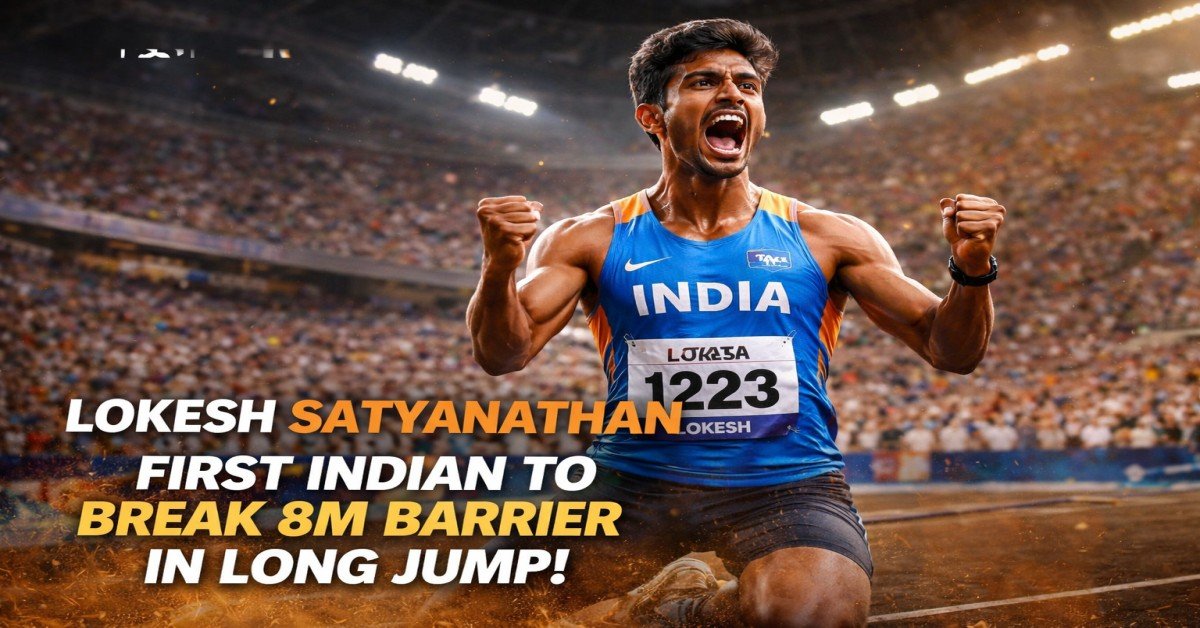
Lokesh Sathyanathan was born on 21 December 1999 in Bengaluru, Karnataka. Now 26, he is an Indian long jumper representing Tarleton State University in the United States NCAA collegiate athletics circuit. In early 2026, he became the first Indian athlete to clear 8 metres in an indoor long jump competition, then went on to win the 2026 NCAA Division I Indoor Championship — becoming one of the most celebrated names in Indian athletics today.
A Sporting Family from Karnataka
Athletics runs deep in the Sathyanathan household. His father, John Sathyanathan, was a footballer who played for the Bangalore Police football team. His sister, Monica, competed as a national-level 400-metre runner. Growing up surrounded by sport and competition, Lokesh found his calling early. His first taste of competitive athletics came at a Bengaluru school meet — he ran 14.27 seconds and jumped a modest distance from behind the board, winning two gold medals. The roar of the crowd and the announcement of his name over the school PA system planted the seed of a lifelong dream.
Lokesh’s mother, Felcy Mary, was his greatest emotional anchor. Tragically, she passed away in 2021 during the second wave of the COVID-19 pandemic. Her parting words to her son — “go follow your dreams and show me what you can do” — became the fuel that drove him across continents and through two surgeries to become a national champion. Every major achievement since has been dedicated to her memory.
In his own words: “When I go home, I’m not just going back with my personal best but with a national title. My mom would be proud.” — Lokesh Sathyanathan, after winning NCAA gold, March 2026.
The Historic 8.01m — How Lokesh Shattered a Barrier No Indian Had Ever Crossed Indoors
On 15 February 2026, Lokesh Sathyanathan walked out onto the boards at the Randal Tyson Indoor Center in Fayetteville, Arkansas, for the Tyson Invitational 2026. What followed was a piece of history: a leap of 8.01 metres — making him the first Indian athlete ever to clear the 8-metre mark in an indoor long jump competition.
The Competition and Context
The field at the Tyson Invitational was world-class. Lokesh finished eighth in a 16-man field. The winner was Cordell Tinch (USA), a world champion in the 110m hurdles, who leapt 8.29m. Jamaica’s Tajay Gayle, the 2019 World Champion, finished fourth with 8.13m. South Africa’s Luvo Manyonga, the Rio 2016 Olympic silver medallist, was sixth with 8.11m. In that elite company, Lokesh’s 8.01m held its own — and made history.
On the same day, he also registered three other jumps of over 7.94m — showing this was not a fluke but a reflection of a genuinely world-class performance level. The jump improved the previous Indian indoor national record of 7.97m, which had been set by fellow jumper Jeswin Aldrin in 2023. It was also Lokesh’s second-best career mark at the time, behind his outdoor personal best of 8.02m from 2023.
Why 8 metres matters: In long jump, 8 metres is the symbolic barrier that separates elite jumpers from world-class contenders — much like the 10-second mark in the 100 metres sprint. No Indian man had ever crossed this mark in an indoor competition before February 2026. The indoor record matters separately because different facilities, run-up lengths, and conditions make indoor jumps technically distinct from outdoor marks.
NCAA Indoor Championship Gold: 8.21m, a New National Record, and Multiple Firsts
Just weeks after his 8.01m breakthrough, Lokesh Sathyanathan produced an even more astonishing performance at the biggest stage in collegiate athletics — the 2026 NCAA Division I Indoor Track and Field Championships, held on 13 March 2026 at the same Randal Tyson Track Center in Fayetteville, Arkansas.
The Winning Jump: 8.21m in the Fourth Round
Lokesh entered the final ranked 8th in the NCAA, ranked 28th in the world — a solid but not dominant position on paper. His first jump in the final was a composed 7.89m, placing him in contention but not yet at the front. The tension built through the rounds. Then, in the fourth attempt of the competition, Lokesh launched off the board and soared to a new personal best and national record of 8.21 metres — a jump that immediately moved him to the top of the leaderboard and ultimately secured the title.
The margin of victory was the finest imaginable. De’Aundre Ward of Southern Mississippi finished second with 8.20m — just one centimetre, or a quarter of an inch, behind Lokesh. Tafadzwa Chikomba of Kansas State took bronze with 8.15m. The top four athletes were separated by only eight centimetres — a reminder of the razor-thin margins at the pinnacle of collegiate athletics. Lokesh held his nerve where others could not. In the final round, he also recorded a further jump of 8.17m — the only jumper to produce two leaps of 8.15m or more in the entire competition.
Multiple records broken simultaneously: The 8.21m jump shattered Lokesh’s own recently set Indian indoor national record of 8.01m. It also gave him the top three indoor jumps in Indian history — all recorded by himself. The jump is ranked the fourth best by any NCAA indoor champion in the last decade, and the 15th best all-time by an NCAA champion.
Historic Firsts Created on 13 March 2026
A single performance created multiple milestones simultaneously. Lokesh became the first Indian-born NCAA Division I men’s long jump champion. He delivered the first individual NCAA Division I title in Tarleton State University’s athletics history. He became the first WAC (Western Athletic Conference) men’s indoor NCAA champion since 2001. He is now the 49th different athlete to win the men’s indoor long jump title at the NCAA Championships. Tarleton State became the 35th different programme to produce the men’s indoor long jump champion.
| Rank | Athlete | Country / University | Distance |
|---|---|---|---|
| 🥇 1st | Lokesh Sathyanathan | 🇮🇳 India / Tarleton State | 8.21m (NR) |
| 🥈 2nd | De’Aundre Ward | 🇺🇸 USA / Southern Miss | 8.20m (PB) |
| 🥉 3rd | Tafadzwa Chikomba | 🇿🇼 Zimbabwe / Kansas State | 8.15m (PB) |
| 4th | 4th athlete | — | 8.13m |
From a School Ground in Bengaluru to a NCAA Championship: Lokesh’s Full Career Story
Lokesh Sathyanathan’s journey to the top was never straightforward. It was shaped by early promise, international exposure, personal tragedy, a near-career-ending injury, multiple university transfers, and an unshakeable will to compete. Here is the complete story.
Where Lokesh Stands: India’s All-Time Long Jump Rankings and the 8m Club
Lokesh’s achievement must be understood within the broader context of Indian long jump. The event has seen remarkable depth since 2020, driven by a new generation of world-class jumpers who represent the best India has ever produced in this discipline.
| Rank | Athlete | Distance | Type |
|---|---|---|---|
| 1st | Jeswin Aldrin | 8.42m | Outdoor (National Record) |
| 2nd | Murali Sreeshankar | 8.41m | Outdoor |
| 3rd | Lokesh Sathyanathan | 8.21m | Indoor National Record (2026) |
| — | Ankit Sharma | 8.19m | Outdoor |
Exam Note: India’s national outdoor long jump record is held by Jeswin Aldrin at 8.42m. The indoor national record is now held by Lokesh Sathyanathan at 8.21m (set 13 March 2026). These are two separate records. Lokesh’s 8.21m is currently the only 8m+ indoor mark by any Indian.
The NCAA Pathway for Indian Athletes
Lokesh’s success shines a spotlight on a model that Indian athletics must consider more seriously. The NCAA collegiate system in the United States offers Indian athletes access to world-class indoor facilities, evidence-based coaching, frequent high-level competition, and structured academic support — a combination that is largely unavailable in India, particularly for technical field events like long jump and triple jump. Lokesh’s head coach Bobby Carter played a central role in fine-tuning his technique, especially landing mechanics, which are critical to converting approach speed into legal distance. In Lokesh’s own words: “There are nights I don’t sleep, but I still show up” — the hallmark of a genuine champion’s mentality.
Why Lokesh’s Achievement Matters: For Indian Athletics, Soft Power, and the Olympic Pipeline
Breaking a Psychological Ceiling
In athletics, milestone distances carry enormous psychological weight. The 8-metre mark in long jump has long been the threshold separating competitive jumpers from genuinely world-class ones. For Indian athletics, where the long jump has historically been overshadowed by sprints and middle-distance events, Lokesh’s repeated clearing of this barrier — in competitive, pressure-filled environments — signals that Indian jumpers are no longer aspiring to reach the world level; they are operating at it. His 8.21m indoor mark would be competitive at many international meets.
Qualification Implications: Paris 2024 → LA 2028
Looking ahead to the 2028 Los Angeles Olympics, the long jump qualification standard is likely to be set around 8.15m–8.20m. Lokesh’s 8.21m indoor mark places him firmly within qualification range. More importantly, it demonstrates that his outdoor performances — currently capped at 8.02m under legal conditions — have the potential to surpass the qualification mark as his technique matures. With two years until LA 2028, Lokesh has time on his side.
India’s Sports Infrastructure Debate
Lokesh’s story amplifies an ongoing debate in Indian athletics: the role of the NCAA pathway versus domestic infrastructure investment. The fact that Lokesh, Sreeshankar, Aldrin, and others have made their breakthroughs partly through access to world-class foreign facilities is simultaneously a testament to individual resilience and an indictment of the lack of international-standard indoor athletics facilities in India. The Athletics Federation of India (AFI) has acknowledged this gap, and Lokesh’s success may catalyse investment in indoor athletics infrastructure.
UPSC / SSC Exam Angle: This topic connects to India’s sports policy, Sports Authority of India (SAI), Khelo India programme, Target Olympic Podium Scheme (TOPS), Athletics Federation of India (AFI), demographic dividend in sports, and India’s soft power through athletics. Mains angle: “Despite producing multiple 8m+ jumpers, India has not won an Olympic long jump medal. Examine the structural barriers in Indian athletics and suggest reforms.”
What Next for Lokesh? Asian Games, World Championships, and the Los Angeles 2028 Dream
The 2026 indoor season has been a landmark chapter, but Lokesh and his team are clear that this is not the summit. Having spent the winter season focused on technical refinements in landing mechanics — rather than chasing raw distance — Lokesh has shown that his approach is methodical and long-term. He has noted that several of his recent fouls in training were at distances of 8.20m–8.30m, suggesting his true ceiling may be considerably higher than what he has registered legally.
Key Targets on the Horizon
The immediate focus shifts to the 2026 NCAA Outdoor Season (May–June), where Lokesh will seek to produce an 8m+ outdoor mark under legal conditions, improving on his personal best of 8.02m. Beyond the NCAA, the 2026 Asian Athletics Championships and Asian Games cycle offer genuine medal-winning opportunities — India’s long jumpers have historically dominated Asian competition. The medium-term goal is qualification for the 2027 World Athletics Championships, followed by the ultimate prize: Los Angeles 2028. At just 26, with his best athletic years still ahead and a world-class support system through Reliance Foundation Athletics and Tarleton State, the trajectory is pointed firmly upward.
Lokesh’s philosophy: “I don’t set a specific target distance for myself. Because that puts a limit on your mind and your potential. I just work towards being better each day.” This growth mindset — combined with technical precision and elite competition — is precisely what makes him a genuine Olympic contender.
Test Yourself: 8 MCQs on Lokesh Sathyanathan and Indian Long Jump
Lokesh Sathyanathan — Quick Quiz
8 exam-style MCQs on India’s historic 8m long jump milestone. Test your facts before your next exam!