
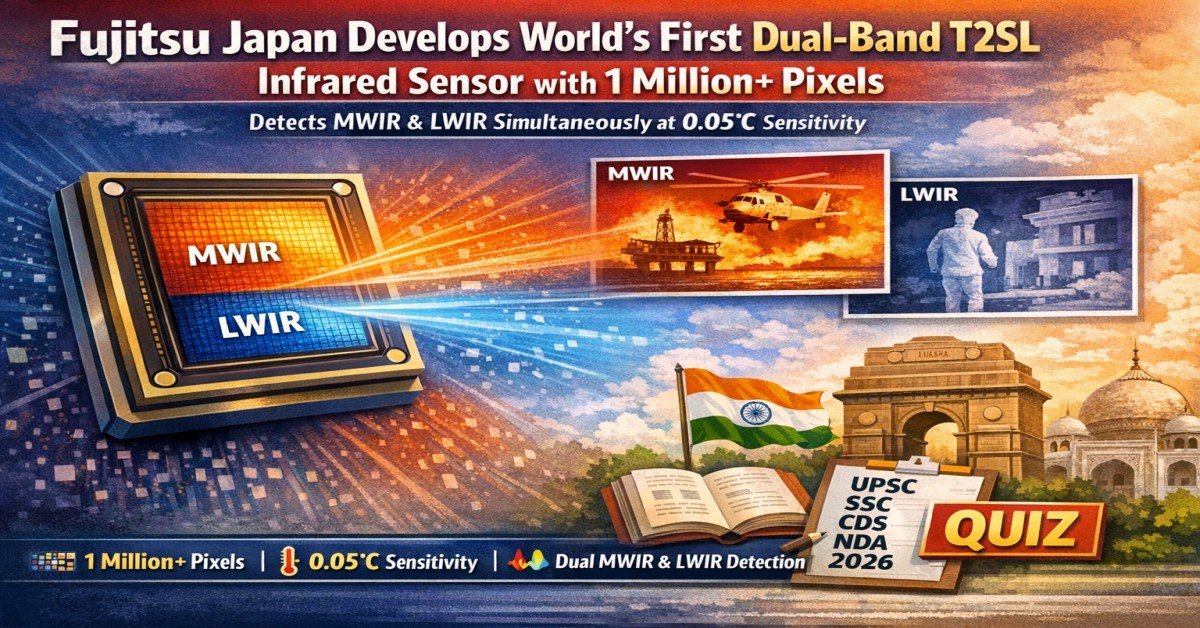
Japan’s Fujitsu Develops World’s First Dual-Band Infrared Sensor — A Milestone in Defence and Disaster Monitoring
A Type-II superlattice sensor with over 1 million pixels that simultaneously detects two infrared wavelengths with 0.05°C sensitivity — built for satellites, aircraft, and defence surveillance platforms.
Fujitsu Announces World’s First Over-1-Megapixel Dual-Band T2SL Infrared Sensor — 27 March 2026
On 27 March 2026, Japanese technology giant Fujitsu Limited, headquartered in Kawasaki, Japan, announced the development of a groundbreaking sensor: the world’s first dual-band Type-II superlattice (T2SL) infrared sensor with over one million pixels (1-megapixel+). The sensor is capable of detecting both Mid-Wavelength Infrared (MWIR) and Long-Wavelength Infrared (LWIR) radiation simultaneously — within a single pixel structure — making it a first-of-its-kind device anywhere in the world.
The sensor was not developed independently. It was built under a formal government contract — the “Prototype of Wide Band and High Responsivity Photo-Detectors” programme — commissioned by the Acquisition Technology and Logistics Agency (ATLA), the defence research and procurement arm of Japan’s Ministry of Defense (JMoD). Fujitsu has already completed delivery of the prototype sensor to ATLA. The company has announced plans to commercialise manufacturing technology derived from this sensor starting in fiscal year 2026, targeting monitoring camera systems and advanced surveillance platforms.
This is not an incremental improvement over existing technology. Previous infrared sensors were limited to detecting a single wavelength band. The ability to detect two infrared bands simultaneously within a single pixel — at over one megapixel resolution — is a qualitative leap that gives operators far richer information about targets, enabling identification of objects that conventional single-band sensors cannot reliably distinguish from background noise.
How the Sensor Works: Type-II Superlattice, Dual-Band Detection, and the Science of Seeing Heat
What is Infrared Radiation and Why Does It Matter for Surveillance?
Infrared (IR) radiation is electromagnetic radiation with wavelengths longer than visible light — typically from 0.75 micrometres (µm) to 1,000 µm. It is produced naturally by all objects that have temperature above absolute zero. This is what makes infrared detection uniquely powerful for military and scientific applications: objects cannot hide their heat. While a vehicle can be painted to camouflage its visible appearance, its engine, tyres, and exhaust will always emit distinctive infrared signatures. Night-vision cameras, heat-seeking missiles, weather satellites, and thermal body scanners all rely on infrared sensing.
The infrared spectrum is divided into multiple sub-bands. The two most relevant for defence and environmental monitoring are the Mid-Wavelength Infrared (MWIR: ~3–5 µm) — which captures high-temperature targets like vehicle engines, missile plumes, and fires — and the Long-Wavelength Infrared (LWIR: ~8–14 µm) — which is better suited for detecting the ambient-temperature thermal signatures of people, terrain, and infrastructure. Each band has different strengths and weaknesses depending on atmospheric conditions, target type, and detection range.
The Problem with Single-Band Sensors
Until now, virtually all infrared imaging sensors in operational use were designed to detect only one band — either MWIR or LWIR. This means that if a sensor is designed for MWIR, it may struggle to accurately detect the thermal signature of a person in an open field (a primarily LWIR signature). Conversely, an LWIR sensor cannot effectively detect missile plumes or vehicle engines at a distance. Operators facing complex, multi-temperature scenes — such as a battlefield with both warm-bodied combatants and hot machinery — needed two separate sensor systems, which increased the weight, cost, and complexity of platforms and created gaps in coverage during sensor switching. Additionally, single-band sensors are more susceptible to false alarms and target masking — where a target with a temperature similar to its background can disappear from the sensor’s image entirely, a significant tactical vulnerability.
The T2SL Breakthrough: Detecting Two Bands in One Pixel
Fujitsu’s sensor is built on a Type-II Superlattice (T2SL) material platform. In a superlattice structure, semiconductor materials — in this case III-V compound semiconductors such as Indium Arsenide (InAs) and Gallium Antimonide (GaSb), or InAs and Indium Arsenide Antimonide (InAsSb) — are stacked as extremely thin alternating layers, typically just a few nanometres each. The physical proximity of these layers causes their electron energy states to couple across the interfaces — a quantum mechanical effect that allows engineers to precisely engineer the energy gap of the detector material by adjusting layer thicknesses. This tunability is the key to T2SL’s power: the same material platform can be engineered to absorb MWIR and LWIR wavelengths within a single pixel structure, eliminating the need for two separate detector arrays.
Fujitsu’s innovation layered this dual-band detection capability onto a focal plane array of over one million pixels (1 megapixel+) — a resolution that was previously unachievable at this level of sensitivity for a dual-band infrared sensor. The sensor detects thermal differences of as little as 0.05°C — a sensitivity that allows it to distinguish objects whose temperatures differ by less than one-twentieth of a degree Celsius. Crucially, process engineering advances also enabled miniaturisation of individual pixels — allowing more pixels per unit area, which directly increases detection range and identification capability for distant targets.
Simple analogy for the exam: Think of single-band IR sensors as a black-and-white camera — they show temperature differences but in one limited range. Fujitsu’s dual-band T2SL sensor is like a colour camera — it shows both hot and cool temperature signatures simultaneously, giving operators a richer, more accurate picture of the scene, dramatically reducing the chance of missing or misidentifying a target.
| Feature | Conventional IR Sensor | Fujitsu T2SL Dual-Band (World First) |
|---|---|---|
| Bands detected | Single band only (MWIR or LWIR) | Both MWIR + LWIR simultaneously |
| Pixel count | Typically under 640×512 (~0.3 MP) | Over 1 million pixels (1MP+) |
| Thermal sensitivity | 0.1°C – 0.3°C typical | 0.05°C or less |
| Background noise rejection | Lower — targets may be masked | Higher — dual-band enables better discrimination |
| Platform requirement | Two separate sensor systems for dual-band | Single sensor system for both bands |
| World-first status | — | ✅ Yes — over-1MP dual-band T2SL |
Where This Sensor Will Be Deployed: From Satellites and Warplanes to Forest Fire Detection and Infrastructure Inspection
1. Defence and Military Surveillance
The sensor was commissioned by Japan’s Ministry of Defense, and its primary initial application is military surveillance. In the defence domain, dual-band infrared detection enables longer-range target detection and identification compared to single-band systems. A fighter aircraft or surveillance drone equipped with this sensor can identify a ground vehicle’s engine signature at far greater distances, giving pilots and operators more decision time. The sensor’s ability to discriminate targets from background clutter is also critical for missile seekers — enabling more accurate terminal guidance in scenarios where conventional sensors might be confused by decoy flares or terrain features. Japan’s Self-Defence Forces are increasingly investing in advanced sensor systems as part of their Defence Buildup Plan (2022–2027), which involves doubling Japan’s defence budget to 2% of GDP. This sensor directly fits that capability expansion.
2. Satellite and Airborne Earth Observation
One of the most transformative applications of this sensor lies in satellite and airborne optical systems. A satellite carrying this sensor can simultaneously capture MWIR and LWIR imagery of the Earth’s surface — enabling early disaster assessment (detecting forest fires, volcanic activity, and industrial disasters far faster and more accurately than single-band systems), environmental monitoring (measuring ocean surface temperatures, urban heat islands, and vegetation stress), and agricultural surveillance (mapping crop health and soil moisture). For disaster-prone countries like Japan — and increasingly India — such sensors can provide the minutes of advance warning that save lives.
3. Disaster Prevention and Emergency Response
Japan is one of the world’s most disaster-prone nations, regularly facing earthquakes, typhoons, volcanic eruptions, and tsunamis. The dual-band sensor’s ability to detect subtle thermal changes in infrastructure — such as heat buildup in bridges, power lines, nuclear facilities, or industrial plants — before catastrophic failure makes it a powerful tool for predictive maintenance and disaster prevention. Combined with the sensor’s night-and-day capability (infrared imaging does not depend on visible light), it enables continuous 24/7 monitoring of critical infrastructure and disaster-vulnerable zones.
4. Monitoring Camera Products — FY2026 Commercialisation
Fujitsu has explicitly announced that starting in fiscal year 2026, it will leverage the manufacturing processes developed for this sensor to create commercial monitoring camera products. These would be targeted at the security and surveillance industry — airports, ports, nuclear installations, power grids, and border monitoring. The commercialisation roadmap also includes applications in infrastructure inspection (detecting heat leaks in buildings, detecting defects in power distribution systems) and scientific research (high-resolution thermal mapping for climate science and materials research).
UPSC GS-III / SSC angle: This sensor is highly relevant to questions on dual-use technology, satellite remote sensing, early disaster warning systems, infrared technology in defence, Japan’s defence spending, and emerging technology in surveillance. Remember: MWIR for hot objects (engines, fires) · LWIR for ambient-temperature objects (people, terrain). Applications: satellites, aircraft, monitoring cameras, infrastructure inspection, disaster prevention.
Fujitsu Limited and ATLA: Who Built This and Who Commissioned It?
Fujitsu Limited
Fujitsu Limited (Tokyo Stock Exchange: 6702) is Japan’s largest digital services and technology company by market share. Headquartered in Kawasaki, Kanagawa Prefecture, Japan, Fujitsu employs approximately 113,000 people globally and reported consolidated revenues of 3.6 trillion yen (approximately $23 billion USD) for the fiscal year ended March 2025. The company’s portfolio spans five technology pillars: AI, Computing, Networks, Data & Security, and Converging Technologies. It has a long history of cutting-edge semiconductor research, including compound semiconductor sensors, high-performance computing, and quantum computing — areas relevant to Japan’s national defence modernisation. The company’s stated purpose is to make the world more sustainable through innovation in digital transformation.
ATLA — Acquisition Technology and Logistics Agency
The Acquisition Technology and Logistics Agency (ATLA) — known in Japanese as Bōei Sōbi-chō — is a government agency under Japan’s Ministry of Defense, established in October 2015. ATLA is responsible for the research, development, procurement, and lifecycle management of all defence equipment and technology for Japan’s Self-Defence Forces. It manages Japan’s entire defence acquisition process — from basic research contracts to final procurement — and plays a role similar to India’s Defence Research and Development Organisation (DRDO) combined with the Defence Acquisition Council (DAC). The dual-band infrared sensor was developed under ATLA’s programme for advanced photo-detector prototypes, reflecting Japan’s strategic priority of strengthening domestic defence technology capabilities.
Why This Matters for India: Defence Sensors, ISRO’s Satellites, and the DRDO Technology Race
India’s Infrared Sensor Landscape
India has been progressively building indigenous infrared sensor capabilities through the Defence Research and Development Organisation (DRDO), specifically the Centre for Military Airworthiness and Certification (CEMILAC) and the Solid State Physics Laboratory (SSPL). Indian-made thermal imaging sights are now fitted on the Arjun MBT, and DRDO has developed LWIR-based forward-looking infrared (FLIR) systems for helicopters and vehicles. However, India does not yet have a comparable dual-band megapixel-class T2SL sensor — making Fujitsu’s breakthrough a technology benchmark India must aspire to close.
India-Japan Defence Technology Partnership
India and Japan signed the Agreement Concerning the Transfer of Defence Equipment and Technology in 2015 — one of Japan’s earliest such bilateral agreements, enabled by the relaxation of Japan’s post-war pacifist arms export restrictions. The two countries cooperate under the India-Japan Special Strategic and Global Partnership, with defence technology collaboration — including sensors, maritime patrol aircraft, and advanced electronics — a growing component. Fujitsu’s sensor breakthrough could, in time, be a candidate for technology transfer discussions under this framework, particularly given India’s expanding satellite reconnaissance programme (RISAT, EMISAT) and the IAF’s growing requirement for advanced airborne sensors.
ISRO’s Remote Sensing Relevance
India’s space agency ISRO operates a growing constellation of Earth observation and reconnaissance satellites. The TES (Technology Experiment Satellite), RISAT series, and Cartosat series carry various optical and radar sensors. The dual-band T2SL infrared sensor represents the next generation of technology for thermal infrared satellite payloads — an area where ISRO’s SAC (Space Applications Centre, Ahmedabad) has active R&D programmes. Access to or indigenous development of T2SL-class sensor technology would significantly enhance India’s satellite-based disaster monitoring, agricultural surveillance, and defence reconnaissance capabilities.
UPSC GS-II / GS-III Mains angle: This topic connects to India-Japan Special Strategic Partnership, DRDO’s indigenous sensor development, ISRO’s Earth observation capabilities, dual-use technology governance, and India’s semiconductor strategy (India Semiconductor Mission — ISM). Important link: India’s semiconductor ecosystem development — which this sensor requires advanced compound semiconductors for — is a key policy priority under the ISM launched in 2022.
Why This is a Global Technology Milestone — and What It Means for the Future of Surveillance
Fujitsu’s dual-band T2SL infrared sensor sits at the intersection of three of the most consequential technology trends of the 2020s: advanced sensing, semiconductor innovation, and dual-use (civil-military) technology convergence. Its significance extends well beyond Japan’s borders.
Raising the Global Benchmark for Infrared Imaging
By demonstrating that dual-band detection is achievable at megapixel resolution with sub-0.1°C thermal sensitivity, Fujitsu has set a new global performance benchmark. Other nations and companies working on advanced infrared sensors — including in the United States (Raytheon, L3Harris), France (SOFRADIR/Lynred), Israel (SCD), and India (DRDO) — will now need to match or surpass this specification to remain competitive in the defence and satellite sensor markets. This is the technology equivalent of breaking the 8m barrier in long jump — once it is done, the field moves permanently to a higher level.
Reducing the Cost and Complexity of Advanced Surveillance
One of the most practically transformative implications of this sensor is its potential to reduce the weight, cost, and complexity of surveillance platforms. Today, to achieve dual-band infrared imaging, platforms must carry two separate sensor assemblies — with separate cooling systems, electronic interfaces, and power supplies. Fujitsu’s single-sensor dual-band capability could cut the weight and footprint of advanced infrared systems by a significant fraction, making it feasible to integrate them into smaller drones, micro-satellites (CubeSats), and lightweight aircraft that cannot currently carry dual-sensor payloads.
Japan’s Broader Defence Technology Strategy
This sensor breakthrough must be understood in the context of Japan’s Defence Buildup Plan (2022–2027) — a historic five-year plan to double Japan’s defence budget from approximately 1% to 2% of GDP, the most significant expansion of Japanese military capability since World War II. A central pillar of this plan is the development of indigenous, cutting-edge defence technology to reduce dependence on imported systems. ATLA’s commissioning of Fujitsu’s sensor is a direct expression of this strategy: Japan investing in breakthrough domestic sensor technology that will underpin next-generation surveillance aircraft, missiles, and satellite systems.
Test Yourself: 8 MCQs on Fujitsu’s Dual-Band Infrared Sensor
Dual-Band IR Sensor — Quick Quiz
8 exam-style MCQs on Fujitsu’s T2SL sensor breakthrough. Test your facts before your next exam!