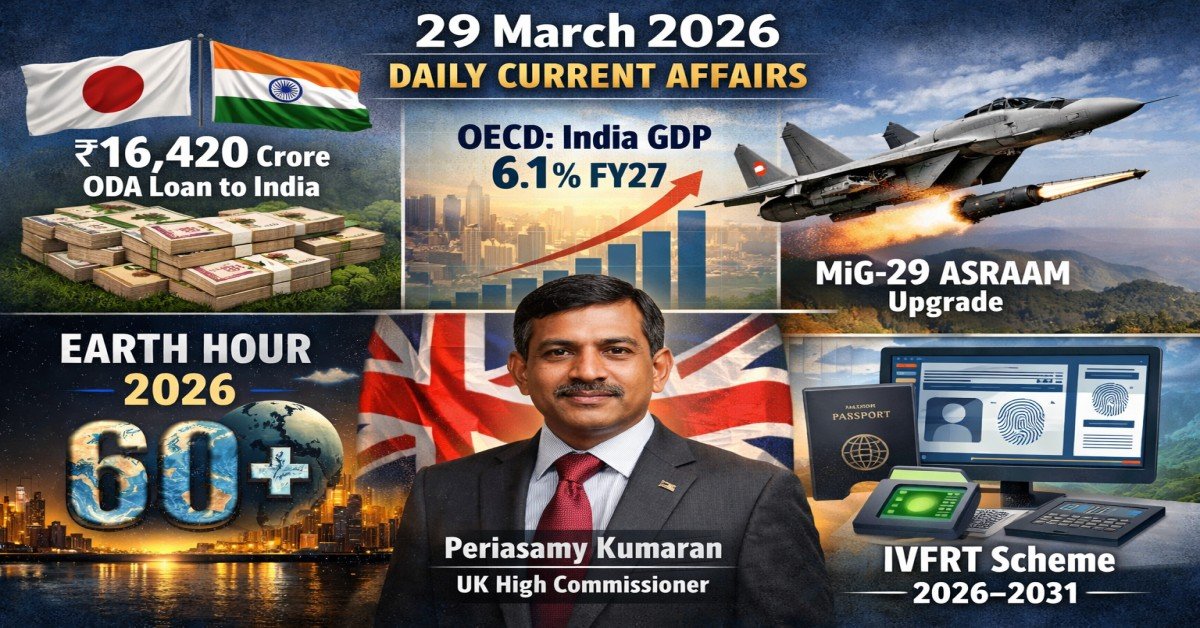
Japan Commits ₹16,420 Crore ODA Loan to India — Metro Rail, Healthcare, and Sustainable Horticulture
In a major step forward for India-Japan bilateral cooperation, the Government of Japan committed an Official Development Assistance (ODA) loan of JPY 275.858 billion — approximately ₹16,420 crore — to support four strategic infrastructure and development projects across India. The exchange of notes was formalised on 24 March 2026 between Alok Tiwari, Joint Secretary in the Department of Economic Affairs (Ministry of Finance), and Keiichi Ono, Ambassador of Japan to India. Loan agreements were simultaneously signed between the Government of India and the Japan International Cooperation Agency (JICA).
This ODA package deepens one of India’s most strategically significant bilateral partnerships. Japan has historically been India’s largest bilateral Official Development Assistance partner — channelling funds predominantly into economic infrastructure at a rate far above the OECD-DAC average. The four projects serve three states: Karnataka, Maharashtra, and Punjab.
The Four Projects in Detail
1. Bengaluru Metro Rail Project Phase 3 — JPY 102.480 billion (largest allocation): The single biggest slice of the package goes towards expanding Bengaluru’s Namma Metro network under Phase 3. The city’s mass rapid transit system, which started as a short line in 2011, has grown substantially through Phases 1 and 2. Phase 3 aims to extend the network further, easing chronic traffic congestion in one of Asia’s fastest-growing tech hub cities. The investment directly connects to goals of reducing vehicular pollution, lowering commute times, and promoting shift from private vehicles to public transport — contributing to India’s climate commitments.
2. Mumbai Metro Line 11 Project — JPY 92.400 billion: The second-largest allocation funds the Mumbai Metro Line 11 project, expanding the financial capital’s urban rail network. Mumbai’s metro expansion is a foundational pillar of the city’s effort to decongest its famously overburdened suburban rail system and road network. Line 11 will improve connectivity between key corridors, supporting economic activity in one of the world’s largest urban agglomerations.
3. Strengthening Tertiary Healthcare in Maharashtra — JPY 62.294 billion: This allocation addresses Maharashtra’s tertiary healthcare capacity — specifically the construction and upgradation of hospitals, medical colleges, and nursing institutions. The project targets the structural gap between demand for advanced medical care and the available infrastructure, while simultaneously strengthening medical education and nursing training systems. It aligns with India’s Universal Health Coverage (UHC) aspirations under Ayushman Bharat.
4. Promoting Sustainable Horticulture in Punjab — JPY 18.684 billion: The smallest but strategically important allocation focuses on agricultural diversification in Punjab — a state traditionally dependent on wheat and paddy cultivation. The project encourages farmers to transition towards high-value horticulture crops, supports value chain development, and builds stronger market linkages. This directly aligns with India’s goal of doubling farmers’ incomes and reducing the environmental burden of water-intensive paddy cultivation in a groundwater-stressed region.
| Project | State | Allocation (JPY Bn) | Sector |
|---|---|---|---|
| Bengaluru Metro Rail Phase 3 | Karnataka | 102.480 bn | Urban Transport |
| Mumbai Metro Line 11 | Maharashtra | 92.400 bn | Urban Transport |
| Strengthening Tertiary Healthcare | Maharashtra | 62.294 bn | Healthcare / Education |
| Sustainable Horticulture | Punjab | 18.684 bn | Agriculture |
UPSC/SSC Exam Angle: This topic connects to India-Japan Strategic Partnership, JICA, Official Development Assistance, urban transport policy, Ayushman Bharat (UHC), agricultural diversification, and Atmanirbhar Bharat. Key points: Notes exchanged on 24 March 2026; JICA is the implementing agency; total loan = JPY 275.858 billion ≈ ₹16,420 crore; three states covered — Karnataka, Maharashtra, Punjab.
OECD Trims India’s FY27 GDP Forecast to 6.1% — Middle East Conflict and Energy Shock Cast a Long Shadow
The Organisation for Economic Co-operation and Development (OECD) released its Economic Outlook Interim Report on 26 March 2026, revising India’s GDP growth forecast for FY 2026-27 (FY27) downward by 10 basis points to 6.1%, from an earlier projection of 6.2%. Despite this slight moderation, India retains its standing as the world’s fastest-growing major economy — well ahead of China (4.4% in 2026), the United States (2.0%), Japan (0.9%), and the United Kingdom (0.7%).
Why Was the Forecast Trimmed?
The 10 basis point downward revision reflects a combination of external and domestic factors. The primary driver is the escalating Middle East conflict — specifically the disruption to energy flows through the Strait of Hormuz, which carries a substantial share of global crude oil and LNG shipments. This has generated a sharp surge in global energy prices, raising India’s import bill and feeding into domestic inflation pressures. The OECD’s report notes these energy shocks are also disrupting the global supply of key commodities including fertilisers, with cascading effects on food prices.
Domestically, the OECD flags a gradual withdrawal of fiscal stimulus as the government pursues fiscal consolidation — reducing its central budget deficit from 4.9% of GDP in FY25 to 4.5% in FY26, with a further targeted reduction ahead. While prudent, this consolidation naturally moderates the direct demand boost from government spending. Additionally, gas rationing in industrial zones is expected to disrupt some production activities in specific sectors.
The Inflation Warning and RBI Rate Implications
The most concerning element of the OECD report for monetary policy watchers is its inflation forecast for FY27: 5.1% — a dramatic jump from an estimated 2.0% in FY26. This surge is attributed to two compounding forces: the fading of the beneficial price effects from good monsoon seasons and previous food-price corrections, combined with sharply rising global energy and fertiliser costs flowing through to domestic prices. To manage this, the OECD projects that the Reserve Bank of India (RBI) may temporarily raise its policy repo rate during Q2 2026 (April–June 2026). This would mark a reversal from the easing cycle and has significant implications for credit markets, home loans, and corporate investment planning.
UPSC Mains (GS-III) Angle: The OECD report tests multiple interconnected themes — India’s trade exposure to Middle East conflict, monetary policy response to imported inflation, fiscal consolidation trade-offs, India’s position in global growth rankings, and the Strait of Hormuz as a strategic choke point. Note: India imports over 80% of its crude oil, making it highly vulnerable to energy price shocks. A $1 increase in per-barrel oil prices costs India approximately $2 billion annually in added import expenditure.
IAF Moves to Arm MiG-29 UPG Fleet with ASRAAM — Doubling Combat Range Against China and Pakistan
In a significant step towards modernising its air combat capability, the Indian Air Force (IAF) is set to integrate the Advanced Short Range Air-to-Air Missile (ASRAAM) onto its fleet of MiG-29 UPG fighter aircraft. The Ministry of Defence issued a Request for Proposals (RFP) on 25 March 2026 covering the integration and certification of ASRAAM on the MiG-29 UPG variant, along with launchers, associated avionics interfaces, ground support equipment, and comprehensive training packages for aircrew and maintenance personnel.
What is ASRAAM and Why Does It Matter?
ASRAAM — Advanced Short Range Air-to-Air Missile — is a fourth-generation, within-visual-range (WVR), infrared-guided air-to-air missile developed by European defence manufacturer MBDA. It first entered service with the Royal Air Force (RAF) of the United Kingdom in 1998. Key technical specifications include a length of 2.9 metres, weight of 88 kilograms, a high-explosive blast-fragmentation warhead, and a speed exceeding Mach 3. Its engagement range of over 25 kilometres is more than double that of the Soviet-era R-73 missile (10–15 km) it will replace. ASRAAM uses a fire-and-forget principle — once launched, it guides itself autonomously to the target using an advanced imaging infrared (IIR) seeker, freeing the pilot to immediately take evasive action.
The missile supports high off-boresight (HOBS) engagements — when linked to a Helmet-Mounted Display (HMD), a MiG-29 pilot needs only to look at an enemy aircraft to cue and fire the missile, even at extreme angles relative to the aircraft’s nose direction. It can sustain up to 50G of maneuverability through body-lift aerodynamics and tail-control fins — critical in close-range dogfights.
The Strategic Context: China’s PL-10 and Pakistan’s PL-10E
The urgency behind this upgrade is driven by what India’s adversaries have already deployed. China’s PL-10 missile — operational since 2015 on platforms including the J-10C, J-16, and stealth J-20 — travels at Mach 4 and has an engagement range of 20–30 km. Pakistan’s JF-17 Block III aircraft, operated since 2021, carry the export variant PL-10E. Against these systems, the IAF’s ageing Soviet R-73 missiles (1980s design, 10–15 km range) on its MiG-29 fleet represent a capability gap. ASRAAM’s larger rocket motor (166mm diameter vs PL-10’s ~160mm) provides superior sustained velocity and engagement range — compensating for its marginally lower peak speed. With ASRAAM already operational on LCA Tejas and Jaguar aircraft, the MiG-29 integration extends IAF’s ASRAAM standardisation across its full frontline fleet.
Indigenisation note: In August 2021, MBDA and Bharat Dynamics Limited (BDL) signed a licensing agreement to establish a Final Assembly, Integration and Test (FAIT) facility at BDL’s Hyderabad complex. This facility will also support Maintenance, Repair and Overhaul (MRO) operations for ASRAAM in India — a significant step towards Atmanirbhar Bharat in missile systems. The IAF operates over 55 MiG-29 aircraft, including eight twin-seat trainer variants. The MiG-29 fleet saw active deployment in Operation Sindoor (2025).
Earth Hour 2026: 20 Years of Switching Off — WWF’s Global Climate Campaign Observed on 29 March
Earth Hour 2026 was observed across the globe on 29 March 2026, with millions of people switching off non-essential lights from 8:30 PM to 9:30 PM local time in a symbolic act of solidarity for climate action and environmental conservation. This year’s event carries special significance — it marks 20 years since Earth Hour was first observed.
Origins and Scale of Earth Hour
Earth Hour was launched in Sydney, Australia in 2007 as a symbolic one-city initiative by the World Wide Fund for Nature (WWF). Within two years it had grown into a global movement. Today, Earth Hour is observed in over 190 countries and territories, involving hundreds of millions of people, governments, corporations, and civil society organisations. Landmark monuments, government buildings, and corporate headquarters around the world — from the Eiffel Tower in Paris to the Gateway of India in Mumbai — participate by turning off non-essential lights.
In India, WWF India, in collaboration with the Ministry of Environment, Forest and Climate Change (MoEFCC), organised awareness and outreach activities in Gwalior, Madhya Pradesh to mark the 20th anniversary. This year’s campaign theme, “Give an Hour for Earth”, extends the movement’s call to action beyond the symbolic one-hour lights-off to encourage citizens to dedicate time each day to environmental advocacy and sustainable behaviour.
UPSC/SSC Exam Angle: Earth Hour is organised by WWF (World Wide Fund for Nature), not UNEP or any UN body — a commonly confused fact in exams. It started in Sydney, 2007 and is now in its 20th year (2026). The event takes place towards the end of March every year. It promotes awareness about climate change and energy conservation.
Periasamy Kumaran Appointed India’s Next High Commissioner to UK; Vikram Doraiswami Moves to China
The Government of India has announced a significant reshuffle in its top diplomatic postings in two of its most strategic bilateral relationships. Periasamy Kumaran, currently serving as Secretary (East) in the Ministry of External Affairs (MEA), has been appointed as India’s next High Commissioner to the United Kingdom, succeeding Vikram Doraiswami. Simultaneously, Vikram Doraiswami has been designated as India’s next Ambassador to China — a posting of enormous strategic sensitivity given the India-China border situation and the ongoing process of boundary talks.
About Periasamy Kumaran
Periasamy Kumaran is a 1992-batch Indian Foreign Service (IFS) officer with extensive experience in India’s eastern neighbourhood and broader Asian diplomacy. As Secretary (East), he has overseen India’s bilateral relations with countries in the extended eastern neighbourhood. His appointment to the UK comes at a time when India-UK ties are advancing along multiple fronts, including the ongoing India-UK Free Trade Agreement (FTA) negotiations, defence cooperation, education partnerships, and the large Indian diaspora in Britain.
Why these appointments matter: The posting of a senior IFS officer to China signals India’s intention to manage the relationship with Beijing carefully at a time when bilateral tensions — while reduced since the 2020 Galwan crisis — remain complex. The UK appointment matters for the FTA negotiations and diaspora-led soft power. Both postings reflect the MEA’s assessment of strategic priorities for 2026–2027.
BHASHINI–PFRDA MoU and IVFRT 2026–2031: Digital Public Infrastructure Meets Language Inclusion
BHASHINI–PFRDA MoU: Pension Services in Your Mother Tongue
The Digital India BHASHINI Division (DIBD), operating under the Ministry of Electronics and Information Technology (MeitY), signed a landmark Memorandum of Understanding with the Pension Fund Regulatory and Development Authority (PFRDA) under the initiative “BHASHINI for Seva / Sanchalan — A BHASHINI Sahayogi Program.”
The collaboration aims to integrate BHASHINI — India’s National Language Digital Public Infrastructure — with PFRDA’s pension management platforms. In practical terms, this will enable citizens subscribing to NPS (National Pension System) and APY (Atal Pension Yojana) to access pension-related information, registration, grievance redressal, and service interactions in their regional languages, breaking the language barrier that often excludes non-English-speaking rural and semi-urban populations from the formal pension ecosystem. BHASHINI supports all 22 scheduled languages of the Indian Constitution.
What is BHASHINI? BHASHINI (Bhasha Daan) is India’s AI-powered language technology platform, developed under the National Language Technology Mission. It provides open-source translation, transcription, and speech recognition capabilities across India’s 22 scheduled languages. It is a key component of India’s Digital Public Infrastructure (DPI) strategy — the same framework that powers UPI, Aadhaar, and DigiLocker.
IVFRT Scheme Extended for 2026–2031: Smarter Immigration for a Globalising India
The Union Cabinet approved the continuation of the Immigration, Visa, Foreigners Registration and Tracking (IVFRT) Scheme for a further five years, from 2026 to 2031. IVFRT provides a centralised, technology-driven platform for all visa issuance, immigration processing at ports of entry, and foreigner registration and tracking activities across India. The renewed phase places particular emphasis on digital modernisation — including mobile-compatible services and self-service kiosks at major airports and border checkpoints — to make immigration faster, more transparent, and more secure. The scheme is critical for managing India’s growing inbound tourism, business travel, and international student mobility.
Rashtriya Vigyan Puraskar 2026: Government Opens Nominations for India’s Premier National Science Award
The Central Government has opened nominations for the Rashtriya Vigyan Puraskar (RVP) 2026 — India’s highest national award recognising outstanding contributions in the fields of science, technology, and innovation. The RVP was established to honour scientists, technologists, and innovators whose work has significantly advanced India’s scientific landscape and contributed to national development.
Structure and Eligibility
The Rashtriya Vigyan Puraskar replaces the earlier fragmented set of science awards with a single, consolidated national framework under the Department of Science and Technology (DST). The award covers three tiers: the Vigyan Ratna (highest, for lifetime contributions), the Vigyan Shri (for distinguished contributions), and the Vigyan Yuva–Shanti Swarup Bhatnagar (for young scientists under 45). Eligibility extends to scientists and technologists working in both government and private sector organisations, as well as individuals of Indian Origin residing abroad whose work has directly benefited Indian communities or society. This diaspora inclusion clause recognises the significant contribution of India-origin researchers at top global institutions.
UPSC/SSC Angle: Rashtriya Vigyan Puraskar was introduced as a replacement for the older Shanti Swarup Bhatnagar Prize and other science awards — consolidating recognition into a single national framework. It is awarded on National Science Day (28 February) — the anniversary of C.V. Raman’s discovery of the Raman Effect in 1928. RVP 2026 nominations are now open.
Test Yourself: 10 MCQs on 29 March 2026 Current Affairs
29 March 2026 — Quick Quiz
10 exam-style MCQs on Japan ODA, OECD forecast, IAF ASRAAM, Earth Hour, appointments, BHASHINI, IVFRT and more. Lock in your score!