India Declares Itself Naxal-Free as March 31 Deadline Is Met — Nearly Six Decades of LWE Insurgency Ends
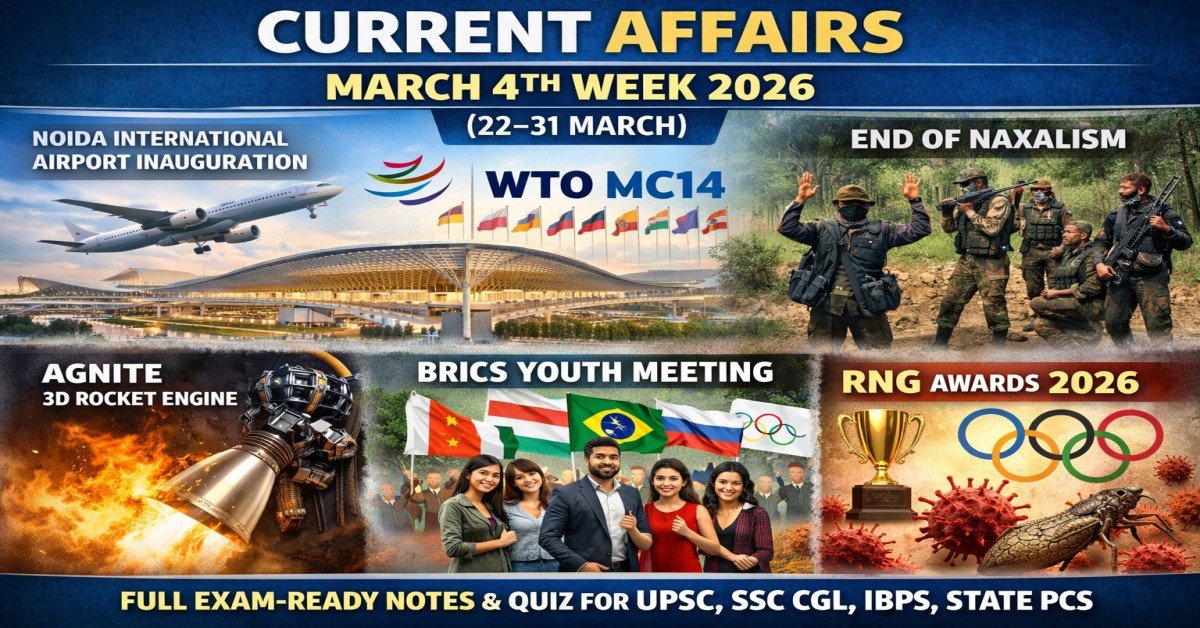
In a defining moment for India’s internal security history, the Government of India declared victory over the Left Wing Extremism (LWE) / Naxalite–Maoist insurgency on 31 March 2026 — meeting the deadline publicly announced by Union Home Minister Amit Shah. In a statement to the Lok Sabha, Home Minister Shah declared that India had become effectively “Naxal-free”, marking the end of an armed insurgency that had lasted nearly six decades, claimed an estimated 17,000 civilian and security force lives, and at its peak covered 180+ districts across nine states.
The Deadline’s Origins: Amit Shah first set the March 31, 2026 deadline at a public meeting in 2024, calling the LWE menace “the biggest internal security challenge for India.” He reaffirmed it repeatedly as the deadline approached, stating: “By March 31, 2026, we will eradicate Naxalism from the country, ensuring that no citizen has to lose their life because of it.” The declaration represents one of the most significant internal security achievements since Indian Independence.
How It Was Achieved: The Numbers Tell the Story
The decline of LWE was not a single operation but the cumulative result of a decade of sustained, multi-pronged action. The number of LWE-affected districts fell from 126 in 2014 to 90 in 2018, 38 in April 2024, 18 in April 2025, and just 7 by early 2026 — the final cluster comprising Bijapur, Narayanpur, Sukma, Kanker, and Dantewada in Chhattisgarh, West Singhbhum in Jharkhand, and Kandhamal in Odisha. The number of active armed Maoist cadres fell from over 2,000 in 2024 to approximately 220 by early 2026. Between 2014 and March 2026, over 16,496 Naxals surrendered, with 2025 recording the highest single-year surrenders at 2,337. Police stations reporting LWE violence fell from 465 in 2010 to just 119 in 2025, and fatalities declined by over 85%.
A decisive operational milestone came in May 2025, when a major operation in the Karregutta Hills (Chhattisgarh-Telangana border) — codenamed Operation Black Forest — resulted in the killing of 31 Naxals including Nambala Keshava Rao, General Secretary of CPI (Maoist), effectively decapitating the organisation’s top leadership. The final formal milestone on 31 March 2026 came when Chelluri Narayana Rao (alias Suresh), a top leader of the Andhra-Odisha Border Special Zonal Committee (AOBSZC), surrendered alongside other members, prompting Andhra Pradesh’s DGP to formally declare AP a Naxal-free state.
What Enabled the Decline: Security + Development Synergy
The success rested on a three-pronged framework combining security operations, development outreach, and political commitment. Security-wise, the deployment of specialised CRPF units like CoBRA (Commando Battalion for Resolute Action), intelligence-led targeted operations, inter-state force coordination, and the deployment of District Reserve Guards (DRGs) — local tribal youth recruited to fight their former captors — proved decisive. Development-wise, road construction, mobile and internet connectivity, banking access via PMJDY, and welfare scheme delivery to the remotest tribal hamlets removed the grievance ecosystem that Maoists exploited for recruitment. PM Shah gave credit to CRPF, BSF, ITBP, CoBRA, state police forces, and crucially, the tribal communities who turned against the insurgency.
UPSC GS-III / GS-II Mains Angle: This topic connects to India’s internal security framework, Left Wing Extremism policy, National Policy and Action Plan (2015), CoBRA forces, Naxalbari uprising 1967, CPI (Maoist), Scheduled Tribe rights, Red Corridor, Article 355 (Centre’s duty to protect states from internal disturbance), and development-security nexus. The origin of LWE: Naxalbari, West Bengal, 1967 — peasant uprising led by Charu Majumdar, Kanu Sanyal, Jangal Santhal.
WTO MC14 Concludes Without E-Commerce Moratorium Deal — “Yaoundé Package” Saved, Geneva Talks Next
The 14th WTO Ministerial Conference (MC14), held from 26–29 March 2026 in Yaoundé, Cameroon — the first WTO Ministerial on African soil — concluded in the early hours of 30 March 2026 without a binding agreement on the two most critical issues: the e-commerce duty moratorium and WTO reform. By 31 March 2026, the e-commerce moratorium that had been in place since 1998 officially expired — the first time in nearly three decades that countries technically gained the legal right to impose customs duties on electronic transmissions like digital goods, streaming services, and software downloads.
The E-Commerce Moratorium — Why It Lapsed
Since 1998, WTO members had agreed — and renewed at every biennial Ministerial — to refrain from imposing customs duties on cross-border electronic transmissions (e-books, software, music, streaming). The moratorium’s lapse does not mean tariffs are immediately imposed; WTO members must take specific domestic legislative action. However, it removes the multilateral barrier, creating uncertainty for global digital trade worth hundreds of billions of dollars annually.
The impasse at MC14 was a clash of national interests. The United States pushed for a long-term or permanent extension. Brazil was only willing to accept a short renewal of around two years. Washington’s refusal to accept less than a long-term deal kept negotiations deadlocked. India, which had historically opposed any extension on the grounds that it deprives developing countries of tariff revenue on digital trade, signalled some flexibility — but the US-Brazil divide proved unbridgeable. India also, alongside South Africa, successfully blocked the incorporation of the Investment Facilitation for Development (IFD) Agreement into the WTO’s formal rulebook, arguing it falls outside the WTO’s mandate.
What Was Achieved: The “Yaoundé Package”
Despite the failures, MC14 was not entirely without outcome. WTO Director-General Dr. Ngozi Okonjo-Iweala preserved draft texts — collectively called the “Yaoundé Package” — covering: a draft Ministerial Declaration on WTO Reform, a draft Ministerial Decision on Electronic Commerce, a draft Decision on the TRIPS Moratorium, and progress on a dedicated package for Least Developed Countries (LDCs). These texts will serve as the negotiating basis at the next WTO General Council meeting in Geneva, likely in 2027 ahead of MC15. MC14 also adopted two formal decisions: on integrating small economies into the multilateral trading system, and on Special and Differential Treatment (S&DT) provisions for developing countries.
UPSC GS-II Mains Angle: Key concepts tested — WTO e-commerce moratorium, TRIPS (Trade-Related aspects of Intellectual Property Rights), Special and Differential Treatment (S&DT), Appellate Body crisis, Most-Favoured-Nation (MFN) principle, India’s stance on digital trade taxation, WTO reform debate (developed vs developing countries), and the Investment Facilitation for Development Agreement. India’s position: Oppose permanent e-commerce moratorium (revenue concern) + Block IFD (outside WTO mandate).
India’s Updated NDC 2031–2035: 60% Non-Fossil Power, 47% Emissions Intensity Cut, 3.5–4 Bn Tonne Carbon Sink
The Union Cabinet, chaired by PM Narendra Modi, approved India’s updated Nationally Determined Contribution (NDC) for the period 2031–2035 — to be formally submitted to the United Nations Framework Convention on Climate Change (UNFCCC) under the Paris Agreement. This updated NDC raises ambition across all three key climate metrics and represents India’s most comprehensive climate commitment to date.
The Three New Targets
Target 1 — Non-Fossil Power Capacity: India commits to achieving 60% of cumulative installed electricity capacity from non-fossil fuel sources by 2035, up from the previous 50% by 2030 target. As of February 2026, India already has 52.57% non-fossil installed capacity — having reached the 50% target nearly five years ahead of schedule. This means India is well on track to exceed 60% before 2035.
Target 2 — Emissions Intensity: India targets a 47% reduction in the emissions intensity of GDP (emissions per unit of GDP) compared to 2005 levels by 2035. The previous target was 45% by 2030. India had already achieved a 36% reduction by 2020, demonstrating strong implementation momentum. Critically, India continues to use emissions intensity — not absolute emissions as its primary metric, meaning total emissions can still rise as long as GDP grows faster than emissions.
Target 3 — Carbon Sink: India commits to creating a carbon sink of 3.5 to 4.0 billion tonnes of CO₂ equivalent through forest and tree cover by 2035 (from 2005 base). This is up from the previous target of 2.5–3 billion tonnes. By 2021, India had already created a sink of approximately 2.29 billion tonnes CO₂ equivalent through afforestation and ecosystem restoration. Forest cover currently stands at around 24% of geographic area, below the constitutional aspiration of 33%.
| Target | Old NDC (2021–2030) | New NDC (2031–2035) |
|---|---|---|
| Non-fossil power capacity | 50% by 2030 | 60% by 2035 |
| Emissions intensity reduction | 45% from 2005 levels | 47% from 2005 levels |
| Carbon sink | 2.5–3 Bn tonnes CO₂ eq. | 3.5–4 Bn tonnes CO₂ eq. |
| Current status (2026) | — | 52.57% non-fossil · 36% intensity reduction · 2.29 Bn t sink |
Structural tension to know for exams: Despite strong renewable growth (52% non-fossil capacity), India’s actual clean energy generation remains around 22–23% of total — because renewables generate less per unit of capacity than coal. India also plans 100 GW of new coal capacity and continues fossil fuel investments. Critics note this creates an internal contradiction in India’s climate strategy. This is a common UPSC Mains question format: “India’s NDC targets reflect ambition but structural contradictions remain. Examine.”
Energy Statistics India 2026 Released — NSO’s 33rd Edition Maps India’s Energy Landscape
The National Statistics Office (NSO), under the Ministry of Statistics and Programme Implementation (MoSPI), released the 33rd edition of Energy Statistics India 2026 — an annual flagship publication serving as the definitive centralised repository of India’s energy reserves, production, consumption, capacity, and trade data across all energy sources — fossil fuels and renewables.
Key Highlights from the Report
The Total Primary Energy Supply (TPES) stood at 9,32,816 KTOE (Kilo Tonnes of Oil Equivalent) for FY 2024-25, representing a growth of 2.95% over the previous year. The report documents the progress of India’s energy transition — tracking the expanding contribution of renewables (solar, wind, hydro) alongside the persistent dominance of coal in power generation. India added a record 52,536 MW of installed generation capacity in FY 2025-26 up to January 2026, with renewables accounting for 43,026 MW (82%) of new additions, nuclear 700 MW, and coal 8,810 MW — reflecting the structural shift underway in India’s power sector.
IRDAI Introduces Ind AS Financial Reporting for Insurance Sector from 1 April 2026 — The Last Holdout Migrates
The Insurance Regulatory and Development Authority of India (IRDAI) has introduced the Indian Accounting Standards (Ind AS) based Financial Reporting Framework for the insurance sector, effective 1 April 2026. This marks a landmark transition: the insurance sector was the last major financial sector in India still operating under the older Indian Generally Accepted Accounting Principles (I-GAAP) under the Insurance Act, 1938. Most listed companies, banks, and NBFCs had already migrated to Ind AS in earlier phases.
What Changes and Why It Matters
The move to Ind AS — India’s equivalent of the global International Financial Reporting Standards (IFRS) — means insurance companies will now use Ind AS 117 (Insurance Contracts), which is India’s version of IFRS 17 (notified by the Ministry of Corporate Affairs in August 2024). This shifts the insurance sector from a rule-based, premium-recognition framework to a principle-based, fair-value accounting model. It applies to all categories: Life insurers, General insurers, Stand-Alone Health Insurers, and Reinsurers. The change enhances the comparability of Indian insurers with global peers, improves transparency for policyholders and investors, and aligns India’s financial reporting with international norms — a key component of India’s ambition to be a global financial hub.
India’s Next Census to be Conducted Digitally — Commencing 2026, Concluding by March 2027, First Caste Data Since 1931
India is set to conduct its next national population Census using a fully digital methodology — commencing in 2026 and scheduled to conclude by 1 March 2027. The census, originally due in 2021, was postponed due to the COVID-19 pandemic — a delay of five years. The upcoming Census carries extraordinary historical significance: it will be the first Census since 1931 to capture granular caste data beyond the broader Scheduled Caste (SC) and Scheduled Tribe (ST) classifications.
Key Features of the 2027 Census
The Census will be conducted using digital devices including mobile phones and laptops, replacing the paper-based enumeration of previous rounds. A self-enumeration portal will be available in 16 languages, allowing households to fill their data directly online. Enumerator tablets will be used for door-to-door verification. Every usual resident of India is required to register in the National Population Register (NPR), prepared under the Citizenship Act, 1955. The Census will document that India now has 36 States and Union Territories (up from 35 in the 2011 Census, following J&K’s reorganisation), and the number of districts has risen from 640 to 784. Statutory towns have increased from 4,041 to 5,128, reflecting India’s rapid urban growth.
The caste census component — the first comprehensive caste enumeration since 1931 — is politically significant. It will enumerate Other Backward Classes (OBCs) and other caste groups alongside SCs and STs, providing data that could reshape reservation policy and social welfare targeting for decades. The Census is conducted by the Office of the Registrar General and Census Commissioner of India under the Ministry of Home Affairs. The first synchronous decennial census was conducted in 1881 under W.C. Plowden.
IONS IMEX TTX 2026 at Kochi + Supreme Court Expands Right to Die with Dignity in Harish Rana Judgment
IONS Maritime Exercise (IMEX) TTX 2026 — Indian Navy Hosts Indian Ocean Naval Exercise
The Indian Navy hosted the IONS Maritime Exercise (IMEX) Table-Top Exercise (TTX) 2026 at the Maritime Warfare Centre, Southern Naval Command, Kochi. IMEX is conducted under the framework of the Indian Ocean Naval Symposium (IONS) — a multilateral forum of 26 Indian Ocean littoral navies established in 2008 on India’s initiative. IONS promotes cooperative maritime security, humanitarian assistance, and disaster relief (HADR) coordination across the Indian Ocean Region.
A Table-Top Exercise (TTX) is a simulation-based, discussion-driven exercise where naval officers and planners work through hypothetical scenarios without deploying actual vessels or assets — useful for testing doctrine, communication protocols, and interoperability. The 2026 TTX reflected growing concerns about Indian Ocean security: Houthi attacks on commercial shipping, energy flow disruptions through the Strait of Hormuz, and piracy threats from the Gulf of Aden — all live threats in the geopolitical environment of early 2026.
Harish Rana v. Union of India (2026) — Supreme Court Expands Right to Die with Dignity
In a landmark constitutional judgment, the Supreme Court of India, in Harish Rana v. Union of India (2026), allowed for the first time in Indian judicial history the withdrawal of Clinically Assisted Nutrition and Hydration (CANH) in cases of terminally ill patients. The judgment reaffirmed that the Right to Die with Dignity is a component of the Right to Life and Personal Liberty under Article 21 of the Constitution. CANH refers to the artificial delivery of nutrients and fluids — through tubes, drips, or intravenous lines — to patients who are unable to eat or drink naturally. Its withdrawal in terminal cases has been a contested frontier in both medical ethics and law.
This judgment is the latest milestone in a evolving constitutional jurisprudence: from Gian Kaur v. State of Punjab (1996) (Right to Life doesn’t include right to die) to Common Cause v. Union of India (2018) (passive euthanasia + living wills permitted) to Common Cause v. Union of India (2023) (simplification of living will procedures). The 2026 Harish Rana case represents the final doctrinal evolution — expanding passive euthanasia to include CANH withdrawal under defined conditions, based on medical certification by three experts with ~20 years experience confirming terminal condition.
Test Yourself: 10 MCQs on 31 March 2026 Current Affairs
31 March 2026 — Quick Quiz
10 exam-style MCQs on India Naxal-free, WTO MC14, India’s NDC, IRDAI Ind AS, Census 2027, IONS IMEX, and more. Ace every mark!