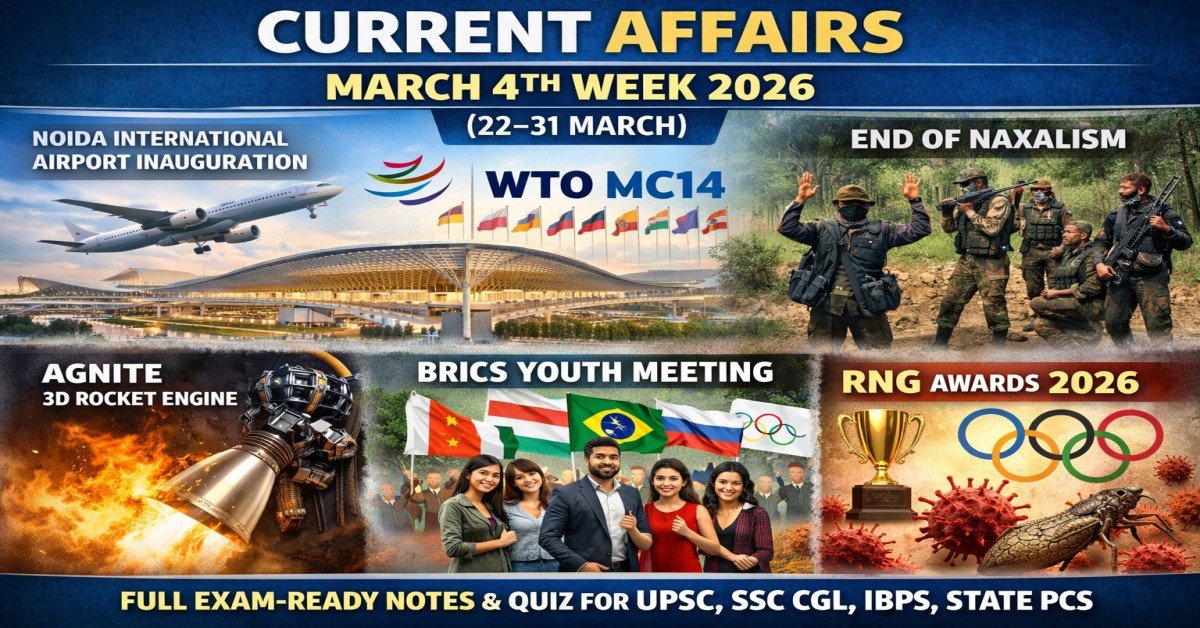
Supreme Court allows passive euthanasia; Naxalism declared ended; National Dental Commission constituted; Sonam Wangchuk released
Harish Rana case — landmark ruling on the right to die with dignity
On 11 March 2026, the Supreme Court of India delivered a landmark verdict in Harish Rana v. Union of India, allowing the withdrawal of Clinically Assisted Nutrition and Hydration (CANH) for the first time in the nation’s judicial history. Harish Rana had been in a Persistent Vegetative State (PVS) for approximately thirteen years following a fall in 2013, with no advance directive or living will in place. Building on the 2018 Common Cause v. Union of India judgment — which first recognised the Right to Die with Dignity as a fundamental right under Article 21 — this ruling specifically addressed the withdrawal of clinically assisted nutrition, going further than any previous Indian court had. The bench also expressed a preference for the term “withholding or withdrawing life-sustaining treatment” over the older phrase “passive euthanasia,” which it considered legally imprecise.
Judicial evolution of end-of-life jurisprudence: Aruna Shanbaug v. Union of India (2011) first permitted passive euthanasia under High Court supervision as parens patriae. Common Cause (2018) elevated it to a fundamental right under Article 21 and validated advance directives (living wills). The Harish Rana ruling (2026) goes further by permitting CANH withdrawal for the first time and simplifying the oversight mechanism to reduce delays in executing a patient’s or family’s lawful wishes.
India’s Naxalite insurgency effectively ended — Andhra Pradesh declared Naxal-free
On 30 March 2026, Home Minister Amit Shah announced that India had effectively neutralised the Left Wing Extremism (LWE) movement, reporting that most remaining cadres of the Communist Party of India (Maoist) had been killed in encounters, arrested, or had surrendered ahead of the government’s self-imposed 31 March 2026 deadline. Andhra Pradesh was specifically proclaimed Naxal-free on 30 March — a development closely linked to the surrender of a Central Committee member of CPI (Maoist) and the dismantling of the Andhra-Odisha Border Special Zonal Committee (AOBSZC). At the movement’s peak, LWE had a presence in over 150 districts across 10 states; that figure had fallen to below 30 districts by 2026, reflecting the success of the dual strategy combining security operations with developmental investment in affected areas.
National Dental Commission constituted; Bal Vivah Mukt Bharat launched; Governors appointed
On 19 March 2026, the Government of India constituted the National Dental Commission (NDC), replacing the Dental Council of India that had regulated dental education under the Dentists Act, 1948. The NDC brings dental regulation in line with the broader National Medical Commission (NMC) framework and introduces greater transparency and accountability in dental college recognition. On 14 March 2026, the government launched “Bal Vivah Mukt Bharat” (Child Marriage-Free India) — a national campaign with legislative, administrative, and community engagement components. President Droupadi Murmu appointed new Governors for seven states and two Union Territories on 6 March 2026, exercising Presidential authority under Article 153 of the Constitution.
Inflation targeting framework renewed at 4% till 2031; West Asia war shocks India’s economy; Rajasthan Industrial Park Promotion Policy 2026 launched
Flexible Inflation Targeting renewed for 2026–2031
The Government of India, in formal consultation with the Reserve Bank of India, extended the Flexible Inflation Targeting (FIT) framework for a further five-year period: 1 April 2026 to 31 March 2031. This is the second renewal of the framework, which was originally adopted in 2016 via an amendment to the RBI Act, 1934 (Section 45ZA) and first renewed in 2021. The retail inflation target stays unchanged at 4% CPI with a tolerance band of ±2% — upper limit 6%, lower limit 2%. India’s CPI in February 2026 stood at 3.21%, comfortably within the band despite global cost pressures. The six-member Monetary Policy Committee (MPC) — three RBI officials including the Governor (who chairs and holds the casting vote), plus three external government-appointed members — retains responsibility for achieving this target. India’s benchmark 10-year G-sec yield rose to 6.94% in late March 2026 amid oil price surge and rupee depreciation, signalling rising market expectations of monetary tightening.
Exam trap alert on MPC: Under Section 45ZA of the RBI Act, the inflation target is set by the central government “in consultation with the Reserve Bank” — not independently by the RBI. This distinction is frequently tested. Also note: the casting vote in case of a tie belongs to the RBI Governor, not the Finance Ministry appointees.
West Asia war — macroeconomic turbulence for India
The conflict that erupted with US-Israel strikes on Iran on 28 February 2026 delivered cascading shocks to India’s economy through March. Iran’s blockade of the Strait of Hormuz — through which roughly one-fifth of globally traded oil and significant LNG flows — reduced shipping transits from a normal 200–300 per week to near zero, triggering a global energy crisis. India imports approximately 60% of its crude oil from West Asian nations, most routed through this chokepoint. The Indian crude basket surged 40% since January 2026, pushing above USD 100 per barrel. The rupee weakened to a record low of ₹92.28 per US dollar on 4 March. The Department of Economic Affairs described India’s near-term outlook as “more uncertain” in its March 2026 Monthly Economic Review. India evacuated approximately 4.26 lakh citizens from conflict-affected countries.
Rajasthan Industrial Park Promotion Policy-2026
On 25 March 2026, the Government of Rajasthan under Chief Minister Bhajanlal Sharma (BJP) introduced the Industrial Park Promotion Policy-2026 (IPPP-2026), approved by the Cabinet in February 2026. The policy creates four models for industrial park development: (1) RIICO provides all land; (2) developer owns 80%, RIICO provides 20%; (3) developer owns 100%; (4) PPP mode. Private parks must have a minimum of 50 acres and 10 industrial units. Capital subsidies range from 20% (up to ₹100 crore investment) to a flat ₹30 crore (₹100–₹250 crore) to up to ₹40 crore (above ₹250 crore). The policy also reimburses 50% of CETP costs, exempts electricity duty for renewable energy users, and routes all clearances through the Raj Nivesh Portal. RIICO (Rajasthan State Industrial Development and Investment Corporation) is the nodal agency.
Exercise Vayu Shakti 2026; ₹858 crore MoD contracts; Army-IITM MoU for NIC at Avadi; Iran’s IRIS Lavan docks at Kochi
Exercise Vayu Shakti 2026 — IAF combat power display at Pokhran
The Indian Air Force (IAF) staged Exercise Vayu Shakti 2026 at the Pokhran Field Firing Range in Rajasthan’s Thar Desert — a location of immense symbolic and strategic significance, having hosted India’s Pokhran-I (1974) and Pokhran-II (1998) nuclear tests. The exercise demonstrated the IAF’s integrated day-and-night combat capabilities, including precision strikes by fighter aircraft, helicopter gunships, and unmanned aerial vehicles. President Droupadi Murmu was the chief guest and witnessed the demonstration. Conducted periodically, Vayu Shakti exercises serve both as an internal readiness assessment and as a strategic message of deterrence, particularly relevant against the backdrop of heightened regional tensions linked to the West Asia war.
₹858 crore MoD contracts — Russia air defence + Boeing P-8I maintenance
The Ministry of Defence signed two defence contracts worth a combined ₹858 crore at Kartavya Bhawan-2, New Delhi on 27 March 2026. The first — worth ₹445 crore — was concluded with JSC Rosoboronexport of Russia for short-range air defence systems to protect Indian Army formations from aerial threats including drones, aircraft, and cruise missiles. The second — worth ₹413 crore — was signed with Boeing India Defense Private Ltd under the ‘Buy Indian’ category with 100% Indigenous Content, covering Depot Level Maintenance (DLM) of the Indian Navy’s P-8I maritime patrol aircraft fleet at an in-country MRO (Maintenance, Repair and Overhaul) facility. The P-8I is a long-range anti-submarine warfare and maritime surveillance platform operated by the Indian Navy.
Army EME-IITM Pravartak MoU — Nodal Indigenisation Centre at Avadi
The Indian Army’s Corps of Electronics and Mechanical Engineers (EME) signed a Memorandum of Understanding with the IITM Pravartak Technologies Foundation — IIT Madras’s technology commercialisation arm — on 26 March 2026. The agreement creates a collaborative framework to jointly identify, develop, and field indigenous engineering solutions for military equipment. A Nodal Indigenisation Centre (NIC) was established at Avadi, Chennai — home of the Heavy Vehicles Factory (HVF), which produces the Arjun Main Battle Tank — to harness the regional industrial base and strengthen the Tamil Nadu Defence Corridor. On 7 March 2026, India allowed the Iranian naval vessel IRIS Lavan to dock at Kochi port on humanitarian grounds, a carefully calibrated signal of India’s intent to maintain working relationships with Tehran even while officially neutral in the war.
NASA IXPE reveals reflected shock in RCW 86; Micron Sanand ATMP operational; JJM extended to 2028; Green Hydrogen standards notified; Cheetah population reaches 53
NASA IXPE — new findings on 2,000-year-old supernova RCW 86
On 27 March 2026, NASA released the latest findings from its Imaging X-ray Polarimetry Explorer (IXPE) mission — a joint project of NASA and the Italian Space Agency (ASI), led by NASA’s Marshall Space Flight Center in Huntsville, Alabama, and launched on 9 December 2021. The study focused on RCW 86, a supernova remnant located approximately 8,000 light-years away in the southern constellation Circinus. RCW 86 is identified as the remnant of the “guest star” documented by Chinese Han Dynasty astronomers in 185 AD, making it the oldest documented supernova in human history. It is classified as a Type Ia supernova. IXPE’s polarimetric observations of the outer southwestern rim revealed a reflected shock — confirming the blast wave has reached the outer boundary of a low-density cavity the progenitor star carved before it exploded. The composite image (yellow = low-energy X-rays from Chandra/XMM-Newton; blue = high-energy X-rays; purple = new IXPE polarimetry data at lower-right outer rim; optical starfield from NOIRLab) was released on 27 March 2026.
Micron ATMP, Green Hydrogen standards, and JJM 2.0
PM Modi inaugurated Micron Technology’s Semiconductor ATMP (Assembly, Testing, Marking and Packaging) facility in Sanand, Gujarat on 2 March 2026. The plant contains a 500,000 sq ft raised-floor clean room — reportedly the world’s largest — and shipped its first DRAM module to Dell Technologies, marking India’s entry into advanced semiconductor assembly under the Semiconductor Mission. On 10 March 2026, India notified standards for Green Ammonia and Green Methanol production under the National Green Hydrogen Mission — a key regulatory step for the hydrogen economy. The Cabinet approved Jal Jeevan Mission 2.0 (JJM 2.0) on 11 March 2026, extending the mission to 2028 to complete the goal of 100% household tap water access. India’s cheetah population at Kuno National Park reached 53 animals after cheetah Jwala delivered five cubs.
2026 Iran War reshapes global order; India’s strategic neutrality; Pakistan as mediator; India hosts BRICS 2026; CMS COP15 Brazil
The 2026 Iran War — geopolitical earthquake
On 28 February 2026, the United States and Israel launched coordinated air and missile strikes on Iranian military and nuclear facilities, beginning the 2026 Iran War. Iran responded by imposing a blockade of the Strait of Hormuz and conducting retaliatory strikes on US bases in the region. Former Iranian Supreme Leader Ayatollah Ali Khamenei was reported killed in the strikes, plunging Iran into political uncertainty. The US Navy sank the Iranian warship IRIS Dena in the Indian Ocean — bringing the conflict to South Asia’s doorstep and raising regional maritime security concerns. Pakistan positioned itself as a diplomatic back-channel between Washington and Tehran, re-emerging as a geopolitically relevant mediator after years of relative isolation. India, as the 2026 BRICS Chair, faces the difficult task of forging consensus among member states including both Iran and the UAE — which hold opposing positions in the conflict.
India’s position on the Iran war — exam relevance: India maintained strategic neutrality, a posture similar to its approach during the Russia-Ukraine war. PM Modi spoke personally with leaders of Iran, Saudi Arabia, UAE, Qatar, Oman, Kuwait, and Bahrain, consistently calling for dialogue and de-escalation. India’s stated position: “war is not the solution; dialogue and diplomacy are the only path.” India did not take sides publicly while quietly evacuating citizens and protecting energy supply chains — a calculated multi-alignment strategy.
CMS COP15, Brazil — 40 migratory species gain protection
The 15th Conference of Parties (COP15) to the Convention on the Conservation of Migratory Species of Wild Animals (CMS) was held in Brazil in March 2026. The meeting concluded with the decision to add 40 new migratory species to its international protection lists, including several threatened marine species — sharks and rays — along with multiple bird species that traverse national borders and require coordinated international conservation action. The CMS, popularly called the Bonn Convention (signed in Bonn, Germany in 1979), operates under the United Nations Environment Programme (UNEP). India is a signatory and has listed several migratory species — including Amur falcons, humpback whales, and leatherback sea turtles — for protection under domestic frameworks.
India updates 2035 NDCs; World Air Quality Report 2025 improvement; GIB conservation breakthrough; LPG crisis exposes India’s Hormuz vulnerability
India’s updated 2035 climate targets — more ambitious NDCs
India formally submitted updated Nationally Determined Contributions (NDCs) for the 2035 horizon to the UNFCCC in March 2026. The updated targets commit India to reducing the emissions intensity of its GDP by 47% compared to 2005 levels and achieving 60% of its total installed electricity generation capacity from non-fossil fuel sources by 2035. Both targets represent a meaningful step up from the earlier 2030 NDC commitments (45% emissions intensity reduction; 50% non-fossil capacity). India’s long-term vision remains achieving Net Zero emissions by 2070. These updated NDCs were submitted alongside India’s 2035 Long-Term Low Emissions Development Strategy, demonstrating India’s commitment to climate action even as the West Asia conflict created short-term pressure to increase fossil fuel consumption.
Air quality, Great Indian Bustard, and the LPG crisis
The World Air Quality Report 2025, released in March 2026, showed India recording measurable improvements in urban air quality — attributed to the expanded National Clean Air Programme (NCAP), BS-VI vehicle standards, and green energy transitions in key cities. The World Bank and Government of India jointly launched a USD 299.66 million programme on 17 March 2026 to accelerate air quality improvement specifically in Uttar Pradesh, targeting both industrial and vehicular emissions in the Ganga Plain — one of the world’s most polluted airsheds. Conservation efforts for the Great Indian Bustard (GIB) using a “Jumpstart Approach” in Gujarat showed measurable population recovery for one of India’s most endangered birds. In stark contrast, the Iran war exposed India’s energy vulnerability: India imports approximately 60% of its LPG, with nearly 90% of that transiting the Strait of Hormuz, yet India maintains no dedicated LPG Strategic Reserve — a structural gap that caused actual cooking fuel shortages in several states during March 2026.
India wins ICC Men’s T20 World Cup 2026 — third title, history at Ahmedabad; J&K wins maiden Ranji Trophy; Exercise Vayu Shakti 2026
India’s ICC Men’s T20 World Cup 2026 victory — three simultaneous records
On 8 March 2026, India defeated New Zealand by 96 runs in the ICC Men’s T20 World Cup 2026 final at Narendra Modi Stadium, Ahmedabad. The tournament was co-hosted by BCCI and Sri Lanka Cricket and ran from 7 February to 8 March 2026. With this victory, India achieved three simultaneous world firsts: becoming the first team to win three ICC Men’s T20 World Cup titles (2007, 2024, 2026); the first team to successfully defend the Men’s T20 World Cup; and the first team to win the tournament on home soil. The 96-run margin was also India’s largest winning margin in a T20 World Cup final.
Jasprit Bumrah was named Player of the Final for taking 4 wickets for 15 runs (4/15). Sanju Samson received the Player of the Tournament award for scoring 321 runs at an average of 80.25 with a strike rate of 199.37. The team was captained by Suryakumar Yadav. India’s T20I team was ranked No. 1 in the world as of March 2026. The ICC prize money for the winners was USD 2.34 million out of the total pool of USD 11.25 million. In a separate announcement, the BCCI awarded Team India an additional ₹131 crore bonus — approximately six times the ICC prize amount.
Additional T20 WC 2026 facts: Italy participated for the first time in an ICC Men’s T20 World Cup. The tournament featured 20 nations across four groups of five for the group stage. New Zealand featured in their second men’s T20 WC final. England reached the semi-finals. Zimbabwe stunned Australia in the group stage. The 20-team format included a Super 8 round before the semi-finals.
J&K wins maiden Ranji Trophy 2025-26 — historic debut final triumph
In one of Indian domestic cricket’s most celebrated upsets, Jammu and Kashmir claimed their first-ever Ranji Trophy title in the 2025-26 season — doing so in their debut final appearance. The final was held at KSCA Cricket Stadium in Hubballi (Hubli), Karnataka. J&K defeated eight-time champions Karnataka by virtue of a massive first-innings lead: J&K scored 584, Karnataka responded with 293, giving J&K a lead of 291 runs. The team was captained by Paras Dogra. Chief Minister Omar Abdullah was present in the stands to witness the historic moment. J&K became only the 10th team in 92 years of Ranji Trophy history (the tournament began in 1934) to win the title in their debut final. The Ranji Trophy is India’s premier domestic first-class cricket competition.
Garbh-ini AI maternal health initiative; FSSAI lifetime licences; SHINE app for women railway staff; SCB Medical College fire tragedy
Garbh-ini — AI for maternal health and neonatal outcomes
The Garbh-ini initiative — a data-driven and AI-assisted research programme aimed at reducing maternal mortality and neonatal deaths — was prominently featured at the India AI Impact Summit 2026, inaugurated by PM Modi in March 2026. Launched in 2019, Garbh-ini builds India-specific predictive models for pregnancy complications and infant survival by studying environmental, nutritional, socioeconomic, and genetic factors in the Indian population — recognising that models developed for Western or East Asian populations may not accurately reflect India’s conditions. The initiative targets India’s disproportionately large share of global neonatal deaths — a figure that remains one of the most important public health challenges facing the country.
In a significant ease-of-living reform on 14 March 2026, the Health Ministry granted lifetime validity to FSSAI food safety licences and simultaneously ended the dual licensing requirement for street food vendors — reducing the compliance burden on millions of informal food entrepreneurs who are a critical part of India’s urban food economy.
SHINE App, SCB fire, and NCBC new appointments
Indian Railways launched the SHINE app on 10 March 2026 — a dedicated digital platform providing a safe, confidential grievance and safety channel for women employees of Indian Railways. The app allows reporting of workplace harassment, tracking of complaint status, and access to legal and safety guidance. On 16 March 2026, a devastating fire at SCB Medical College in Cuttack, Odisha killed at least 10 patients, exposing systemic fire-safety deficiencies in government healthcare institutions and prompting the Supreme Court to take suo motu cognisance. The National Commission for Backward Classes (NCBC) received a new Member: Mrs. Kiran Umesh Mahalle (former Mayor, Amravati) joined on 20 March 2026; NCBC functions under Article 338B, inserted by the 102nd Constitutional Amendment, 2018, under the Ministry of Social Justice and Empowerment.
Noida International Airport (Jewar) inaugurated; Madurai Airport gets international status; Gyan Bharatam manuscript survey launched; Fixed-fare airline routes under UDAN
Noida International Airport inaugurated — 28 March 2026
Prime Minister Narendra Modi inaugurated the Noida International Airport — widely known as Jewar Airport — on 28 March 2026. The airport is situated in Jewar, Gautam Buddha Nagar, Uttar Pradesh, and is designed to serve as the second major aviation gateway for the Delhi NCR region, offering significant capacity relief to the saturated Indira Gandhi International Airport in Delhi. India’s largest greenfield airport project by planned footprint, it is connected to the Yamuna Expressway with a planned metro rail link under development. Phase 1 capacity is approximately 12 million passengers per year, with a long-term vision to accommodate over 70 million annually. The Cabinet had approved the Greenfield Connectivity Project specifically for Jewar Airport on 11 March 2026. On the same date, the Cabinet also approved international status for Madurai Airport in Tamil Nadu.
Gyan Bharatam Mission and fixed-fare UDAN routes
The government launched the Gyan Bharatam Mission — a national initiative to survey, geo-tag, and digitally archive India’s vast legacy of ancient manuscripts presently held in private homes, temples, monasteries, and academic libraries. Citizens can contribute information through the Gyan Bharatam mobile application. The project aims to create a comprehensive Manuscript Presence Map covering domains including philosophy, mathematics, astronomy, medicine, and governance. On aviation connectivity, the Ministry of Civil Aviation introduced a fixed-fare model under the UDAN scheme for select regional routes — providing passengers with a single, static fare regardless of booking date or season, eliminating dynamic pricing anxiety for middle-class and first-time flyers. The inaugural fixed-fare flight linked Rewa (Madhya Pradesh) with Raipur (Chhattisgarh).
Sanju Samson — Player of Tournament; BCCI ₹131 crore bonus; Ramnath Goenka Awards 2026; Rajasthan city renames; India tops global T20I rankings
Key sports awards and recognitions
Sanju Samson‘s performance at the ICC Men’s T20 World Cup 2026 — 321 runs at an average of 80.25 and strike rate of 199.37 — earned him the coveted Player of the Tournament award, cementing his status as one of the finest white-ball batters India has produced. Jasprit Bumrah‘s 4/15 in the final made him the Player of the Final. The BCCI announced a ₹131 crore bonus for the entire squad — approximately six times the USD 2.34 million ICC prize — reflecting the commercial and emotional significance of India winning the tournament on home soil. The Indian men’s T20I team was ranked No. 1 globally as of March 2026, while the women’s T20I team was ranked No. 3.
Sonam Wangchuk released; Rajasthan city renames; Ramnath Goenka Awards
Environmental activist and Ladakh water conservation pioneer Sonam Wangchuk was released from Jodhpur Central Jail on 14 March 2026 after the Ministry of Home Affairs quashed his National Security Act (NSA) detention. Wangchuk — known globally for his ice stupa water conservation projects and as the inspiration behind the 3 Idiots character Phunsukh Wangdu — had been held since September 2025 (107 days) for leading protests demanding full statehood for Ladakh and Sixth Schedule constitutional protections for its tribal communities. In Rajasthan, Chief Minister Bhajanlal Sharma announced three city renames to honour historical and cultural identity: Mount Abu → Aburaj, Kama Dik → Kamvan, and Jahazpur (Bhilwara) → Yagyapur. The Ramnath Goenka Excellence in Journalism Awards 2026 recognised outstanding journalistic contributions across print, television, and digital media platforms.
Test Your Knowledge
15 questions across all 10 categories · One question at a time · Instant feedback after each answer