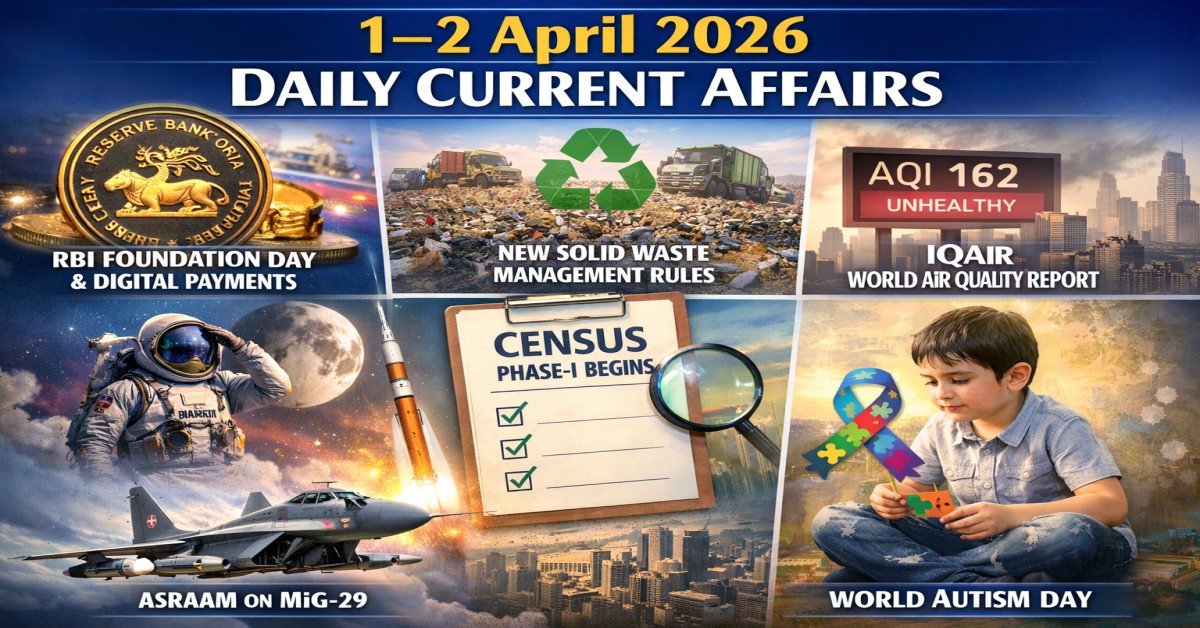
RBI Completes 91 Years — Foundation Day, New Digital Payment Rules & Payments Vision 2028 Explained
The Reserve Bank of India (RBI) marked its 91st Foundation Day on 1 April 2026, having been established on 1 April 1935 under the Reserve Bank of India Act, 1934. Founded on the recommendations of the Hilton Young Commission (1926), the central bank commenced operations with its headquarters in Kolkata before shifting permanently to Mumbai in 1937. The RBI was nationalised on 1 January 1949, transitioning from a privately-owned to a government-owned institution. As India’s monetary authority, regulator of the banking sector, manager of foreign exchange reserves, and issuer of currency, the RBI’s foundation date — coinciding with the start of India’s fiscal year — carries particular symbolic weight in Indian economic history.
Timeline to Remember: RBI Act — 1934 · Established — 1 April 1935 · Headquarters: Kolkata (1935) → Mumbai (1937) · Hilton Young Commission — 1926 · Nationalisation — 1 January 1949 · First Governor: Sir Osborne Smith · First Indian Governor: C.D. Deshmukh (1943) · Current Governor: Sanjay Malhotra.
New Digital Payment Rules Effective 1 April 2026
Alongside the Foundation Day, significant new regulatory changes in India’s digital payments ecosystem came into force from 1 April 2026. The RBI mandated Two-Factor Authentication (2FA) as a compulsory requirement for all digital payment transactions — including those conducted via UPI, NEFT, RTGS, IMPS, and card-based payments — closing security gaps that had existed in certain transaction categories. This follows a broader RBI drive to reduce payment fraud, which had risen alongside India’s explosive growth in digital transactions. Separately, the Income Tax Act, 2025 (replacing the 1961 Act) came into force from 1 April 2026, introducing a simplified, consolidated tax code after decades of incremental amendments.
State Bank of India (SBI) reported over 500 outage complaints on its UPI systems on 1 April, attributed to scheduled maintenance coinciding with high transaction volumes from the new financial year opening — a reminder of the criticality of digital payment infrastructure resilience.
RBI Payments Vision 2028 — What’s New
The RBI separately released its Payments Vision 2028 document — a four-year roadmap for India’s payments ecosystem covering the period through 2028. The centrepiece innovation is the Payments Switching Service (PaSS) — a new mechanism that enables seamless portability of payment mandates (like standing instructions, recurring payments, and auto-debits) when customers change their primary bank account. This addresses a longstanding friction in India’s digital banking ecosystem where switching banks required manual re-registration of all payment mandates. Other key proposals include the introduction of e-cheques as a fully digital equivalent of paper cheques, an expanded “switch on/off” facility that lets users enable or disable specific digital payment channels (UPI, NEFT, card) to reduce fraud risk, enhanced TReDS (Trade Receivables Discounting System) interoperability for MSME finance, and 15 specific initiatives focused on fraud prevention and rural payment outreach.
UPSC GS-III / RBI Grade B Angle: Key areas tested — Functions of RBI (monetary authority, banker to government, lender of last resort, forex manager), history of RBI, Hilton Young Commission, RBI Governors, digital payments ecosystem (UPI, NEFT, RTGS, IMPS, e-RUPI), Payment and Settlement Systems Act 2007, PCI DSS, two-factor authentication, cybersecurity in fintech. Also note: The repo rate at 5.25% reflects RBI’s calibrated easing stance following a US-India trade deal that reduced tariff pressures.
Solid Waste Management Rules 2026 — India Mandates 4-Stream Segregation, EPR Framework & Digital Waste Tracking
The Union Ministry of Environment, Forest and Climate Change (MoEFCC) notified the Solid Waste Management Rules, 2026, effective 1 April 2026, replacing the decade-old Solid Waste Management Rules, 2016. The new rules are framed under the Environment (Protection) Act, 1986 and represent India’s most comprehensive overhaul of solid waste governance — incorporating circular economy principles, digital monitoring, and the internationally recognised Extended Producer Responsibility (EPR) framework alongside the Polluter Pays Principle (PPP).
Four-Stream Segregation at Source — The Core Change
The most operationally significant change is the mandatory four-stream waste segregation at source, upgrading from the earlier two-stream (wet/dry) model. The four streams are: (1) Wet waste — organic/biodegradable waste that must be locally composted or processed through biogas plants; (2) Dry waste — recyclables (paper, plastic, metal, glass) that must be channelled to Material Recovery Facilities (MRFs); (3) Sanitary waste — used diapers, sanitary napkins, bandages, etc. requiring authorised, segregated disposal; and (4) Special care/hazardous household waste — batteries, e-waste, medicine strips, chemicals requiring dedicated authorised treatment. This granularity dramatically improves recyclability rates and reduces landfill burden, which currently handles over 80% of India’s municipal solid waste.
The rules also introduce Extended Bulk Waste Generator Responsibility (EBWGR) — making large waste generators like hotels, malls, hospitals, and apartment complexes legally responsible for on-site processing of their own waste, reducing the burden on municipal systems. A centralised digital portal operated by the Central Pollution Control Board (CPCB) will track the entire waste lifecycle — from generation registration to processing audits — creating a real-time national waste data dashboard for policy use.
| Waste Stream | Category | Mandated Disposal Method |
|---|---|---|
| 🟢 Wet Waste | Organic / Biodegradable | Local composting / Biogas plants |
| 🔵 Dry Waste | Recyclables (paper, plastic, metal) | Material Recovery Facilities (MRFs) |
| 🟡 Sanitary Waste | Diapers, napkins, bandages | Authorised segregated disposal |
| 🔴 Special Care Waste | Batteries, medicines, e-waste | Dedicated authorised treatment |
UPSC GS-III / GS-II Mains Angle: Key concepts — Extended Producer Responsibility (EPR), Polluter Pays Principle (PPP), Environment (Protection) Act 1986, Circular Economy, Material Recovery Facility (MRF), Central Pollution Control Board (CPCB), National Green Tribunal (NGT), EBWGR, Swachh Bharat Mission 2.0, landfill crisis in Indian cities, Solid Waste Management Rules 2016 (replaced). Common Mains question: “India’s solid waste management remains mired in structural gaps. Critically examine with reference to the Solid Waste Management Rules, 2026.”
Census 2027 Phase-I Commences 1 April — House Listing Begins, Self-Enumeration Portal Live in 16 Languages
India’s long-awaited digital Census 2027 officially commenced its Phase-I (House Listing and Housing Census) on 1 April 2026, with field operations running from 16 April to 15 May 2026 in notified States and Union Territories. The self-enumeration portal — accessible in 16 Indian languages — went live on 1 April, allowing households to begin recording their own data for the first time in Indian Census history. This marks India’s transition from a paper-based, enumerator-dependent process to a fully digital enumeration framework — the first such exercise at this scale globally.
What Phase-I Records — Housing, Assets & Infrastructure
Phase-I is not about population counts. It captures housing conditions, household amenities, and physical assets through a 33-question questionnaire covering: type of dwelling structure, number of rooms, roof/wall/floor material, drinking water source, sanitation facility, cooking fuel type, lighting source, internet access, smartphone ownership, television, bicycle/vehicle ownership, and banking access. Crucially, for the first time, the questionnaire includes a category for “live-in couples” — such relationships treated as a “stable union” will be recorded as married couples for census purposes, reflecting evolving social realities in India.
The Census is being conducted by the Office of the Registrar General and Census Commissioner of India (ORGI) under the Ministry of Home Affairs (MHA). Notable ambassador for the digital Census is Odisha-based sand artist Sudarshan Patnaik. The upcoming Census will also document India’s changed administrative geography: 36 States/UTs (up from 35 in 2011, due to J&K’s bifurcation into J&K and Ladakh in 2019) and 784 districts (up from 640 in 2011), alongside rapid urban growth with statutory towns rising from 4,041 to 5,128.
UPSC GS-II / GS-I Mains Angle: Census 2027 as policy input — planning, welfare targeting, delimitation, women’s reservation (106th Constitutional Amendment Act, 2023), OBC data since 1931, NPR (National Population Register) under Citizenship Act 1955, Article 81 (Lok Sabha composition), Article 82 (delimitation), first synchronous census 1881 under W.C. Plowden, Census Act 1948. Note: Caste data (OBC enumeration) in the Census will feed directly into reservation policy debates — a recurring Mains theme.
NASA’s Artemis II Launches 1 April 2026 — Humans Return to the Moon’s Neighbourhood After 54 Years
In a landmark moment for human space exploration, NASA’s Artemis II mission launched on 1 April 2026 — sending a four-person crew on a crewed flyby of the Moon for the first time since the Apollo 17 mission in December 1972, a gap of 54 years. Artemis II does not land on the Moon; it is a crewed free-return trajectory that takes the crew around the Moon and back, testing all life-support and navigation systems that will be used in the subsequent Artemis III mission — which aims to land astronauts, including the first woman and first person of colour, on the lunar surface. The mission uses the Space Launch System (SLS) rocket and the Orion spacecraft.
The Artemis Programme — Context for Exams
The Artemis Programme is NASA’s flagship lunar exploration initiative, named after the twin sister of Apollo in Greek mythology. It aims to establish a sustained human presence on and around the Moon as a stepping stone for eventual crewed missions to Mars. The programme involves international partners including ESA (European Space Agency), JAXA (Japan Aerospace Exploration Agency), CSA (Canadian Space Agency), and India’s ISRO, which signed the Artemis Accords in June 2023. Artemis I (November 2022) was an uncrewed test flight that successfully demonstrated the SLS-Orion combination. Artemis II (1 April 2026) is the crewed orbital Moon flyby. Artemis III (planned 2027) will be the first crewed lunar landing since Apollo 17.
The mission also carries broader geopolitical significance: it represents the US asserting primacy in the renewed global space race, with China’s Chang’e programme aiming for its own crewed lunar landing by 2030. India’s Chandrayaan-4 mission (aimed at lunar sample return) is also in development, making the Artemis II launch a key inflection point in multi-nation lunar competition.
UPSC GS-III / Prelims Angle: Artemis Programme structure (I → II → III), Space Launch System (SLS) vs Falcon Heavy vs ISRO LVM3, Orion spacecraft, Lunar Gateway (planned space station in Moon orbit), Artemis Accords (India signed June 2023), Apollo 17 (last Moon landing, 1972), Apollo programme (1961–1972), ISRO’s Chandrayaan and Gaganyaan missions, Commercial Crew Programme, Starship development. Classic question: “Distinguish between Artemis I, II and III missions of NASA.”
IQAir World Air Quality Report 2025: Loni Is World’s Most Polluted City — India 6th Most Polluted Country
The IQAir World Air Quality Report 2025 — published by the Swiss air quality technology company IQAir — released its latest global ranking on 2 April 2026, delivering a stark assessment of India’s air pollution crisis. Loni, Uttar Pradesh, was ranked as the world’s most polluted city, recording an annual average PM2.5 concentration of 112.5 µg/m³ — a figure that is 22.5 times the World Health Organisation (WHO) guideline of 5 µg/m³. Delhi ranked as the 4th most polluted city globally. At the country level, India ranked 6th most polluted nationally, with Pakistan topping the list as the world’s most polluted country, followed by Bangladesh, Tajikistan, Chad, and Congo.
The Numbers — Cities, Countries, and India’s Scale
The report analysed air quality data from 9,446 cities across 143 countries — the largest dataset in the report’s history. Its most damning India-specific finding: all 25 of the world’s most polluted cities are located in India, Pakistan, and China, with five of the top 10 in India alone — Loni, Byrnihat (Assam-Meghalaya border), Delhi, Ghaziabad (UP), and Ula (UP). Only 14% of global cities met the WHO’s PM2.5 annual guideline of 5 µg/m³. The primary pollution sources identified for India are: vehicle emissions from ageing fleets, industrial discharge without adequate filtration, crop residue burning (stubble burning in Punjab, Haryana), construction dust from urbanisation, and climate-driven wildfire smoke — a growing factor as India’s heatwaves intensify.
The report is particularly significant for UPSC given its intersection with multiple GS papers: GS-I (geography of pollution hotspots), GS-II (government policy response — NCAP, Graded Response Action Plan), and GS-III (environment, climate). India’s National Clean Air Programme (NCAP), launched in 2019 with a target of 40% reduction in particulate matter by 2026, has shown progress in some cities but clearly failed to address the fundamental problem of pollution sources in the Indo-Gangetic Plain.
UPSC GS-III / Prelims Angle: PM2.5 vs PM10 (size: 2.5 and 10 micrometres), AQI categories (Good/Satisfactory/Moderate/Poor/Very Poor/Severe), National Clean Air Programme (NCAP 2019), Graded Response Action Plan (GRAP — Supreme Court mandated for Delhi), CPCB (Central Pollution Control Board), SAFAR system (System of Air Quality and Weather Forecasting), Stubble Burning (Punjab & Haryana) and alternatives, WHO Global Ambient Air Quality Guidelines (2021 — updated 5 µg/m³), IQAir (Swiss company, independent, PM2.5 data-based). Classic trap: IQAir uses PM2.5, not AQI, as its primary metric.
IAF to Arm MiG-29UPG with ASRAAM Missile — BDL-MBDA Partnership Deepens India’s Air Combat Upgrade
The Indian Air Force (IAF) announced plans to integrate the Advanced Short Range Air-to-Air Missile (ASRAAM) on its fleet of MiG-29UPG fighter jets — replacing the ageing Soviet-era R-73 missile that had been the IAF’s primary within-visual-range (WVR) air combat weapon for nearly four decades. The decision deepens India’s shift from Russian to Western and indigenous missile systems, and represents a significant upgrade to the IAF’s close-combat dogfighting capability at a time of heightened regional security concerns.
ASRAAM — Technical and Strategic Details
ASRAAM, developed by MBDA (a European missile consortium with British, French, German, Italian and Spanish ownership), is a fourth-generation, heat-seeking, fire-and-forget short-range air-to-air missile with a range exceeding 25 km, speed above Mach 3, length of 2.9 metres, weight of 88 kg, and carries a high-explosive blast/fragmentation warhead. Its imaging infrared seeker gives it superior off-boresight acquisition capability — it can lock on to targets at angles significantly off the aircraft’s nose, providing a decisive tactical advantage in within-visual-range combat. A 2021 agreement between MBDA and Bharat Dynamics Limited (BDL) enables local assembly and testing of ASRAAM at BDL’s facility in Hyderabad, aligning with Atmanirbhar Bharat defence goals. The missile is already integrated on India’s HAL Tejas and SEPECAT Jaguar fighters, making MiG-29 integration the third platform.
India operates 55 MiG-29s (including 8 trainer variants), originally inducted in 1987 after procurement from the Soviet Union. The UPG (Upgrade) programme — a $900 million deal signed in 2009 — added the Zhuk-ME radar, glass cockpit, and advanced avionics, extending the fleet’s operational life. The MiG-29 fleet is expected to retire around 2033–2037, with the HAL Tejas Mk2 as its planned replacement. The ASRAAM integration ensures the fleet remains combat-relevant through its remaining service life.
UPSC GS-III / CDS / NDA Angle: Key concepts — BDL (Bharat Dynamics Limited — under Ministry of Defence, Hyderabad), MBDA (European missile consortium), Atmanirbhar Bharat in Defence, Defence Acquisition Procedure (DAP 2020), HAL Tejas (LCA — Light Combat Aircraft), GeM for defence procurement (Indian Army’s first capital procurement contract via GeM — April 2026), MiG-29 history, fire-and-forget missile technology, WVR (Within Visual Range) vs BVR (Beyond Visual Range) air combat.
Round-Up: World Autism Day, IONS Chairmanship, RBI NOP Cap, Utkal Divas, CMS COP 15, Shachi NGOPV, Hockey India Awards
World Autism Awareness Day — 2 April
World Autism Awareness Day (WAAD) is observed annually on 2 April. Established by the United Nations General Assembly in 2007 (Resolution 62/139) and first observed in 2008, the day promotes global awareness of autism spectrum disorder (ASD) — a neurodevelopmental condition characterised by differences in social communication, behaviour, and sensory processing. The 2026 theme emphasised moving from “awareness” to “acceptance and inclusion” — reflecting the neurodiversity movement’s emphasis on accommodating autistic individuals rather than treating neurodivergence as a deficit. India’s Rights of Persons with Disabilities Act, 2016 (RPWD Act) includes autism among 21 recognised disabilities, mandating 4% reservation in government jobs and equal rights in education.
India Assumes IONS Chairmanship 2026–2028 After 16 Years
At the IMEX TTX 2026 hosted in Kochi, India formally assumed the Chairmanship of the Indian Ocean Naval Symposium (IONS) for 2026–2028 — a position it last held in 2010. IONS, established in 2008 on India’s initiative, now comprises 26 Indian Ocean littoral navies with 8 observer nations. The chairmanship positions India as the dominant maritime security leader in the Indian Ocean Region (IOR) — particularly significant amid Houthi attacks on Red Sea shipping, the Iran conflict‘s impact on the Strait of Hormuz, and China’s growing naval footprint in the IOR through its String of Pearls strategy.
RBI Caps Banks’ Net Open Position at $100 Million — Rupee Hits ₹94.8/Dollar
The Reserve Bank of India imposed a $100 million cap on banks’ Net Open Position (NOP) in foreign currency per day, with compliance required by 10 April 2026. The NOP measures a bank’s net exposure to exchange rate risk — the difference between its foreign currency assets and liabilities. The cap is far tighter than the earlier limit (25% of bank capital), and forces banks to unwind an estimated $11–15 billion in currency positions. The trigger: the Indian Rupee fell to a record low of ₹94.8 per dollar, a decline of approximately 4%, driven by Iran-West Asia conflict-induced oil price spikes, heavy foreign investor outflows, and dollar demand for energy imports. India’s forex reserves declined by over $30 billion to $698.34 billion. The RBI chose regulatory tightening over direct dollar sales to preserve reserves.
Other Key Events — 1–2 April 2026
Utkal Divas (Odisha Foundation Day) is observed on 1 April every year. Odisha was carved out as a separate province on 1 April 1936, becoming the first state in India formed on a purely linguistic basis — recognising the Odia-speaking population. The state was renamed from “Orissa” to “Odisha” (official Odia spelling) in 2011.
CMS COP 15 (Convention on Migratory Species, 15th Conference of Parties) concluded in Campo Grande, Brazil, with the theme “Connecting Nature to Sustainable Life.” Key outcomes include the adoption of a Global Action Plan for the Steppe Eagle (2026–2035) — listed as Endangered on the IUCN Red List — identification of 40 new species requiring conservation measures, mapping of six major ocean flyways for the first time, an Amazonian Catfish Action Plan, and updated guidelines on underwater noise reduction to protect cetaceans. CMS (also called the Bonn Convention) was signed in Bonn, Germany in 1979 under UNEP.
INS Shachi (Yard 1280) — the lead ship of the Next Generation Offshore Patrol Vessel (NGOPV) project — was launched at Goa Shipyard Limited (GSL). An 11-ship project, with GSL and GRSE (Garden Reach Shipbuilders, Kolkata) building vessels concurrently. The name “Shachi” derives from Indian mythology, meaning one who renders assistance.
At the Hockey India Annual Awards 2025, Hardik Singh won the Balbir Singh Sr. Award for Player of the Year (Men) for the third time, and Navneet Kaur won the women’s equivalent. Zafar Iqbal, a member of India’s Moscow 1980 Olympic gold-winning hockey team, received the Major Dhyan Chand Lifetime Achievement Award. In Formula One, Kimi Antonelli (Mercedes, 19 years old) won the Japanese Grand Prix at Suzuka — his second consecutive F1 victory — becoming the youngest driver to lead the F1 World Championship standings.
Test Yourself: 10 MCQs on 1–2 April 2026 Current Affairs
1–2 April 2026 — Quick Quiz
10 exam-style MCQs on RBI, Solid Waste Rules, Census Phase-I, Artemis II, IQAir, ASRAAM, IONS, and more. Test your exam readiness!