

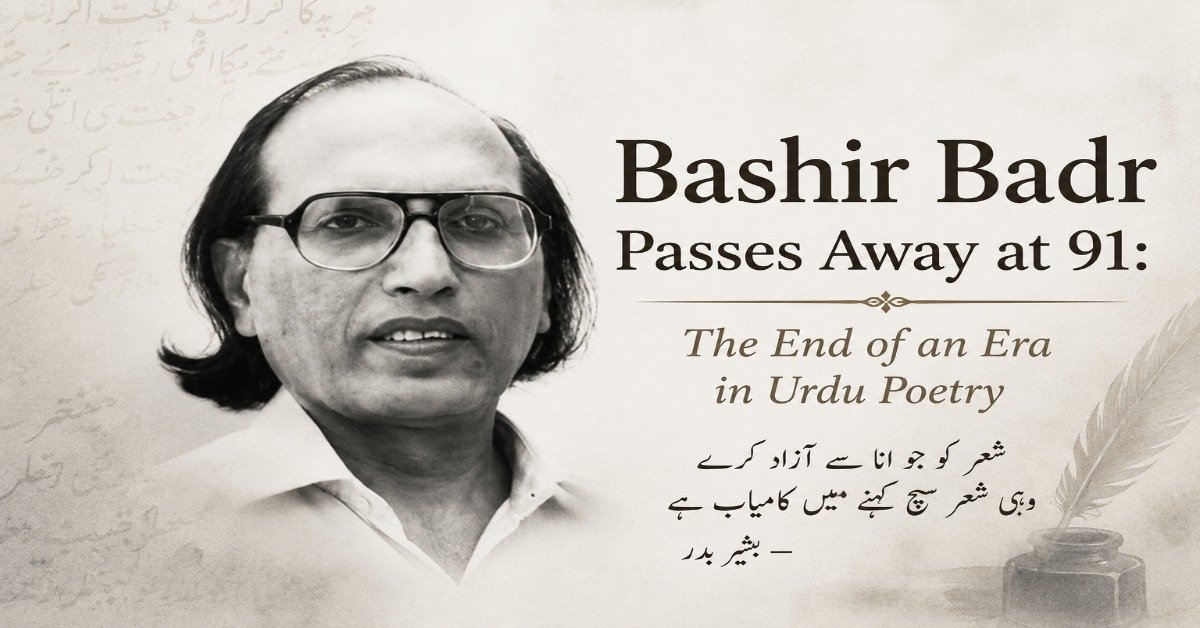
The world of Urdu literature has lost one of its brightest stars. Legendary Urdu poet and Padma Shri awardee Bashir Badr passed away at the age of 91 in Bhopal after a prolonged illness. His death marks the end of an extraordinary literary journey that touched millions of hearts across generations. Known for his soulful ghazals, emotional couplets, and simple yet profound expressions, Bashir Badr was not just a poet — he was an emotion for poetry lovers.
According to family sources, the celebrated poet breathed his last at his residence in Bhopal on May 28, 2026. Literary figures, politicians, artists, and admirers from around the world mourned his demise and paid heartfelt tributes to the legendary shayar.
A Poet Who Made Urdu Poetry Reach Every Home
Bashir Badr was among the rare poets whose words connected equally with scholars and ordinary readers. His poetry carried simplicity, elegance, pain, love, separation, hope, and humanity in a way that made people instantly relate to it.
Born on February 15, 1935, in Ayodhya, Uttar Pradesh, Bashir Badr showed an interest in poetry from a very young age. He later pursued higher education at Aligarh Muslim University, where he completed his PhD in Urdu literature. He also served as a professor and later headed the Urdu Department at Meerut College for many years.
What made Bashir Badr unique was his ability to modernize the traditional Urdu ghazal without losing its classical beauty. He brought everyday emotions into poetry using language that was graceful yet easy to understand. His verses became part of conversations, songs, mushairas, and social media captions long before the digital age made poetry viral.
The Pain Behind the Poetry
Bashir Badr’s life was not free from tragedy. During the 1987 Meerut communal riots, his house was set on fire, and many of his unpublished manuscripts were destroyed forever. This devastating incident deeply affected him and forced him to move to Bhopal. Yet, despite immense personal loss, his poetry never turned bitter. Instead, it continued to speak about humanity, peace, relationships, and emotional resilience.
His writings reflected the wounds of society while still preserving tenderness and hope. This balance between pain and beauty became the hallmark of his literary identity.
Recognition and Awards
Bashir Badr received numerous honors throughout his career for his immense contribution to Urdu literature. The Government of India awarded him the prestigious Padma Shri in 1999. He also received the Sahitya Akademi Award and several literary recognitions from institutions in India and abroad.
His ghazals were recited in mushairas across the world and admired by audiences of every age group. Even people unfamiliar with Urdu literature often knew his famous couplets by heart.
Famous Quotes and Shayari by Bashir Badr
Some poets write poetry. Bashir Badr created timeless emotions through words. Here are some of his most memorable and beloved couplets:
“Log toot jaate hain ek ghar banane mein,
Tum taras nahi khaate bastiyan jalane mein.”
This powerful couplet became a symbol of pain caused by violence and destruction.
“Kuch to majbooriyan rahi hongi,
Yun hi koi bewafa nahi hota.”
One of the most quoted lines in Urdu poetry, expressing emotional understanding and human vulnerability.
“Ujale apni yaadon ke hamare saath rehne do,
Na jaane kis gali mein zindagi ki shaam ho jaaye.”
A deeply emotional reflection on memories, time, and life’s uncertainty.
“Dushmani jam kar karo lekin ye gunjaish rahe,
Jab kabhi hum dost ho jaayein to sharminda na hon.”
This iconic couplet became internationally famous during the 1972 Shimla Agreement between India and Pakistan.
“Mohabbat ek khushboo hai hamesha saath chalti hai,
Koi insaan tanhaai mein bhi tanha nahi rehta.”
A beautiful expression of love and emotional companionship.
“Patthar mujhe kehta hai mera chahne wala,
Main mom hoon usne mujhe chhoo kar nahi dekha.”
This line perfectly reflects Bashir Badr’s emotional depth and poetic sensitivity.
Tributes Pour In
Following the news of his death, many prominent personalities expressed grief. Renowned lyricist Javed Akhtar wrote that “Urdu has become a little poorer today,” while legendary ghazal singer Ghulam Ali described Bashir Badr as a talent “born once in an era.”
Social media platforms were flooded with people sharing his couplets, memories, and videos from old mushairas. Many readers described him as the poet who gave words to their emotions.
A Legacy That Will Never Fade
Bashir Badr may no longer be physically present, but his poetry will continue to live in the hearts of millions. His verses captured the beauty of love, the pain of separation, the fragility of relationships, and the hope hidden within suffering.
In a world constantly changing with time, Bashir Badr’s poetry remains timeless because it speaks directly to human emotions. His words will continue to echo in literary gatherings, classrooms, books, songs, and hearts for generations to come.
With his passing, Urdu literature has lost one of its most beloved voices — but legends like Bashir Badr never truly die. They live forever through their words.



)
