India Hosts the First BRICS Youth Coordination Meeting of 2026 — Launching the Year’s Youth Engagement Agenda
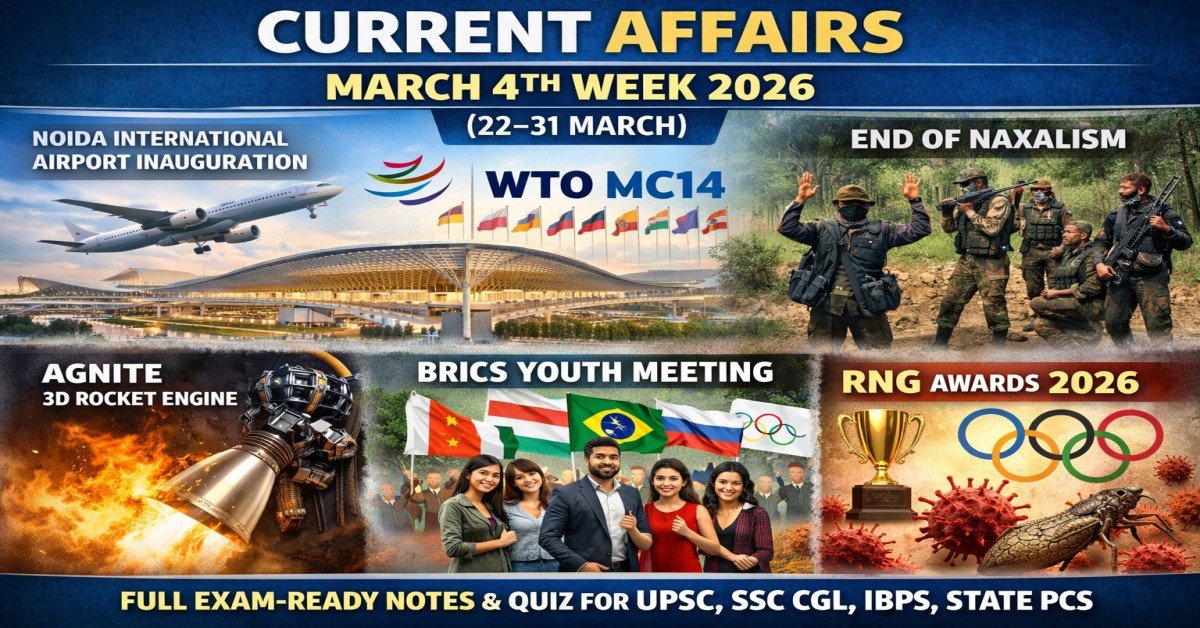
In a significant step forward for multilateral youth diplomacy, the Department of Youth Affairs, Ministry of Youth Affairs and Sports, Government of India organised the inaugural BRICS Youth Coordination Meeting on 25 March 2026. The meeting was conducted in a virtual (online) format and ran from 4:30 PM to 6:00 PM (IST) — a 90-minute session that brought together official youth representatives from every BRICS member country under one digital roof.
This was not merely a procedural meeting. As the first formal youth-focused gathering under India’s BRICS Chairship, it served as the official launchpad for the entire BRICS Youth Track 2026 — setting both the calendar and the content agenda for youth cooperation across the grouping for the remainder of the year.
The event was anchored by the Ministry of Youth Affairs and Sports, which serves as India’s nodal ministry for BRICS people-to-people engagement in the youth domain. Representatives from all eleven BRICS member nations participated — signalling broad multilateral buy-in from the very first engagement of the Chairship year.
India’s Fourth BRICS Chairship: Context, Logo, and the “People-Centric” Vision
How India Assumed the Chair
India assumed the BRICS Chairship on 1 January 2026, succeeding Brazil, which presided over the grouping in 2025 and hosted the 17th BRICS Summit in Rio de Janeiro. This is India’s fourth time holding the BRICS Chairship — having previously led the grouping in 2012 (New Delhi), 2016 (Goa), and 2021 (New Delhi — virtual). With each term, India has progressively deepened the scope and complexity of BRICS cooperation tracks.
The Government of India launched its official BRICS logo and website on 13 January 2026, formally signalling the commencement of Chairship preparations. The logo features a lotus at its centre — representing purity, resilience, and national identity — with petals radiating in the distinct colours of all BRICS member countries, symbolising unity in diversity. A stylised Namaste gesture within the design captures India’s spirit of warmth and inclusive dialogue.
Prime Minister Narendra Modi articulated India’s BRICS vision at the 2025 Rio Summit: “Our goal will be to redefine BRICS as Building Resilience and Innovation for Cooperation and Sustainability… we will advance this forum with a people-centric approach and the spirit of ‘Humanity First.'” This philosophy directly shaped the content and format of the Youth Coordination Meeting.
Expanded BRICS: Who Was in the Room?
An important contextual fact for exam aspirants: BRICS in 2026 is a significantly larger and more diverse grouping than the original five-nation bloc. The current membership stands at eleven full members: Brazil, Russia, India, China, South Africa (the original five), plus Egypt, Ethiopia, Iran, Saudi Arabia, UAE (admitted in 2024) and Indonesia (admitted 2025). Additionally, ten Partner Countries joined in 2025: Belarus, Bolivia, Cuba, Kazakhstan, Malaysia, Nigeria, Thailand, Uganda, Uzbekistan, and Vietnam. Representatives from all these member states participated in the Youth Coordination Meeting, making it a genuinely large-scale multilateral exercise.
“Building for Resilience, Innovation, Cooperation and Sustainability” — Decoding India’s BRICS Theme
What the Theme Means
The overarching theme of India’s 2026 BRICS Chairship is “Building for Resilience, Innovation, Cooperation and Sustainability.” The Youth Coordination Meeting formally initiated all its engagements under this banner. Each word in the theme is deliberate:
Resilience refers to the collective capacity of BRICS nations — and their youth — to withstand economic shocks, climate disruptions, and geopolitical instability. Innovation reflects India’s positioning of technology, startups, and digital public infrastructure as engines of youth-led development. Cooperation underscores the multilateral, consensus-driven approach that India has championed — particularly for the Global South. Sustainability integrates environmental responsibility, green energy transitions, and long-term resource management into every pillar of youth engagement.
Exam angle (UPSC/SSC): Note that the full theme spells out B-R-I-C-S itself — Building · Resilience · Innovation · Cooperation · Sustainability. This is a commonly tested mnemonic-style fact in objective-type competitive exams.
Why a Youth Coordination Meeting Specifically?
A Coordination Meeting is a pre-summit, structural planning session — not a policy-finalising event. Its purpose is to align participating nations on priorities, timelines, and working group structures before substantive thematic meetings begin. By holding this meeting as early as March 2026, India ensured that member countries had sufficient lead time to prepare delegations, coordinate internally, and engage meaningfully in the months-long Youth Track calendar ahead. This reflects India’s track record of administrative efficiency in multilateral forum management — a skill India showcased during its G20 Presidency in 2023.
Seven Pillars of India’s BRICS Youth Track: From Working Groups to the Youth Ministerial
The Complete BRICS Youth Track Structure
At the Coordination Meeting, India formally presented the BRICS Youth Track 2026 — a structured, multi-stage engagement framework that will unfold over the year. The Track is designed as a bottom-up pyramid: starting with technical working-level engagements, scaling up to thematic forums, and culminating in a high-level Youth Ministerial Meeting. Here is the complete structure:
The BRICS Youth Summit has been held annually since 2015. India’s hosting of the 2026 Summit under its own Chairship represents a significant opportunity to shape the summit’s agenda, location, and outcomes — potentially in a high-profile Indian city to boost international visibility.
Nine Priority Pillars: The Content Architecture of BRICS Youth Cooperation in 2026
The Coordination Meeting did not merely set procedural timelines — it established the thematic content architecture for the entire year. Discussions identified nine priority pillars for collaboration across member countries. Each pillar reflects both India’s domestic youth policy priorities and the shared developmental challenges of the Global South.
1. Education and Skills
As the fastest-growing large economy with the world’s largest youth population, India’s emphasis on education and vocational skilling resonates deeply across BRICS. This pillar envisions mutual recognition of qualifications, exchange programmes, joint vocational training standards, and digital learning initiatives — particularly important for emerging BRICS members like Ethiopia and Indonesia where youth employability is a critical challenge.
2. Youth Entrepreneurship
BRICS nations collectively represent a significant share of global startup activity. India, with its thriving startup ecosystem and government programmes like Startup India, is well-positioned to champion this pillar. The focus is on cross-border mentorship, access to venture capital networks, business incubator partnerships, and reducing regulatory barriers for young entrepreneurs within the BRICS bloc. The New Development Bank (NDB) has been identified as a potential financing channel for youth entrepreneurship initiatives.
3. Science and Innovation
This pillar addresses youth-led research collaboration, technology transfer, AI governance for youth, and joint innovation challenges. It aligns with India’s broader Science Technology Innovation policy and the BRICS Science & Technology Commission. Member countries face shared challenges in transitioning youth into STEM careers, and this pillar creates platforms for joint hackathons, research fellowships, and cross-institutional academic partnerships.
4. Social Participation and Inclusion
Reflecting India’s constitutional commitment to inclusive governance, this pillar ensures that youth from marginalised communities, indigenous groups, women, and persons with disabilities are meaningfully represented in BRICS youth forums. It also covers digital inclusion — ensuring that youth in rural and remote regions of BRICS nations can participate in multilateral processes through digital platforms.
5. Health and Sports
Post-pandemic, youth mental health has emerged as a critical concern across all BRICS nations. This pillar covers youth mental health frameworks, preventive health education, access to affordable healthcare, and the use of sports as a diplomacy and social cohesion tool. India’s “Fit India” movement and its success in competitive sports at international events gives it credibility in championing this dual agenda.
6. Environment and Sustainability
Climate action is a defining challenge for today’s youth generation globally. BRICS nations — which collectively account for a substantial share of global emissions but also harbour some of the world’s most climate-vulnerable populations — have a unique responsibility here. This pillar covers youth-led climate advocacy, green skills development, nature-based solution projects, and aligning youth engagement with each country’s Nationally Determined Contributions (NDCs) under the Paris Agreement.
7. Interfaith Dialogue
A particularly distinctive pillar in the 2026 framework, interfaith dialogue acknowledges the extraordinary religious, cultural, and civilisational diversity within the expanded BRICS membership — spanning Hindu, Islamic, Orthodox Christian, Buddhist, and other traditions. Youth-led interfaith dialogue is positioned as a tool for conflict prevention, countering extremism, and building lasting people-to-people ties among nations that may have strategic differences at the governmental level.
8. Youth Exchange
Cultural exchange — through youth delegations, student exchange programmes, cultural festivals, and internship opportunities — has historically been among the most durable forms of bilateral relationship-building. The 2026 pillar aims to institutionalise youth exchange within the BRICS framework, moving beyond one-off visits to structured, recurring exchange programmes with defined outcomes and alumni networks.
Why 9 pillars matter for exam: These are the official priority areas agreed upon at the Coordination Meeting. UPSC and State PCS questions often test the specific thematic areas of multilateral youth/people-to-people programmes. Remember: Education & Skills · Entrepreneurship · Science & Innovation · Social Inclusion · Health & Sports · Environment · Interfaith Dialogue · Youth Exchange = 8 distinct pillars under the BRICS Youth Track 2026.
Why This Meeting Is Strategically Important for India and the Global Youth Agenda
India’s Demographic Dividend — Leveraging Youth Power on the World Stage
India has the world’s largest youth population — approximately 600 million people under the age of 25. By anchoring the BRICS Youth Track under its Chairship, India is not only fulfilling a procedural obligation but actively projecting soft power through youth diplomacy. The Coordination Meeting sends a message to the international community that India views youth not as passive beneficiaries of development policy but as active agents of geopolitical and economic transformation.
BRICS as a Platform for Global South Youth
The expanded BRICS now represents a diverse cross-section of the Global South — from sub-Saharan Africa (Ethiopia, South Africa) to West Asia (Saudi Arabia, UAE, Iran) to Southeast Asia (Indonesia) and Latin America (Brazil). The Coordination Meeting’s emphasis on inclusion, interfaith dialogue, and youth exchange acknowledges that the BRICS Youth Track must be culturally sensitive and logistically equitable to serve this diverse membership. India’s experience managing cultural diversity domestically gives it a comparative advantage in facilitating such inclusive multilateral processes.
Continuity with India’s G20 Legacy
India’s 2023 G20 Presidency was widely praised for its inclusive, digitally enabled, people-to-people approach — including the first-ever G20 Youth Forum (Y20) held on Indian soil. The BRICS Youth Coordination Meeting of 2026 builds directly on this institutional learning. India is applying the same playbook: begin early, build structured engagement calendars, ensure grassroots participation, and culminate in a high-profile ministerial-level outcome. This continuity of approach signals India’s growing maturity as a convenor of multilateral youth processes.
UPSC Mains angle (GS-II): The BRICS Youth Coordination Meeting is a direct example of India’s use of multilateral forums for soft power projection, South-South cooperation, and people-centric diplomacy. It also tests the theme of India’s evolving role in global governance — moving from rule-follower to rule-shaper in multilateral institutions.
BRICS: Origins, Expansion, and India’s Historical Role
From BRIC to BRICS to BRICS+
The grouping began as BRIC — a conceptual framework coined by Goldman Sachs economist Jim O’Neill in 2001 to describe the four largest emerging economies: Brazil, Russia, India, and China. The first formal BRIC Summit was held in Yekaterinburg, Russia in 2009. South Africa was formally invited to join in 2010 and attended the 3rd BRICS Summit in Sanya, China in 2011, transforming the grouping into BRICS. A major expansion occurred in 2024 with Egypt, Ethiopia, Iran, Saudi Arabia, and UAE joining as full members, followed by Indonesia in 2025. Ten Partner Countries also joined in 2025, taking the total BRICS network to 21 countries.
The Three Pillars of BRICS Cooperation
BRICS cooperation is structured across three foundational pillars: (1) Political & Security Cooperation — covering UN reform, counter-terrorism, and multilateral governance reform; (2) Economic & Financial Partnership — trade, investment, the New Development Bank (NDB), and Contingent Reserve Arrangement (CRA); and (3) People-to-People Exchanges — which is the pillar under which the Youth Track, Cultural Forum, Academic Forum, Think Tank Council, Civil Forum, Business Council, and Women’s Business Alliance all operate. The BRICS Youth Coordination Meeting falls squarely under this third pillar.
New Development Bank (NDB): Headquartered in Shanghai, the NDB was established at the 6th BRICS Summit in Fortaleza, Brazil, in 2014. It provides development financing to BRICS and emerging economies. India’s former Finance Minister K.V. Kamath served as its first President. The NDB has been identified as a potential funding vehicle for BRICS youth entrepreneurship initiatives.
Test Yourself: 8 Questions on India’s First BRICS Youth Coordination Meeting 2026
BRICS Youth Track — Quick Quiz
8 exam-style questions covering all key facts from the BRICS Youth Coordination Meeting 2026. Test your retention before your next exam!