
01 · Noida International Airport (Jewar) Phase I Inaugurated by PM Modi — 28 March 2026
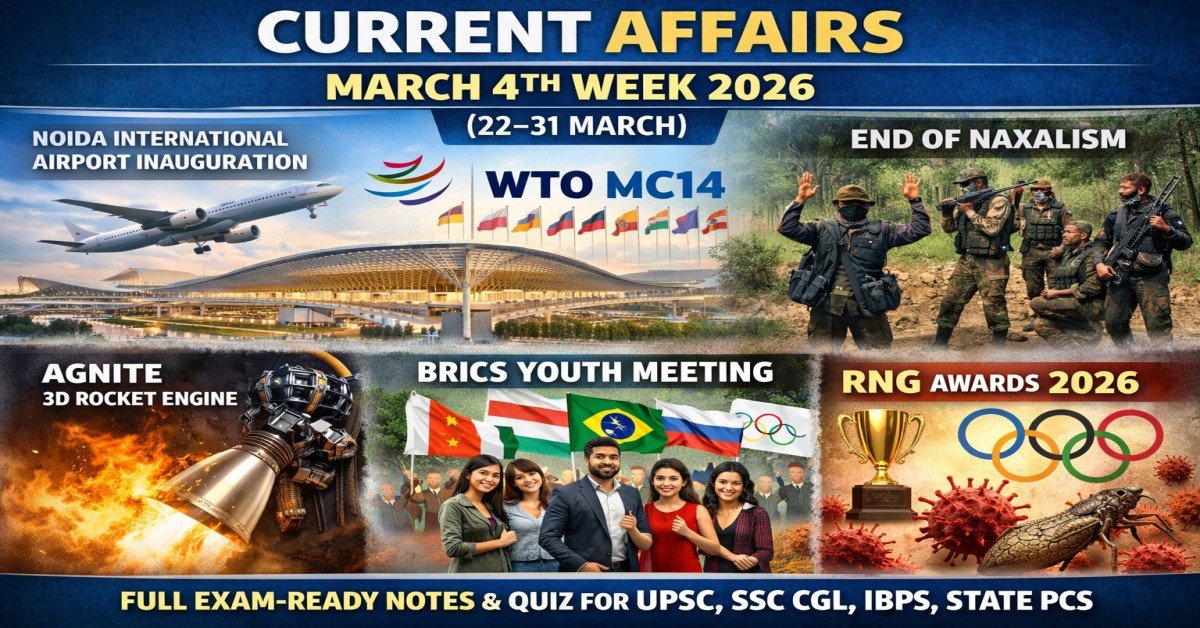
Prime Minister Narendra Modi inaugurated the Phase I of the Noida International Airport at Jewar, Gautam Buddha Nagar, Uttar Pradesh on 28 March 2026 — marking one of the largest aviation infrastructure milestones in north India. UP Chief Minister Yogi Adityanath and Governor Anandiben Patel were present at the ceremony. PM Modi described the occasion as a new chapter in the “Viksit UP, Viksit Bharat Abhiyan.”
Why it matters: The Jewar airport is Delhi-NCR’s second international airport, built to decongest the Indira Gandhi International (IGI) Airport, which handles one of India’s heaviest passenger loads. With Phase I alone capable of handling 1.2 crore (12 million) passengers annually, it dramatically expands NCR’s aviation capacity. It will serve as the primary gateway for Noida, Ghaziabad, Meerut, Mathura, Agra, Faridabad, and surrounding cities.
Key Infrastructure Details
Phase I was constructed at a cost of ₹11,282 crore (~$1.19 billion USD). The airport features a 3,900-metre runway capable of handling wide-body aircraft, a fully equipped passenger terminal, and a cargo hub designed to process over 2.5 lakh metric tonnes annually. PM Modi also laid the foundation stone for a 40-acre Maintenance, Repair and Overhaul (MRO) facility — which will reduce India’s reliance on overseas aircraft maintenance and generate thousands of skilled jobs.
The airport is being developed by Zurich Airport International AG. The long-term vision for the airport is ambitious: at full build-out across all phases, it is expected to handle up to 7 crore (70 million) passengers per year and have five runways — making it one of Asia’s largest aviation hubs by 2036–40. The total project cost across all phases is approximately ₹29,560 crore.
Significance for Uttar Pradesh
With this inauguration, Uttar Pradesh becomes the first state in India to have five international airports — a remarkable transformation for a state historically associated with infrastructure deficits. PM Modi stressed that the airport would directly benefit farmers, food processing industries, MSME exporters, and agricultural producers by opening direct global logistics routes from western UP. Initial operations will focus on domestic routes with IndiGo, Air India Express, and Akasa Air before international services commence.
Exam angle (SSC/UPSC/Banking): Key facts — Location: Jewar, Gautam Buddha Nagar, UP · Developer: Zurich Airport International AG · Phase I cost: ₹11,282 crore · Runway: 3,900 m · Phase I capacity: 1.2 crore passengers/year · Final capacity: 7 crore/year · Inaugurated by: PM Narendra Modi on 28 March 2026 · This makes UP the first state with 5 international airports.
02 · WTO 14th Ministerial Conference (MC14) in Yaoundé, Cameroon — 26–29 March 2026
The 14th Ministerial Conference (MC14) of the World Trade Organization (WTO) was held from 26 to 29 March 2026 at the Palais des Congrès in Yaoundé, Cameroon. This was only the second time a WTO Ministerial Conference was hosted in Africa. The conference was chaired by Luc Magloire Mbarga Atangana, Cameroon’s Trade Minister, and attended by trade ministers from over 160 member nations.
India’s Position at MC14
India was represented by Commerce Minister Piyush Goyal. India’s agenda at MC14 was firmly development-oriented, focusing on three key priorities: a permanent solution for Public Stockholding (PSH) for food security; protection of Special and Differential Treatment (SDT) for developing countries; and opposition to the e-commerce moratorium extension, citing concerns about digital sovereignty and revenue loss for developing nations. India positioned itself as a voice of the Global South, building coalitions with other developing countries including South Africa.
Key Outcomes and Failures of MC14
The conference produced mixed results. On the positive side, ministers agreed to continue negotiations on fisheries subsidies with a target to deliver final recommendations by MC15. The concept of an Integrated Forum on Climate Change and Trade (IFCCT) was moved forward. However, MC14 failed to reach agreement on several critical issues: the e-commerce customs duty moratorium — which has been extended every two years since 1998 — expired without renewal due to a clash between the US (seeking a permanent extension) and Brazil. The WTO Appellate Body, non-functional since 2019 due to US blocking of appointments, remained paralysed, with no consensus on reform.
Key context (UPSC GS-II/III): The WTO is the only global organisation dealing with rules of trade between nations. Established in 1995 under the Marrakesh Agreement, it is headquartered in Geneva, Switzerland. It currently has 164 member countries covering over 98% of global trade. The Ministerial Conference is its highest decision-making body, meeting at least every two years. In 30 years, WTO has produced only two major agreements — a sign of its increasing paralysis.
03 · India Declares End of Naxalite Insurgency — Five-Decade Conflict Reaches Its Close (March–31 March 2026)
In a landmark declaration for India’s internal security, Union Home Minister Amit Shah announced that India has effectively ended the Naxalite (Left Wing Extremism / LWE) insurgency, meeting the government’s self-imposed deadline of 31 March 2026. The announcement marked the near-total dismantling of one of India’s longest-running internal conflicts, which has claimed nearly 20,000 lives over five decades and affected millions of people in India’s tribal heartland.
The Scale of the Turnaround
At its peak around 2000, Naxal violence affected nearly 200 districts across multiple states — a region often called the “Red Corridor” stretching from Andhra Pradesh through Chhattisgarh, Jharkhand, Odisha, Bihar, and Maharashtra. By 2025, the affected area had shrunk to 38 districts. By March 2026, only 7 districts remained on the active LWE list. The government’s strategy combined intensified security operations with focused development intervention — bringing roads, schools, ration shops, Primary Health Centres, and connectivity to previously insurgency-affected areas, particularly in Bastar region of Chhattisgarh.
Legacy Thrust Territories Framework
To prevent resurgence, the Ministry of Home Affairs introduced the concept of Legacy Thrust Territories — formerly Naxal-affected districts identified for continued security presence and developmental intervention even after the insurgency’s decline. This framework ensures that the gains achieved are not reversed and that marginalised tribal communities receive sustained attention from the state.
Historical context: The Naxalite movement began in 1967 in Naxalbari village, Darjeeling district, West Bengal — giving it the name “Naxalism.” It drew ideological inspiration from Mao Zedong’s theories of agrarian revolution. Former PM Manmohan Singh had called Naxalism “the biggest internal security threat” to India. PM Modi’s government set the March 31, 2026 deadline to eradicate it, and Amit Shah made repeated pledges in Parliament to achieve this target.
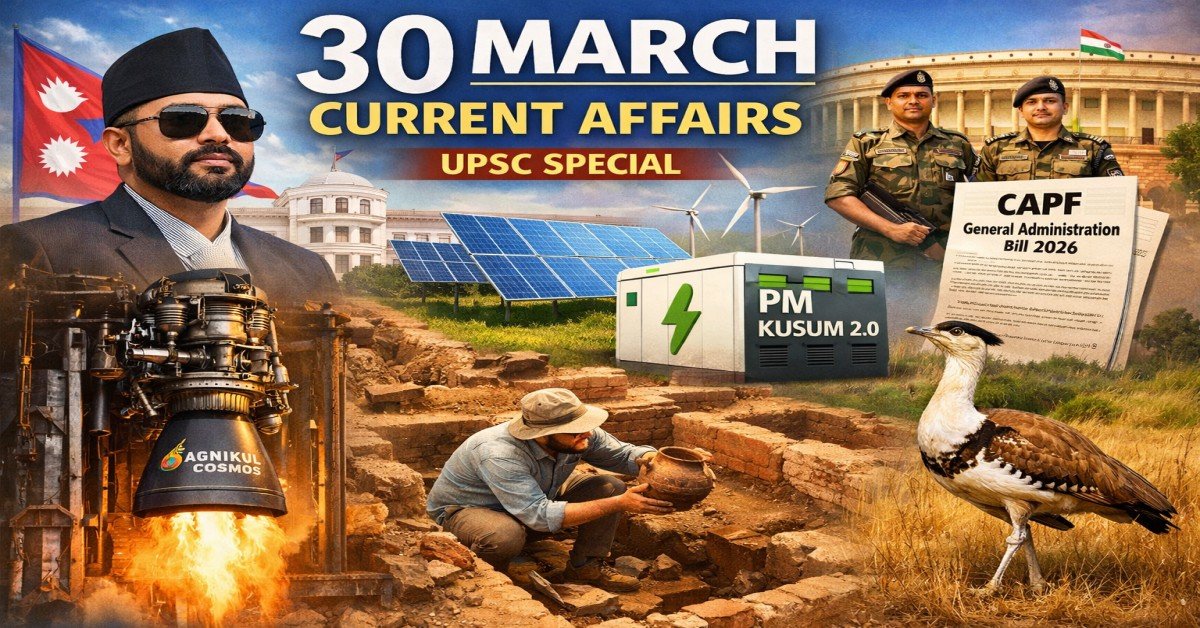
04 · Agnikul Cosmos Tests ‘Agnite’ — World’s Largest Single-Piece 3D-Printed Rocket Engine
Indian private space startup Agnikul Cosmos successfully tested ‘Agnite’ — the world’s largest single-piece 3D-printed rocket booster engine — marking a major milestone in India’s private space sector and in global additive manufacturing for aerospace. The achievement attracted widespread attention from the global space industry as a demonstration that complex rocket propulsion systems can be produced faster, cheaper, and with fewer assembly parts through 3D printing.
What Makes Agnite Significant
Traditional rocket engines are assembled from hundreds of individual components welded or bolted together — a process that is time-consuming, expensive, and prone to failure at junctions. Agnikul’s approach prints the entire engine as a single continuous piece, eliminating most assembly joints and dramatically reducing manufacturing time. Agnite uses semi-cryogenic propulsion technology — powered by liquid oxygen (LOX) and kerosene — a technology Agnikul first successfully demonstrated in its SARTED mission in 2024.
The engine is designed for Agnikul’s Agnibaan launch vehicle — a small rocket built for on-demand launching of satellites up to 100 kg into Low-Earth Orbit (LEO). Agnibaan is launched from Dhanush — India’s first private launchpad, built at the Satish Dhawan Space Centre, Sriharikota. This makes Agnikul one of the most technically advanced private launch companies not just in India but globally.
Exam angle (UPSC GS-III / SSC): Agnikul Cosmos is an IIT Madras-incubated startup. Key facts — Agnite = world’s largest single-piece 3D-printed rocket engine · Developer: Agnikul Cosmos (private company, NOT ISRO) · Propellant: LOX + Kerosene (semi-cryogenic) · Launch vehicle: Agnibaan · Payload: up to 100 kg to LEO · Launchpad: Dhanush, Satish Dhawan Space Centre, Sriharikota.
05 · India Hosts First BRICS Youth Coordination Meeting 2026 — 25 March
The Department of Youth Affairs, Ministry of Youth Affairs and Sports, Government of India organised the first BRICS Youth Coordination Meeting on 25 March 2026 in a virtual format (4:30–6:00 PM IST). As India holds the BRICS Chairship in 2026 — its fourth time after 2012, 2016, and 2021 — the meeting formally launched the BRICS Youth Track 2026 agenda under the theme “Building for Resilience, Innovation, Cooperation and Sustainability.”
BRICS Youth Track 2026 — 7 Key Initiatives
The meeting outlined seven major initiatives: Working Group Meetings, Thematic Engagements, Serve BRICS (cross-border volunteering), Youth Development Forum, Youth Council Meeting, BRICS Youth Summit (held annually since 2015), and the Youth Ministerial Meeting (highest-level engagement). Eight priority pillars were identified for collaboration: Education & Skills, Youth Entrepreneurship, Science & Innovation, Social Inclusion, Health & Sports, Environment & Sustainability, Interfaith Dialogue, and Youth Exchange.
BRICS in 2026 has 11 full members: Brazil, Russia, India, China, South Africa (original 5) + Egypt, Ethiopia, Iran, Saudi Arabia, UAE (2024) + Indonesia (2025). Ten Partner Countries also joined in 2025. The Youth Meeting represented all member nations.
06 · 20th Ramnath Goenka Excellence in Journalism Awards 2026 Presented
The 20th edition of the Ramnath Goenka Excellence in Journalism Awards was held in New Delhi in March 2026. Vice President C.P. Radhakrishnan served as chief guest and presented the awards to 25 journalists across 18 categories. Praveen Jain, National Photo Editor at ThePrint, won the Photojournalism award for a photo essay on six inaccessible UP villages along the India-Nepal border. The jury comprised Justice B.N. Srikrishna, C. Raj Kumar, K.G. Suresh, Rohini Nilekani, and S.Y. Quraishi.
The awards were instituted by the Indian Express Group in 2006 in memory of founder Ramnath Goenka (1904–1991) — known for publishing a blank editorial during the Emergency (1975–77) to protest press censorship. Each award carries ₹1,00,000 + trophy + citation. Often called “India’s Pulitzer Prize.”
07 · IOC Introduces New Women’s Category Protection Policy for LA28 Olympics
The International Olympic Committee (IOC) introduced a new policy specifically designed to protect the integrity of the women’s category in Olympic sports. The policy will come into effect from the 2028 Los Angeles Olympics (LA28). The move addresses growing global debate about fairness in women’s sports, particularly around the eligibility of athletes with varying biological characteristics to compete in women’s categories.
Background and Implications
The IOC policy comes in the wake of controversies at multiple international sporting events regarding eligibility criteria. The new guidelines seek to establish clearer, science-based eligibility standards that balance inclusivity with competitive fairness. The policy applies to all sports governed under the Olympic programme and will require national federations and international sports bodies to align their own rules accordingly before LA28.
About the IOC: The International Olympic Committee is headquartered in Lausanne, Switzerland. Founded in 1894 by Pierre de Coubertin, it is the governing body of the modern Olympic movement. The 2028 Summer Olympics will be held in Los Angeles, USA — its third Olympics after 1932 and 1984.
08 · COVID-19 BA.3.2 “Cicada” Variant Under WHO and CDC Surveillance
A new COVID-19 variant designated BA.3.2, informally called “Cicada” by researchers, was flagged for close monitoring by both the World Health Organization (WHO) and the US Centers for Disease Control and Prevention (CDC). The variant emerged in early 2026 and is being tracked for its transmissibility, severity profile, and immune escape characteristics relative to earlier Omicron sub-variants.
What Is Known So Far
As of late March 2026, BA.3.2 “Cicada” has been classified as a Variant Under Monitoring (VUM) — not yet elevated to Variant of Interest (VOI) or Variant of Concern (VOC) status. Health authorities in several countries are tracking case clusters while emphasising that existing vaccines continue to provide protection against severe disease. The WHO has urged countries to maintain genomic surveillance systems and avoid panic while monitoring the variant’s global spread.
About WHO: The World Health Organization is a specialised agency of the United Nations responsible for international public health. Headquarters: Geneva, Switzerland. Founded: 7 April 1948 (observed as World Health Day). Current Director-General: Tedros Adhanom Ghebreyesus. About CDC: The US Centers for Disease Control and Prevention is based in Atlanta, Georgia, USA.
09 · Centre Renews RBI Mandate to Maintain 4% Retail Inflation Target
The Central Government renewed the mandate of the Reserve Bank of India (RBI) to maintain retail inflation at 4 per cent, with a tolerance band of ±2 per cent (i.e., 2% to 6%). This mandate is set for the next five-year period and reaffirms the commitment to flexible inflation targeting as the cornerstone of India’s monetary policy framework. The RBI’s Monetary Policy Committee (MPC) — a six-member committee — remains the body responsible for meeting this target.
Monetary Policy Committee Composition
The MPC has six members: three from the RBI (including the Governor as ex-officio Chairperson) and three external members appointed by the Central Government. Decisions are made by majority vote, with the RBI Governor having a casting vote in case of a tie. India adopted the flexible inflation targeting framework in 2016 under the amended RBI Act, making the MPC the primary body for rate-setting decisions.
Key banking exam fact: Retail inflation in India is measured by the Consumer Price Index (CPI), compiled by the National Statistical Office (NSO). The RBI targets CPI inflation at 4% (not WPI). The MPC has 6 members — a frequently tested fact in IBPS PO, SBI PO, and RBI Grade B exams.
10 · India Wins 10 Medals at Asia Cup Archery 2026 in Bangkok
India had a stellar performance at the Asia Cup Archery 2026 held in Bangkok, Thailand, winning a total of 10 medals — 2 Gold, 4 Silver, and 4 Bronze. The haul underscored India’s growing dominance in archery at the Asian level and builds momentum ahead of major international events including the LA28 Olympics.
Archery in India — exam context: The Archery Association of India (AAI) is the national governing body for the sport. India has produced world-class recurve and compound archers. The World Archery Federation (formerly FITA) is based in Lausanne, Switzerland. Indian archery has historically been strong in compound formats while recurve (Olympic format) has seen growing results.
Test Yourself: 10 Questions on March 4th Week 2026 Current Affairs
March Week 4, 2026 — Quick Quiz
10 exam-style questions covering all key events from the 4th week of March 2026. Perfect for UPSC, SSC, Banking and State PCS aspirants!

)
)