PM Modi Inaugurates Noida International Airport at Jewar — A New Aviation Era for North India
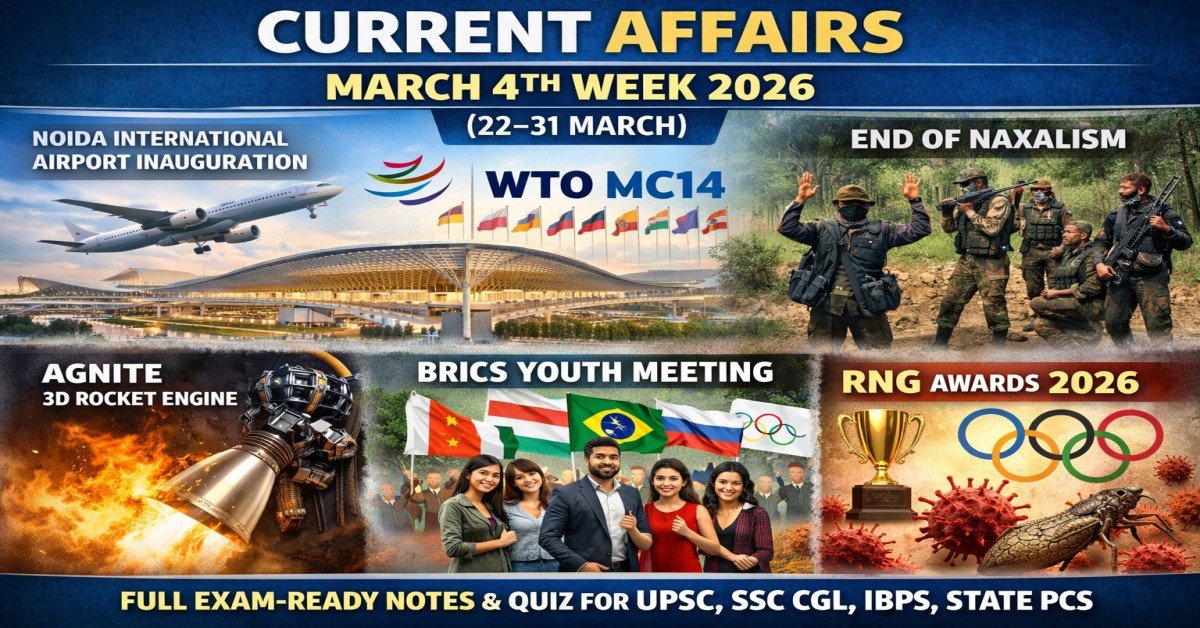
In one of the most significant infrastructure milestones of 2026, Prime Minister Narendra Modi inaugurated Phase I of the Noida International Airport at Jewar, Gautam Buddha Nagar district, Uttar Pradesh, on 28 March 2026. The Prime Minister was joined by UP Chief Minister Yogi Adityanath and Union Ministers at the ceremony, held around noon after a walkthrough inspection of the new terminal building.
The DGCA granted the aerodrome licence to Noida International Airport on 6 March 2026. Cargo and domestic flight operations are expected to begin within 45 days of inauguration — meaning commercial services could launch between mid-April and May 2026. Initial airlines set to operate include IndiGo, Air India Express, and Akasa Air.
Key Facts: Phase I Infrastructure
Phase I was developed at a cost of approximately ₹11,282 crore by Zurich Airport International AG under a Public-Private Partnership (PPP) model. The terminal spans 1,38,000 sq. metres, with a 3,900-metre runway capable of handling wide-body aircraft. An Air Traffic Control (ATC) tower standing 38 metres tall is fully operational. The airport is designed with net-zero emissions as a long-term sustainability goal, integrating energy-efficient systems throughout.
The Phase I cargo hub can process over 2.5 lakh metric tonnes annually, with scalability up to 18 lakh metric tonnes. A 40-acre MRO (Maintenance, Repair and Overhaul) facility was simultaneously announced — PM Modi laid its foundation stone — which will service both domestic and international aircraft, reducing India’s dependence on expensive overseas MRO services.
Regional Significance and Economic Impact
PM Modi described the airport as a “catalyst for western UP’s growth” — directly benefiting districts including Agra, Mathura, Aligarh, Ghaziabad, Meerut, Etawah, Bulandshahr, and Faridabad. The airport aligns with the Viksit UP, Viksit Bharat mission. With this inauguration, Uttar Pradesh becomes the first state in India to host five international airports.
Strategically located along the Yamuna Expressway, the airport is being developed as a multi-modal transport hub, planned to integrate road, rail, metro, and regional transit systems. The convergence of the Eastern and Western Dedicated Freight Corridors at Dadri — close to Jewar — will further amplify the airport’s role as a logistics powerhouse. PM Modi also noted that Jewar was originally approved as an airport site in 2003 under PM Atal Bihari Vajpayee.
The airport’s architectural design draws inspiration from Indian heritage elements — traditional ghats and havelis — blending cultural aesthetics with world-class aviation infrastructure.
UPSC/SSC Exam Angle: This topic is highly relevant for questions on aviation infrastructure, PPP model, MRO sector, Viksit Bharat, Yamuna Expressway corridor, Dedicated Freight Corridor, and UP’s economic transformation. Note developer: Zurich Airport International AG. The total project vision is ₹29,560 crore across all phases with 5 runways ultimately planned.
WTO MC14 in Yaoundé, Cameroon: India Champions Consensus-Based Reform at Fractured Ministerial
The 14th Ministerial Conference (MC14) of the World Trade Organization is being held from 26–29 March 2026 in Yaoundé, Cameroon — making this the first-ever WTO Ministerial Conference hosted on African soil. It is the highest decision-making body of the 166-member organisation, meeting every two years. The conference is being chaired by Luc Magloire Mbarga Atangana, Trade Minister of Cameroon.
India’s Position and Leadership at MC14
India’s delegation is led by Union Commerce and Industry Minister Piyush Goyal, with Commerce Secretary Rajesh Agrawal handling technical negotiations. On 28 March, Piyush Goyal reaffirmed India’s position that WTO reform must be transparent, inclusive, and member-driven — with development remaining the core objective. India has strongly opposed proposals by the US and EU to allow “variable geometry” plurilateral agreements that could bypass consensus-based decision-making.
Commerce Secretary Rajesh Agrawal met US Deputy Trade Representative Joseph Barloon on the sidelines to discuss bilateral trade opportunities and the MC14 agenda, reiterating India’s engagement with the US for a mutually beneficial trade agreement. Goyal also held bilateral discussions with counterparts from the US, China, South Korea, Switzerland, New Zealand, Canada, Morocco, Netherlands, France, and Ethiopia.
WTO DG: Dr Ngozi Okonjo-Iweala (Nigeria) presided over the opening session. The conference agenda includes: WTO Reform, E-Commerce Moratorium, Investment Facilitation for Development (IFD), Fisheries Subsidies, and Agriculture & Development issues. Notably, the Agreement on Fisheries Subsidies entered into force on 15 September 2025 — only the second multilateral agreement in WTO’s 30-year history.
Reform Battle: India vs Developed Nations
The central fault line at MC14 is between two visions of WTO reform. India and the Global South insist on preserving foundational WTO principles: Most-Favoured-Nation (MFN) treatment, consensus-based decision-making, Single Undertaking, and Special & Differential Treatment (S&DT) for developing economies. The US and EU are pushing for plurilateral agreements among “willing” subsets of members — an approach India argues would effectively give powerful nations the ability to set rules while sidelining developing countries. India has used its new bilateral trade relationships with the EU, UK, and US as diplomatic leverage to defend, not dilute, the multilateral order.
Government Extends RBI’s Flexible Inflation Targeting Framework at 4% for Five More Years (2026–2031)
The Government of India has officially extended the Flexible Inflation Targeting (FIT) framework for another five-year term, retaining the Consumer Price Index (CPI) inflation target at 4%, with a tolerance band of ±2% (i.e., 2%–6%), for the period 2026–2031. This reaffirms the monetary policy architecture that was first introduced in India in 2016 and has been renewed once before.
What is Flexible Inflation Targeting?
India adopted Flexible Inflation Targeting in 2016, following recommendations of the Urjit Patel Committee (2014). The framework received statutory backing through the Finance Act, 2016, which amended the RBI Act, 1934 (Section 45ZA). Under FIT, the Government sets the inflation target in consultation with the RBI every 5 years. The Monetary Policy Committee (MPC) — a six-member body — uses tools like the repo rate, CRR, and Open Market Operations (OMOs) to maintain inflation within the target range. If inflation remains outside the 2%–6% band for three consecutive quarters, the RBI must submit a written report to the government explaining the failure and the corrective steps planned.
Current position: As of February 2026, India’s retail CPI inflation stood at 3.21% — comfortably within the target band. The extension provides macroeconomic policy continuity amid global uncertainty caused by the West Asia conflict, US trade policy shifts, and commodity price volatility.
India’s Credit-Deposit (CD) Ratio Hits All-Time High of 83% — Banking Liquidity Under Pressure
India’s Credit-Deposit (CD) ratio climbed to an all-time high of 83% in March 2026, signalling intensifying pressure on the banking system’s liquidity buffers. The ratio measures how much of a bank’s total deposits are deployed as loans — a higher ratio indicates more aggressive lending relative to deposit mobilisation.
Understanding the Numbers
Total bank credit reached ₹207.6 lakh crore, while total deposits stood at ₹250 lakh crore. Credit grew at 13.8% year-on-year, far outpacing deposit growth of just 10.8%. In the fortnight trend, deposits actually fell by ₹1.8 lakh crore, while credit rose by ₹18,672 crore. Most significantly, the incremental CD ratio reached 103.9% — meaning banks are lending more than the fresh deposits they are mobilising in each period. This is structurally unsustainable in the medium term and has prompted RBI concern over systemic liquidity risks.
UPSC/Banking Exam Angle: CD ratio is a standard concept in banking papers. A very high CD ratio (above 80%) signals that banks are stretched — they have limited headroom to absorb sudden deposit withdrawals. RBI typically issues advisories when this ratio rises excessively. This is also relevant to the broader theme of monetary transmission, credit availability, and financial stability.
India’s EV Charging Infrastructure: 27,737 Stations Installed, 22,753 Operational as of March 2026
The Government informed Parliament about the significant expansion of India’s Electric Vehicle (EV) public charging infrastructure as of March 2026. A total of 27,737 EV Public Charging Stations (EVPCS) have been installed across India, of which 22,753 are currently operational. This expansion has been driven primarily by two government schemes: FAME-II (Faster Adoption and Manufacturing of Electric Vehicles — Phase II) and PM E-DRIVE (Electric Drive Revolution in Innovative Vehicle Enhancement).
State-wise Leadership and Policy Framework
The states with the highest number of installed EV charging stations are Uttar Pradesh, Karnataka, Maharashtra, and Tamil Nadu. A key policy enabler is that EV charging infrastructure has been de-licensed, allowing private sector players to establish charging stations without a licence — significantly reducing entry barriers and accelerating deployment. This approach has attracted both large energy companies and startups to the EV charging ecosystem.
Why it matters for India’s climate goals: Expanding EV charging reduces range anxiety — the primary psychological barrier to EV adoption. Wider adoption of EVs reduces fossil fuel dependence, cuts carbon emissions, and supports India’s National Electric Mobility Mission. India targets 30% EV penetration in private vehicles by 2030 under the National Electric Mobility Mission Plan.
PLFS 2025 Report: India’s “Graduate Paradox” — 40% of Young Graduates Unemployed Despite Rising Enrolment
The Ministry of Statistics and Programme Implementation (MoSPI) released the Periodic Labour Force Survey (PLFS) Annual Report for 2025, revealing a deeply concerning structural pattern in India’s labour market. The report, along with the complementary State of Working India (SWI) 2026 study, highlights what researchers call the “graduate paradox”: approximately 40% of graduates aged 15–25 years are unemployed, even as college enrolment rates continue to rise.
Root Causes of the Graduate Paradox
The structural mismatch is multi-layered. India’s economy is not generating sufficient quality jobs to absorb the volume of general degree graduates entering the market each year. High-quality educational institutions — particularly technical and vocational hubs — are disproportionately concentrated in the southern states, creating regional inequity in access to employment-relevant skills. STEM teacher shortages and inadequate faculty growth further limit technical output. A significant cultural factor compounds the problem: many graduates from northern India focus on preparing for a limited number of government vacancies rather than pivoting to the private sector. Meanwhile, automation and AI are eroding entry-level roles traditionally filled by general-degree graduates.
UPSC Mains (GS-III) angle: This topic intersects India’s demographic dividend risk, skilling policy, higher education quality, North-South development asymmetry, and employment generation. Key question format: “India’s demographic dividend risks becoming a demographic disaster unless structural reforms address graduate unemployment. Critically examine.” The PLFS is conducted quarterly and annually by MoSPI.
Sports Round-up: Carolina Marín Retires; Stuti Pradhan Represents India at World Youth Parliament 2026
Carolina Marín — Spain’s Badminton Legend Hangs Up Her Racket
Spanish badminton icon Carolina Marín has announced her retirement from professional badminton at age 32, owing to an injury that forced her to bring forward what would have been her final competitive appearances. Marín leaves the sport with an extraordinary legacy: she is a three-time World Champion (2014, 2015, 2018), a seven-time European Champion, and — most notably — the Olympic Gold medallist at Rio 2016.
Her rivalry with India’s PV Sindhu defined an era in women’s singles badminton. Marín defeated Sindhu in both the Rio 2016 Olympic final and the 2018 World Championship final — two of the sport’s most celebrated matches. She was originally set to play her farewell matches at the April 2026 European Championships in Huelva, Spain, but injury necessitated an earlier retirement announcement.
Stuti Pradhan — Sikkim’s Youth Leader at World Youth Parliament 2026
Stuti Pradhan, a young leader from Sikkim, has been selected as a delegate to represent India at the prestigious World Youth Parliament 2026. She will join young representatives from South Korea, UAE, Kuwait, Chad, Thailand, and Yemen to deliberate on global policy solutions. This selection highlights India’s growing engagement in international youth diplomacy forums.
World Buddhist Peace Conference 2026 — Hyderabad, India: Buddhist Diplomacy as Soft Power
The World Buddhist Peace Conference 2026 was held in Hyderabad, India, bringing together Buddhist scholars, monks, diplomats, and policymakers from across Asia and beyond. The conference focused on harnessing India’s Buddhist heritage as an instrument of soft power and peace diplomacy, particularly in the context of Indo-Pacific geopolitics.
India holds deep civilisational connections to Buddhism — the religion was founded by Gautama Buddha in India, propagated globally under Emperor Ashoka, and nurtured by ancient institutions like Nalanda. India is positioned as a natural bridge between Buddhist-majority nations including Sri Lanka, Thailand, Myanmar, Bhutan, Japan, and Cambodia. However, India currently captures less than 1% of global Buddhist tourism — a figure the conference highlighted as a missed strategic and economic opportunity.
UPSC GS-II Angle: Buddhist diplomacy connects to India’s soft power strategy, BIMSTEC, Mekong-Ganga Cooperation, Indo-Pacific outreach, and civilisational diplomacy. Key institutions: BIMSTEC (Bay of Bengal Initiative for Multi-Sectoral Technical and Economic Cooperation) and Mekong-Ganga Cooperation link India with Southeast Asian Buddhist nations.
Test Yourself: 10 MCQs on 28 March 2026 Current Affairs
28 March 2026 — Quick Quiz
10 exam-style MCQs covering Noida Airport, WTO MC14, RBI inflation target, EV infra, PLFS 2025, Carolina Marín and more. Nail the facts before your next exam!