Dr. Ashok Kumar Panda Recommended as CMD of SAIL by PESB — A Pivotal Leadership Moment for India’s Steel Maharatna
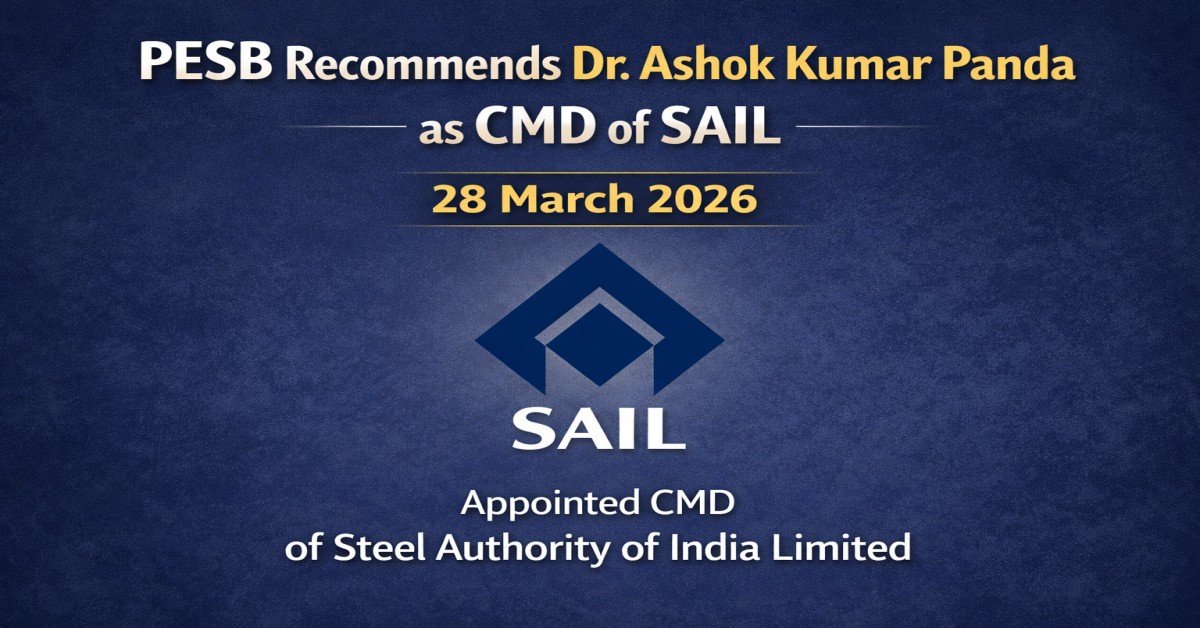
The Public Enterprises Selection Board concluded its selection process on 28 March 2026, naming the experienced SAIL finance chief as its pick to lead the organisation. Here is everything exam aspirants need to know — background, career, significance, and practice questions.
Dr. Ashok Kumar Panda
Formal Proceedings of PESB Meeting No. 26/2026
India’s apex body for senior PSU leadership selection — the Public Enterprises Selection Board (PESB) — convened its 26th meeting of 2026 at 9:00 AM on Saturday, 28 March 2026, to finalise the next head of Steel Authority of India Limited (SAIL). The board conducted structured interviews of a shortlisted panel of ten candidates drawn from SAIL’s own senior leadership, other public sector enterprises, and the Indian Railways. After a thorough round of assessments covering domain knowledge, leadership credentials, organisational vision, and track record, the board formally recorded its recommendation in Minute No. 1 of the proceedings: Dr. Ashok Kumar Panda was its choice for the post of Chairman and Managing Director (CMD), SAIL — a Schedule A appointment.
The recommendation marks the culmination of a selection cycle triggered by the impending exit of the serving CMD. With the conclusion of PESB’s work, the file now travels through a multi-stage government approval pipeline before a formal appointment order can be issued.
Crucial Distinction for Exam Accuracy: A PESB recommendation is the beginning of the appointment process, not its conclusion. Following the recommendation, the Ministry of Steel conducts an internal departmental review. The file then passes through multi-agency scrutiny — including vigilance and security clearance. Only after this process is the file placed before the Appointments Committee of the Cabinet (ACC), which is chaired by the Prime Minister. The formal appointment order is issued only upon ACC approval. Until that point, Dr. Panda carries the recommendation, not the charge.
Why the CMD Post Became Vacant
The search for a new CMD became necessary after Amarendu Prakash — the incumbent Chairman and Managing Director of SAIL — tendered his resignation. With his departure scheduled around 1 April 2026, the Ministry of Steel initiated the PESB selection process in advance to minimise the leadership gap at one of the country’s most strategically significant PSUs. The ministry is separately evaluating whether an interim CMD arrangement is needed to bridge the period between Amarendu Prakash’s exit and the completion of the full ACC approval process for Dr. Panda.
Context on SAIL’s Strategic Importance: SAIL is not merely a steel producer — it is a backbone institution for India’s infrastructure-led growth narrative. It supplies rails for the Indian Railways, structural steel for highways and bridges, plates for the defence sector, and special steels for industrial manufacturing. With national infrastructure spending at historic highs in 2025–26, SAIL’s leadership carries enormous weight in shaping both output capacity and institutional efficiency.
Three Decades Built Inside SAIL’s Financial Architecture
Dr. Ashok Kumar Panda is among the most experienced finance executives in India’s public sector steel industry. His entire professional journey — spanning over three decades — has unfolded within SAIL, making him a genuine institutional insider with a granular understanding of the organisation’s financial systems, plant-level cost structures, commercial pipelines, and strategic priorities.
He entered SAIL in 1992 as a Management Trainee at Bokaro Steel Plant in Jharkhand, one of India’s largest integrated steel plants. The following year, in 1993, he was posted to Rourkela Steel Plant in Odisha, broadening his cross-plant exposure early in his career. Over subsequent years, he rose through roles at the SAIL Corporate Office and Bhilai Steel Plant in Chhattisgarh — taking on increasing financial responsibility at each stage, eventually reaching the rank of Chief General Manager (Finance and Accounts).
His most significant career milestone came when the PESB, after interviewing ten candidates on 8 February 2025, recommended him for the board-level role of Director (Finance) — a recommendation that was subsequently approved by the Appointments Committee of the Cabinet (ACC) through a DoPT order, cementing his position at the very apex of SAIL’s financial leadership. He has concurrently held additional charge as Director (Commercial), giving him exposure beyond pure finance into market-facing commercial strategy.
Career Milestones at a Glance
Educational Qualifications — An Unusual Depth
Dr. Panda’s academic credentials are notably strong even by the standards of India’s senior PSU executives. He completed a Bachelor of Engineering (B.E.) in Electrical Engineering, providing him with a technical foundation that complements his financial expertise — important in a sector as capital-intensive and technology-driven as steel manufacturing.
He then pursued a full-time Post Graduate Diploma in Management (PGDM) with a specialisation in Finance from Xavier Institute of Management, Bhubaneswar (XIM Bhubaneswar) — one of India’s premier business schools with a strong reputation in management education and social sensitivity. Subsequently, he earned a Ph.D. in Business Administration (Finance), adding doctoral-level research depth to his management profile. This tri-combination of engineering, management, and doctoral training is rare in the PSU executive universe and underlines the intellectual rigour he brings to financial strategy.
Areas of Domain Expertise
Over his career, Dr. Panda has developed specialised expertise across several verticals critical to SAIL’s functioning: financial accounting and reporting, cost management and budgeting, annual business planning, treasury and fund management, direct and indirect taxation, project finance, commercial operations, and the management of employee superannuation and welfare trusts. During his tenure as Director (Finance), he also led significant institutional drives including SAIL’s balance sheet deleveraging, operational cost reduction initiatives, rail pricing strategy, and the rollout of e-invoicing and digital invoicing across all steel plants — part of the government’s broader push to digitise PSU financial operations.
From a Post-Independence Vision to a Global-Scale Steel Giant
Steel Authority of India Limited (SAIL) was incorporated in 1973 and stands today as one of the largest steel producers in India and among the top steel companies in Asia. Classified as a Maharatna Central Public Sector Enterprise (CPSE) — the highest tier in India’s PSU categorisation framework — SAIL operates under the administrative jurisdiction of the Ministry of Steel, Government of India.
The company runs five integrated steel plants: Bhilai Steel Plant (Chhattisgarh), Rourkela Steel Plant (Odisha), Durgapur Steel Plant (West Bengal), Bokaro Steel Plant (Jharkhand), and IISCO Steel Plant at Burnpur (West Bengal). It also operates special steel plants and alloy steel units producing high-value specialised steel grades for defence, aerospace, and precision engineering sectors. SAIL employs over 65,000 people directly and supports hundreds of thousands more through its supply chain and township ecosystems around each plant.
Maharatna Status — What It Means: The Maharatna category — introduced in 2010 — grants PSUs the highest degree of financial and operational autonomy. A Maharatna company can independently approve capital investments up to ₹5,000 crore per project without government approval, enter joint ventures, and establish subsidiaries globally. Only the largest and most profitable CPSEs qualify. SAIL holds this status alongside companies like ONGC, Coal India, NTPC, BHEL, IOC, GAIL, and a few others.
| Parameter | Detail |
|---|---|
| Full Name | Steel Authority of India Limited |
| Incorporated | 1973 |
| Category | Maharatna CPSE (Highest tier) |
| Administrative Ministry | Ministry of Steel, Government of India |
| Integrated Steel Plants | Bhilai · Rourkela · Durgapur · Bokaro · IISCO (Burnpur) |
| Special Steel Plants | Salem · Visvesvaraya (Bhadravati) · Alloy Steels Plant (Durgapur) |
| Workforce | Over 65,000 employees |
| Key Products | Rails · Plates · Structurals · HR Coils · Bars & Rods · Special & Alloy Steels |
| Primary Customers | Indian Railways · NHAI · Ministry of Defence · Power Sector · Construction |
| CMD Selection Body | Public Enterprises Selection Board (PESB) |
What Is the PESB and How Does It Function?
The Public Enterprises Selection Board (PESB) is an independent advisory body established by the Government of India specifically to handle the selection and recommendation of candidates for the highest executive posts — Chairman, Managing Director, and Functional Directors — in Central Public Sector Enterprises. It was set up in 1974, operating under the jurisdiction of the Department of Public Enterprises (DPE) under the Ministry of Finance.
For every CMD or Director post that falls vacant, the PESB invites applications or nominations from eligible candidates across PSUs and, depending on the role, from government services. After scrutinising eligibility, shortlisting on the basis of seniority and domain fit, and conducting structured personal interviews, the board records a formal recommendation. The board functions as a merit-based screening layer between PSU career pipelines and the cabinet-level appointment authority.
The Full Appointment Journey — Step by Step
The path from PESB recommendation to formal assumption of charge at a Maharatna PSU involves several sequential steps. Understanding this pathway is valuable both for exam preparation and for appreciating how accountability is built into India’s PSU governance framework.
Interim CMD Question: Since incumbent CMD Amarendu Prakash demits office around 1 April 2026, and the ACC approval process for Dr. Panda will take additional time, the Ministry of Steel must decide whether to designate any SAIL board director to handle interim CMD duties. This interim arrangement is common in PSU transitions and does not affect the standing PESB recommendation.
Test Your Knowledge
10 targeted questions covering the PESB recommendation, Dr. Panda’s career, SAIL’s profile, and the PSU appointment process — directly relevant to UPSC, SSC, and Banking exams