
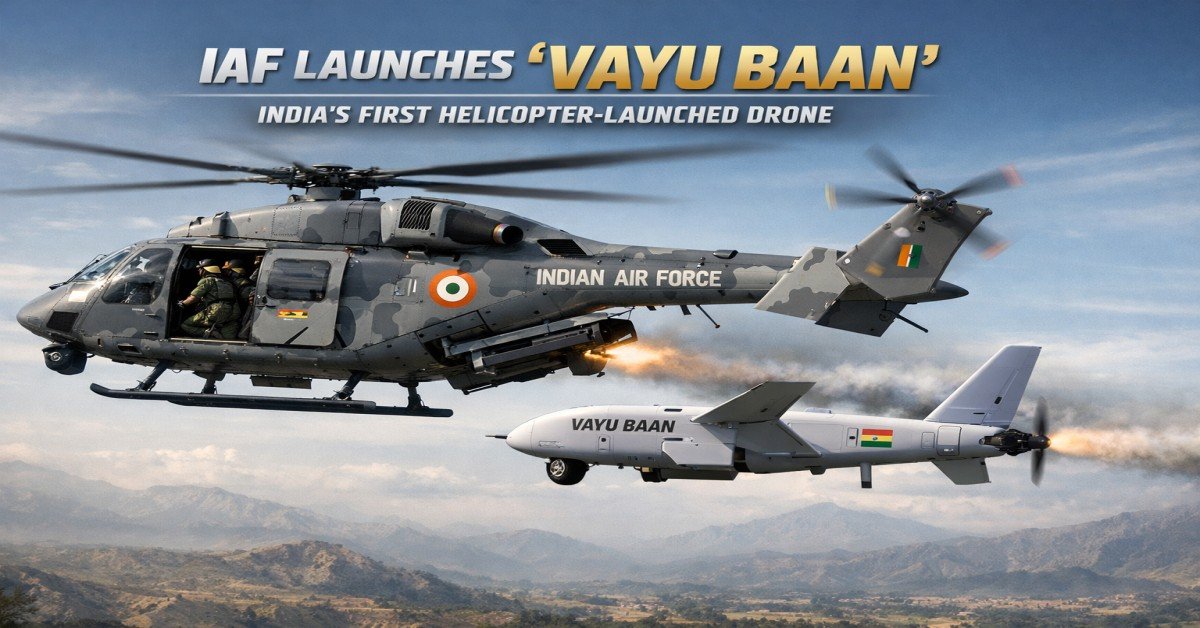
IAF Launches ‘Vayu Baan’: India’s First Helicopter-Launched Drone — A Doctrinal Leap into Stand-Off Unmanned Warfare
On 25 March 2026, the Indian Air Force’s Directorate of Aerospace Design issued a Request for Proposal for Vayu Baan — an indigenous helicopter-dropped loitering munition that will transform India’s rotary-wing attack doctrine. Here is the complete technical and strategic breakdown, with everything exam aspirants need to know.
Project Vayu Baan
The Announcement — IAF Issues RFP on 25 March 2026
The Indian Air Force (IAF), through its Directorate of Aerospace Design (DAD), issued a Request for Proposal (RFP) to Indian domestic vendors on 25 March 2026, formally launching the Vayu Baan programme — India’s first-ever project for the design and development of an indigenous helicopter-launched loitering munition. The RFP invites private sector companies and defence public sector undertakings to submit proposals for the complete system, including hardware, software, ground control infrastructure, and integration with existing IAF rotary-wing platforms.
The name Vayu Baan is drawn from Sanskrit, meaning “Air Arrow” — a fitting description for a weapon system designed to travel independently through the air and strike with precision. The programme falls under the broader category of Air-Launched Effects (ALE) — a global doctrinal concept referring to unmanned systems that are deployed from manned aircraft (whether fixed-wing jets or rotary-wing helicopters) to extend the reach, reduce risk, and enhance the effectiveness of manned platforms.
What Is a Loitering Munition? A loitering munition — also referred to as a kamikaze drone or suicide drone — is an unmanned aerial system that can fly to and circle a target area for an extended period, scanning for and identifying targets using onboard sensors, and then dive into and destroy the target using its own explosive payload. Unlike a conventional missile (which flies in a single trajectory), a loitering munition can hover, wait, abort, and re-engage — giving operators critical decision-making flexibility. Examples globally include Israel’s Harop (used by India), the Switchblade (USA), and the Lancet (Russia).
How Vayu Baan Works — Flight Sequence Explained
The operational concept of Vayu Baan follows a specific deployment sequence. A helicopter on a combat mission carries one or multiple Vayu Baan drones in its cargo hold or door-mounted launcher. At a safe stand-off distance from the target zone — well outside the range of enemy man-portable air-defence systems (MANPADS) — the crew releases the drone through the helicopter’s hatch or door. The drone then falls freely to a safe separation altitude, after which it autonomously deploys its folded wings, activates its propulsion system, and transitions to guided horizontal flight.
Once airborne independently, the drone uses its onboard sensors and AI-driven target identification algorithms to navigate toward the designated target area. It transmits real-time video and telemetry data to operators — either on the launch helicopter through an airborne control station, or to a ground control station (GCS). If the operator confirms the target, the drone executes its strike using the onboard warhead. If circumstances change, the operator can redirect the drone to a new target or abort the mission entirely. The system must maintain operator control within at least 10 km of the launch platform, while also supporting fully autonomous operations beyond 50 km in communication-degraded scenarios.
Why GPS-Denied Operation Matters: In modern contested environments — particularly along India’s northern borders with China and across the Pakistan front — adversaries deploy sophisticated electronic warfare (EW) systems capable of jamming or spoofing GPS signals. A drone that relies solely on GPS for navigation becomes useless the moment the signal is denied or falsified. The Vayu Baan RFP specifically mandates that the system must be capable of operating in GNSS-denied environments, likely through a combination of inertial navigation, terrain-matching algorithms, and AI-based visual navigation — ensuring the drone remains lethal even when the enemy jams the battlefield’s electromagnetic spectrum.
Three Modular Payload Configurations
One of the most operationally significant design choices in Vayu Baan is its modular payload architecture. Rather than being limited to a single role, the drone is engineered to carry three interchangeable payload types, making it adaptable across different mission profiles without requiring a separate drone for each purpose.
| Parameter | Specification | Significance |
|---|---|---|
| Autonomous Range | > 50 km (reports: up to 80 km) | Enables stand-off strike well beyond MANPADS envelope |
| Endurance | ≥ 30 minutes | Extended loiter for target search and engagement |
| Payload Capacity | 500 grams to 1 kilogram | Modular — ISR sensor, warhead, or rocket interface |
| Operator Control Range | Minimum 10 km from launch platform | Keeps helicopter safe from enemy response |
| Launch Method | Helicopter hatch / door release | Passive drop — no launch tube required |
| Wing Deployment | Autonomous post-drop unfold | Compact stowage; auto-transition to flight |
| Navigation | GNSS + GNSS-denied capable | Operates in GPS-jammed / EW environments |
| Target Identification | AI-driven with EO/IR sensors | Reduces operator workload; enables autonomous ID |
| Real-Time Data Link | Live video + telemetry to operator | Enables human-in-the-loop decisions |
| Strike Profile | Configurable terminal engagement | Operator can tailor dive angle and approach |
| Procurement Scope | 10 drones + 2 airborne + 2 ground control stations | Initial batch for trials and operational evaluation |
| Delivery Timeline | 12 months from contract signing | Fast-track programme — accelerated development |
| Procurement Model | Indigenous / domestic vendors only | Aligned with Atmanirbhar Bharat defence policy |
Swarm Capability — A Force Multiplier: A single IAF helicopter equipped with multiple Vayu Baan units can launch several drones simultaneously or in rapid sequence, creating a mini-swarm effect. This swarm can overwhelm localised air defences, saturate enemy sensors with multiple threats, and force defenders to expend valuable MANPAD missiles on decoys while the actual strike drones reach their targets. This tactical application mirrors swarm doctrine being developed globally, but with the specific advantage of helicopter-based mobility and survivability.
Solving the MANPADS Problem — Helicopters Survive by Standing Off
The primary operational driver behind Vayu Baan is the rapidly escalating threat posed by Man-Portable Air-Defence Systems (MANPADS) to rotary-wing aircraft. Helicopters like the Mil Mi-17, the indigenous Advanced Light Helicopter (ALH) Dhruv, and the Light Combat Helicopter (LCH) Prachand are central to India’s battlefield mobility, close air support, and special forces insertion doctrine. However, their relatively low speed and flight altitude make them acutely vulnerable to shoulder-fired surface-to-air missiles — MANPADS systems that adversaries including China and Pakistan, and their proxies, are increasingly fielding along India’s contested borders.
Vayu Baan fundamentally changes this calculus. By enabling a helicopter to launch a precision strike from over 50 km away — well outside the engagement envelope of any MANPAD system — it converts the helicopter from a vulnerable close-attack platform into a survivable stand-off launch node. The helicopter crew never needs to expose itself to anti-aircraft fire; the drone does the dangerous work in contested airspace.
High-Altitude Operations — The Himalayan Imperative: India’s most operationally demanding theatre is the Himalayan frontier — covering the Line of Actual Control (LAC) with China in Ladakh, Arunachal Pradesh, and Sikkim, at altitudes ranging from 14,000 to 18,000 feet. Drones operating at these altitudes face thinner air, reduced propulsion efficiency, extreme temperatures, and potential GPS signal degradation from Chinese electronic warfare assets. The Vayu Baan RFP explicitly mandates high-altitude testing before operational clearance — recognising that the Himalayan frontier is its primary intended theatre of operations.
Vayu Baan vs India’s Existing Harop — Same Family, Different Role
India already operates the Harop loitering munition, acquired from Israel for approximately USD 100 million. The Harop is a formidable system — with a range exceeding 200 km, an endurance of over 6 hours, and an anti-radiation capability designed to home in on enemy radar emissions. However, Harop is a ground-launched system that requires wheeled vehicles and dedicated launch infrastructure. It cannot be deployed from a helicopter.
Vayu Baan fills a completely different tactical niche — it is a helicopter-integrated, rapidly deployable, platform-organic capability. Where Harop is suited for strategic-level, pre-planned strikes on radar installations, Vayu Baan is designed for tactical, time-sensitive engagements during active helicopter operations — responding to emerging threats in real time, without requiring external support infrastructure. Together, they will give India a layered and complementary loitering munition ecosystem.
Atmanirbhar Bharat Defence Connection: The Vayu Baan RFP is restricted exclusively to Indian domestic vendors — both private sector companies and defence public sector undertakings. This approach reflects India’s broader Atmanirbhar Bharat defence policy, which aims to reduce dependence on foreign arms imports and build a self-sustaining indigenous defence industrial base. India spent over USD 21 billion on defence imports between 2016 and 2020. Programmes like Vayu Baan — designed from scratch by Indian engineers, for Indian operational needs, using Indian manufacturing — are central to reversing this dependence.
IAF Helicopters That Will Carry Vayu Baan
The RFP does not restrict Vayu Baan to a single helicopter type — its door/hatch-launch mechanism is designed for broad compatibility across IAF rotary-wing platforms. The most likely candidates for early integration include the Mil Mi-17 V5 — the IAF’s primary medium-lift utility and combat helicopter — the Advanced Light Helicopter (ALH) Dhruv and its armed variant, the Rudra, and the Light Combat Helicopter (LCH) Prachand — India’s indigenously developed high-altitude attack helicopter that achieved operational clearance in 2022 and has been specifically designed for Himalayan warfare. The ability to launch Vayu Baan from Prachand would be particularly significant, creating a seamless pairing of indigenous attack helicopter and indigenous drone.
An Elite Club — Nations Pursuing Helicopter-Launched Drones
Helicopter-launched autonomous loitering munitions remain among the rarest and most technically challenging weapon systems in existence. Only a handful of nations have meaningfully pursued this capability, and even fewer have achieved operational deployment. With Vayu Baan, India is joining this elite group — not as a follower adopting a foreign design, but as an innovator developing an indigenous system tailored to its own operational doctrine.
| Country | Programme / System | Platform Type | Status |
|---|---|---|---|
| 🇺🇸 USA | DARPA Gremlins / Army Air-Launched Effects (ALE) | Fixed-wing transport aircraft + helicopters | Testing |
| 🇨🇳 China | Drone swarms from Xi’an H-6 bomber; helicopter-launched programs | Bomber + rotary (experimental) | Experimental |
| 🇬🇧 UK | Loyal Wingman concept for Boeing AH-64E Apache | Attack helicopter | Development |
| 🇮🇱 Israel | Harop (ground-launched) · Rotem-L (helicopter-compatible) | Ground + helicopter (Rotem) | Deployed |
| 🇮🇳 India | Vayu Baan — IAF DAD · Indigenous ALE programme | Helicopter (Mi-17, Dhruv, Prachand) | RFP Issued · Mar 2026 |
DARPA Gremlins Programme — For Exam Awareness: The US Defense Advanced Research Projects Agency (DARPA) launched the Gremlins programme to develop drones that can be launched from and recovered by transport aircraft like the C-130. Unlike Vayu Baan — which is a one-way loitering munition — the Gremlins concept envisioned recoverable, reusable drones. The programme successfully tested aerial recovery in October 2021. This is a useful comparison point for UPSC and CDS exam questions on global drone programmes.
Fast-Track Programme: Vayu Baan is being developed on an accelerated timeline — the entire process from contract signing to delivery is mandated to be completed within 12 months. This compressed schedule reflects both the urgency of the operational requirement and the IAF’s confidence in the Indian private defence sector’s capability to deliver. India’s defence industrial ecosystem has grown significantly in recent years, with companies like Ideaforge, NewSpace Research, Raphe mPhibr, and Alpha Design Technologies developing proven UAV platforms.
Test Your Knowledge
10 targeted questions covering Vayu Baan’s technical specs, strategic significance, global comparisons, and related IAF capabilities — exam-critical for UPSC GS-3, CDS, AFCAT, NDA, and SSC