Rajasthan Launches ‘Industrial Park Promotion Policy 2026’ to Attract Investment and Generate Employment
What was announced and when
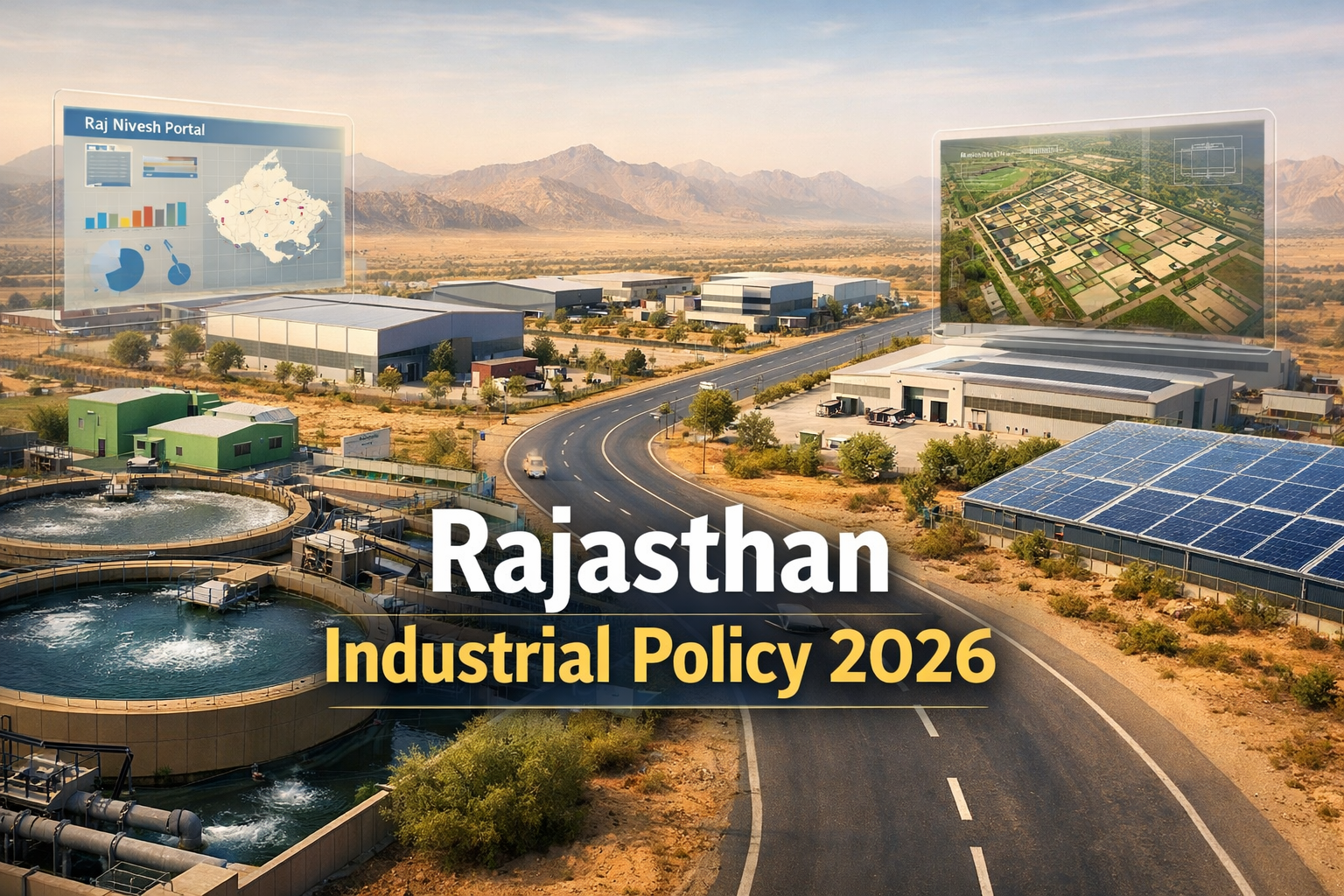
On 25 March 2026, the Government of Rajasthan formally introduced the Industrial Park Promotion Policy-2026 — a comprehensive framework designed to accelerate the development of modern industrial parks across the state. The policy was unveiled under the leadership of Chief Minister Bhajanlal Sharma and received formal Cabinet approval in February 2026 during a Cabinet meeting in Jaipur that also cleared several other major governance decisions. With its introduction, Rajasthan signals an ambitious attempt to reposition itself as one of India’s most investor-friendly and industrially capable states.
The policy is wide-ranging in its intent: it seeks to attract both domestic and foreign investors, create large-scale employment opportunities across the state, develop world-class industrial infrastructure, and ensure that industrial growth reaches even the less-developed regions of Rajasthan — not just its established urban centres. It draws explicit alignment with national-level programmes including Make in India and Atmanirbhar Bharat, positioning Rajasthan’s industrial ambition as an extension of India’s broader self-reliance agenda.
Why this matters for competitive exams: Industrial policies of major states are consistently tested in UPSC Prelims (Economy/Polity), Mains GS III (Infrastructure, Investment Models), RAS/RPSC, SSC, and banking exams. This policy brings together multiple high-value exam concepts simultaneously: PPP models, CETP, single-window clearance, RIICO, stamp duty concessions, and Ease of Doing Business — all in one current-affairs event.
Why Rajasthan Needs This Policy — The Industrial Landscape and Investment Gap
Rajasthan’s industrial position in India
Rajasthan is India’s largest state by geographical area, covering approximately 342,000 square kilometres — about 10.4% of the nation’s total land. This vast expanse offers a significant natural advantage: raw land availability at relatively lower cost compared with more industrialised states such as Maharashtra, Gujarat, or Tamil Nadu. The state is rich in mineral resources including limestone, gypsum, marble, copper, zinc, and lead — assets that naturally attract mining-linked manufacturing. Its growing expressway and logistics network, proximity to Delhi-NCR, and access to the Delhi-Mumbai Industrial Corridor (DMIC) add further logistical appeal.
Yet despite these advantages, Rajasthan has historically underperformed relative to its industrial potential. Industrial activity has tended to cluster in a handful of cities — Jaipur, Jodhpur, Udaipur, Kota, and Bhilwara — while large swaths of the state, particularly in its eastern and western districts, have seen limited manufacturing investment. The new policy directly addresses this imbalance by designing incentives that actively push investment toward underdeveloped and less-industrialised regions.
The policy’s broader economic vision
The Bhajanlal Sharma government, which came to power in December 2023, has consistently emphasised industrial growth as a centrepiece of Rajasthan’s economic revival strategy. The state hosted its Rising Rajasthan Global Investment Summit in December 2023, which generated investment intent memoranda worth several lakh crore rupees. The Industrial Park Promotion Policy-2026 is, in many ways, the institutional architecture needed to convert those investment pledges into on-the-ground reality — providing developers and investors with a clear, predictable framework for setting up and operating industrial parks across the state.
The policy is also designed to complement Rajasthan’s existing industrial policy ecosystem. It works alongside the state’s RIICO Industrial Policy, the Rajasthan Investment Promotion Scheme (RIPS), and sectoral policies covering textiles, defence manufacturing, electronics, and agro-processing. Together, these frameworks are intended to create a layered incentive structure that makes Rajasthan genuinely competitive with industrially mature states.
Static GK — Rajasthan industrial basics (frequently tested): Rajasthan is India’s largest state by area · Capital: Jaipur · Key industrial cities: Jaipur (gems, textiles), Jodhpur (handicrafts, cement), Udaipur (zinc smelting), Kota (chemicals, engineering), Bhilwara (textiles, synthetic yarn) · Major minerals: zinc (largest reserves in Asia at Zawar mines), marble (Makrana, Rajsamand), limestone, gypsum, copper · RIICO manages over 380 industrial areas in the state.
The Policy’s Core Architecture — Four Distinct Models for Industrial Park Development
Why multiple models matter
One of the most innovative design features of the Industrial Park Promotion Policy-2026 is its adoption of four distinct development models rather than a single rigid framework. This flexibility acknowledges that different investors — large corporations, medium-sized developers, and public-private consortium partners — have different risk appetites, land-ownership profiles, and capital structures. By offering a menu of models, the state lowers entry barriers and broadens the universe of potential participants. The common minimum requirement across all private-sector models is a minimum area of 50 acres and a commitment to accommodate at least 10 industrial units within the park.
Minimum eligibility for private industrial parks: A private developer seeking recognition and benefits under this policy must commit to a minimum park area of 50 acres and ensure the park houses at least 10 operational industrial units. These thresholds are designed to prevent fragmented, sub-scale development — encouraging integrated industrial ecosystems rather than isolated factories dressed up as parks.
Sector-specific parks — a targeted approach
Beyond the four general development models, the policy provides for the creation of sector-specific industrial parks — dedicated clusters tailored to the requirements of particular industries. The sectors identified for such specialised parks include medtech (medical technology and devices), fintech (financial technology infrastructure), and petrochemicals, among others. Sector-specific parks benefit from shared infrastructure — testing laboratories, cold chains, regulatory compliance cells — that individual units within a general industrial zone cannot economically build on their own. This clustering approach mirrors successful models seen in states like Gujarat (GIFT City for fintech) and Karnataka (aerospace park near Bengaluru).
Investor Incentives — Subsidy Slabs, Tax Concessions, and Infrastructure Support
Capital investment subsidy — three-tier slab structure
The policy introduces a clearly defined three-tier capital investment subsidy structure to reward developers who commit larger capital outlays. Rather than a flat-rate benefit that treats small and large investors identically, this graduated structure is designed to provide proportionally meaningful support across a range of investment scales while ensuring fiscal prudence for the state exchequer. The slabs are as follows:
| Investment Size | Subsidy / Incentive | Category |
|---|---|---|
| Up to ₹100 crore | 20% capital subsidy on investment | Small / entry-level parks |
| ₹100 crore – ₹250 crore | Flat ₹30 crore subsidy | Mid-scale parks |
| Above ₹250 crore | Up to ₹40 crore subsidy | Large / anchor parks |
Tax and duty concessions
Beyond direct capital subsidies, the policy extends several tax and duty relaxations that reduce the recurring cost of doing business within Rajasthan’s industrial parks. Electricity duty exemption applies specifically to units that source their power from renewable energy — a deliberate design choice that simultaneously cuts investor costs and nudges the industrial sector toward cleaner energy consumption. Stamp duty concessions lower the transaction costs associated with land registration and conveyance. Land conversion charge concessions reduce the fees payable when agricultural or other land is converted to industrial use — a frequent and costly step in greenfield park development.
Together, these concessions address the three primary cost pressures that investors repeatedly cite as barriers to entry: energy costs, property transaction costs, and regulatory fees at the time of land acquisition and conversion.
Infrastructure provisioning — cost-sharing with the state
A notable commitment in the policy is the state government’s pledge to ensure the availability of three foundational infrastructure inputs at all recognised industrial parks: water supply, electrical connectivity, and road access. These will be provided through a cost-sharing arrangement between the state government or RIICO and the private developer — rather than placing the entire infrastructure burden on the investor. Particularly significant is the provision that the government will bear the cost of constructing the approach road connecting the industrial park to the nearest state or national highway.
Why the approach-road commitment matters: Connectivity is consistently the single biggest deterrent to greenfield industrial development in interior regions. Developers who might otherwise invest in cheaper land in less-developed districts are put off by the cost of building access roads themselves. By making road connectivity a government responsibility up to the nearest approach road, the policy specifically lowers the barrier to investing in underdeveloped districts — serving the balanced regional growth objective simultaneously.
Built for the Future: The Policy’s Environmental and Sustainability Provisions
CETP reimbursement — tackling industrial effluent
One of the most environmentally significant provisions in the policy is the financial support extended to Common Effluent Treatment Plants (CETPs). A CETP is a shared facility that collects, treats, and safely disposes of liquid waste generated by multiple industrial units within a park. Rather than requiring each unit to build and operate its own effluent treatment infrastructure — which is expensive and often poorly maintained by smaller enterprises — a CETP centralises this function at the park level, achieving economies of scale and far more reliable environmental compliance.
Under the Industrial Park Promotion Policy-2026, industrial park developers can claim a 50% reimbursement of the expenditure incurred in establishing a CETP, subject to a specified cap. This provision directly reduces one of the most significant upfront capital costs in setting up a green industrial park, making environmentally responsible development financially viable even for medium-sized developers.
What is a CETP? A Common Effluent Treatment Plant (CETP) is a centralised facility that treats wastewater collectively from multiple industrial units. It is particularly critical for industries that generate liquid chemical waste — textiles, dyeing, pharmaceuticals, petrochemicals — where individual unit-level treatment is economically impractical. CETPs are mandated by the Environment Protection Act, 1986 and regulations under it. Rajasthan’s 50% CETP reimbursement reflects a convergence of environmental regulation and industrial promotion — an increasingly common model in responsible industrial policy-making.
Renewable energy integration and clean technology incentives
The policy’s electricity duty exemption for renewable energy use is not merely a financial concession — it is a deliberate policy nudge toward solar and wind energy adoption within industrial parks. Rajasthan is the leading state in India for renewable energy capacity, contributing over 16% of the country’s renewable energy output as of early 2026, driven by its vast solar potential in the Thar Desert and significant wind energy installations. By exempting industrial units that draw power from renewable sources from electricity duty obligations, the policy creates a direct financial incentive to connect to Rajasthan’s already abundant clean energy infrastructure.
Additionally, the policy encourages the adoption of clean technologies and eco-friendly industrial practices more broadly — including water recycling, waste minimisation, and green building standards — positioning Rajasthan’s industrial parks as sustainable destinations rather than conventional polluting zones.
Implementation Machinery — RIICO as Nodal Agency and the Single-Window Raj Nivesh Portal
RIICO — Rajasthan’s industrial development backbone
The Rajasthan State Industrial Development and Investment Corporation (RIICO) has been designated as the nodal agency responsible for implementing the Industrial Park Promotion Policy-2026. This is a natural fit: RIICO is the state government’s primary vehicle for industrial area development, land allotment, and infrastructure investment, and currently manages more than 380 industrial areas spread across Rajasthan’s districts. Under the new policy, RIICO’s mandate expands significantly — it now coordinates not just RIICO-owned industrial zones but also the approval, monitoring, and support of privately developed and PPP-mode industrial parks.
RIICO’s role under the policy includes: land allotment and acquisition assistance (particularly for Models 1 and 2 where government land is involved), investor coordination to match prospective investors with available park opportunities, infrastructure planning and co-investment, and ongoing compliance monitoring to ensure parks maintain minimum unit counts and environmental standards over time.
Raj Nivesh Portal — single-window clearance digitalised
For investors and developers, one of the most practically valuable elements of the policy is the commitment to route all approvals through the Raj Nivesh Portal — Rajasthan’s digital single-window clearance system. In traditional industrial development, a park developer or anchor investor must navigate multiple departments — revenue, pollution control, electricity, water, urban development, fire safety — each with its own application process, fee structure, and timeline. This fragmentation creates delay, uncertainty, and scope for inefficiency.
The Raj Nivesh Portal consolidates all these clearances into a single digital interface. A developer submits one application; the portal routes it to the relevant departments; approvals are tracked in real time; and the developer receives a single consolidated clearance. This dramatically reduces the time-to-land for industrial investment and aligns with Rajasthan’s stated goal of improving its ranking in India’s Ease of Doing Business (EoDB) assessments conducted by the Department for Promotion of Industry and Internal Trade (DPIIT).
Ease of Doing Business context: India’s DPIIT annually assesses states on their Business Reform Action Plan (BRAP) — covering 301 reform points across categories like labour regulation, single-window systems, land access, utility infrastructure, and environmental clearances. Rajasthan has been working to improve its EoDB ranking. The Raj Nivesh Portal and the four-model flexibility of IPPP-2026 directly address several BRAP parameters — making this policy partly a response to India’s competitive state-ranking exercise as well as an industrial growth driver.
Why This Policy Is a Significant Step — For Rajasthan, India’s Industrial Map, and Exam Preparation
Balanced regional development — the equity dimension
One of the most important but least-discussed dimensions of the Industrial Park Promotion Policy-2026 is its explicit focus on balanced regional development. Rajasthan’s industrial footprint has historically been concentrated in a narrow belt of western and southern cities. The eastern districts — and particularly the tribal belt of southern Rajasthan around Banswara and Pratapgarh — have missed out on the employment and income gains that manufacturing brings. The approach-road commitment, cost-sharing for basic infrastructure, and the special early-mover incentive for the first ten parks are all calibrated to make it rational for investors to choose underdeveloped locations rather than always defaulting to already-established industrial hubs.
This design reflects an understanding that industrial policy must do two things simultaneously: attract investors (through competitive incentives) and distribute the resulting gains (through location-specific inducements). IPPP-2026 attempts both.
National programme alignment — Make in India and Atmanirbhar Bharat
The policy’s explicit alignment with Make in India (launched 2014, aimed at raising India’s manufacturing share of GDP to 25%) and Atmanirbhar Bharat (launched 2020, focused on reducing import dependence and building domestic production capacity) is not merely rhetorical. Both national programmes offer state-level complementary incentives through PLI (Production Linked Incentive) schemes, DPIIT approvals, and National Industrial Corridor Development Corporation (NICDC) projects. By framing Rajasthan’s industrial parks as aligned delivery vehicles for these national programmes, the state government positions itself to attract central government co-investment and gain access to PLI-eligible investments in sectors like electronics, pharmaceuticals, and defence.
Competitive context — how Rajasthan compares with peer states
Rajasthan competes primarily with Gujarat, Madhya Pradesh, Uttar Pradesh, and Haryana for large manufacturing investments in north-central India. Gujarat’s PCPIR (Petroleum, Chemicals and Petrochemicals Investment Region), MP’s Pithampur and Mandideep industrial zones, and UP’s Yamuna Expressway industrial belt are all active competitors for the same pool of investors. IPPP-2026’s combination of flexible development models, graduated subsidies, green infrastructure support, and a functioning single-window portal represents a genuine effort to match or exceed these peer-state offerings — particularly for medium-sized investors who may have been deterred by the complexity of older Rajasthan industrial frameworks.
GS III / Mains relevance: This policy is directly relevant to UPSC Mains GS III topics including: Infrastructure development · Industrial policy and PPP models · Inclusive growth and balanced regional development · Environmental regulation and industry · Ease of Doing Business reforms · Role of state-level corporations in economic development · Federal cooperative investment frameworks. It can be cited as a recent example in answers on any of these themes.
How Examiners Will Test This — Question Types, Traps, and Memory Aids
Most probable question formats
Statement-based (UPSC Prelims format): “Statement 1: Rajasthan’s Industrial Park Promotion Policy-2026 requires a minimum of 100 acres for private parks. Statement 2: RIICO is the nodal agency for implementation.” Statement 1 is incorrect (it is 50 acres, not 100); Statement 2 is correct. Only Statement 2 is true — a typical number-substitution trap.
Single correct option: “Under the Rajasthan Industrial Park Promotion Policy-2026, what percentage of CETP expenditure is reimbursed to developers?” → 50%. “Which portal has been designated for single-window clearance under the policy?” → Raj Nivesh Portal. “What is the subsidy provided for investments between ₹100 crore and ₹250 crore?” → Flat ₹30 crore.
Match the following: Model 1 ↔ RIICO provides full land; Model 3 ↔ Fully private; Model 4 ↔ PPP mode; CETP ↔ 50% reimbursement; Raj Nivesh ↔ Single-window portal; RIICO ↔ Nodal agency.
RAS / Rajasthan PSC (most detailed): All four models individually, all three subsidy slabs, all specific concessions (electricity duty, stamp duty, conversion charges, approach road), RIICO’s expanded role, and the minimum 50-acre / 10-unit thresholds are all individually testable in state PCS exams.
Mnemonics for fast recall:
4 Models → “RIICO · Hybrid · Private · PPP” (RHPP — remember as Rajasthan’s Happy Private PPP)
Subsidy slabs → “20% — ₹30 Cr — ₹40 Cr” (up to 100 cr / 100–250 cr / above 250 cr)
CETP = 50% reimbursement (half the treatment cost, half the pollution)
Minimum thresholds → 50 acres & 10 units (Five-Zero and One-Zero)
Nodal Agency = RIICO; Portal = Raj Nivesh
Related concepts — connect for holistic preparation
This policy links naturally to several other exam-relevant concepts. PPP models in India — BOT, BOOT, DBFOT, HAM — and how they differ from the state-private hybrid models in IPPP-2026. DPIIT and EoDB — the Business Reform Action Plan and how states are ranked. Make in India (launched September 2014 by PM Modi, 25 focus sectors) and its state-level delivery mechanisms. Production Linked Incentive (PLI) Schemes — the central government’s parallel incentive programme across 14 sectors. Industrial Corridors — DMIC (Delhi-Mumbai, passing through Rajasthan), AKIC (Amritsar-Kolkata, via eastern India), and how state industrial policies plug into corridor frameworks. Understanding these connections allows you to write far richer exam answers on any single topic.
Test Yourself: 10 MCQs on Rajasthan Industrial Park Promotion Policy 2026
IPPP 2026 — Rajasthan Quiz
10 MCQs targeting every key fact — subsidy slabs, development models, RIICO, CETP, Raj Nivesh Portal, and exam traps. Ideal for UPSC Prelims, RAS, SSC, and banking exams.