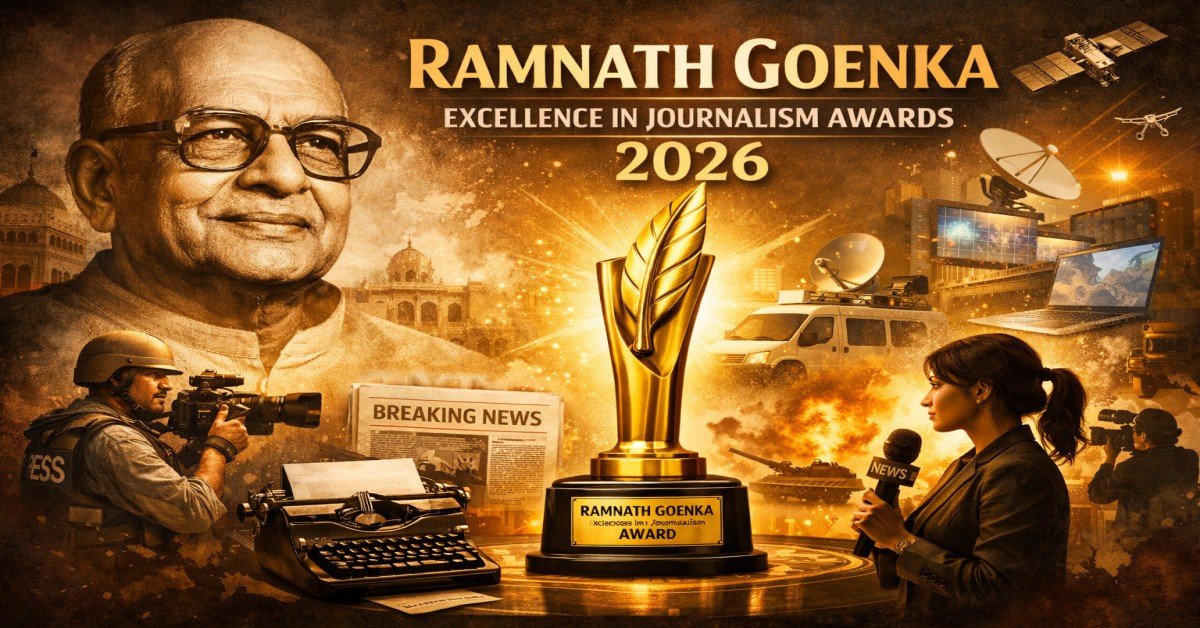
20th Ramnath Goenka Excellence in Journalism Awards 2026 — India’s Most Prestigious Press Honour Goes Milestone
The 20th edition of the Ramnath Goenka Excellence in Journalism Awards was held in New Delhi in March 2026, marking two landmark decades of recognising India’s finest journalistic work. Vice President C.P. Radhakrishnan served as the chief guest and personally presented the awards, making it one of the highest-profile ceremonies in the award’s history. A total of 25 outstanding journalists were honoured across 18 categories spanning print, digital, and broadcast journalism.
The Ramnath Goenka Excellence in Journalism Awards are widely regarded as India’s equivalent of the Pulitzer Prize. Instituted by the Ramnath Goenka Foundation — an initiative of the Indian Express Group — the awards honour work that demonstrates courage, independence, depth, and measurable public impact. All work recognised in the 2026 ceremony was published or broadcast during the calendar year 2024.
The 20th edition is particularly significant not only as a milestone but because it reflects two decades of mapping the evolution of Indian journalism — from the print-dominant world of 2006 to today’s converged, multi-platform media landscape where digital-first publications and broadcast journalists stand on equal footing with legacy newspapers.
Vice President Radhakrishnan Presents the 20th Edition — Honouring Goenka’s “Blank Editorial” Legacy
The Vice President’s Address
Vice President C.P. Radhakrishnan, addressing the gathering, stressed the indispensable role of journalism in a functioning democracy. He pointed out that journalists not only inform the public but also act as guardians of truth and accountability. He called upon the media to remain neutral, objective, and committed to the larger interests of society — particularly at a time when disinformation and algorithmic echo chambers threaten the quality of public discourse.
Paying tribute to Ramnath Goenka, Radhakrishnan highlighted Goenka’s legendary act of resistance during the Emergency (1975–77): publishing a blank editorial to protest state censorship imposed by the Indira Gandhi government. He noted that this act of journalistic silence was more powerful than any words could have been — a defining moment in the history of India’s free press and a symbol of principled defiance that continues to inspire editors and reporters to this day.
Key Quote: “Ram Nath Goenka demonstrated the power of silence by publishing a blank editorial during the Emergency. True journalism must remain neutral, objective, and committed to the larger interests of society.” — Vice President C.P. Radhakrishnan at the 20th RNG Awards Ceremony.
The Ramnath Goenka Memorial Debate
The Ramnath Goenka Memorial Debate — a tradition held alongside the annual awards since its early editions — was also conducted as part of the 20th milestone ceremony. The debate provides a platform for engaged public discourse on the role of journalism in contemporary India, with speakers drawn from across the political, academic, and media spectrum. It reflects the award’s broader mission: not only to celebrate past excellence but to actively shape journalism’s future by fostering rigorous debate.
The Indian Express Group’s Perspective
Viveck Goenka, Chairman and Managing Director of the Indian Express Group, in his welcome address, underlined how journalism is being shaped by unprecedented disruptive forces — from artificial intelligence reshaping newsrooms to structural shifts driven by digital monetisation pressures and political polarisation. He reiterated that genuine journalism means “going where the story takes you and not letting how you vote dictate how you report” — a direct echo of Ramnath Goenka’s own editorial philosophy.
Spotlight on the Winners — Journalism That Made a Difference in 2024
Why this matters for exams: Praveen Jain’s award-winning story is a perfect case study in rural development reporting and the digital divide — themes directly relevant to UPSC GS-II (Welfare Schemes, Governance) and GS-III (Infrastructure, Digital India). It also highlights the role of the press in holding the state accountable for the last-mile delivery failure in border and tribal regions.
Beyond the confirmed Photojournalism winner, the 20th edition saw journalists from multiple leading newsrooms win across categories including investigative reporting, Hindi journalism, business and economic coverage, environment and science writing, and regional language journalism. Categories carried both a Print/Digital track and a separate Broadcast track, effectively awarding two journalists per such category.
The 18 Award Categories of the 20th Ramnath Goenka Excellence in Journalism Awards
The Ramnath Goenka Awards cover the full spectrum of India’s journalism ecosystem — from grassroots rural reporting to global financial analysis; from photojournalism to long-form books; from Hindi and regional language journalism to foreign correspondents covering India. Here is the complete list of categories for the 20th edition:
| # | Category | Track |
|---|---|---|
| 1 | Hindi Journalism | Print/Digital & Broadcast |
| 2 | Regional Language Journalism | Print/Digital & Broadcast |
| 3 | Investigative Reporting | Print/Digital & Broadcast |
| 4 | Reporting on Politics & Government | Print/Digital & Broadcast |
| 5 | Business & Economic Journalism | Print/Digital & Broadcast |
| 6 | Environment, Science & Technology | Print/Digital & Broadcast |
| 7 | Uncovering India Invisible (Rural Reporting) | Print/Digital & Broadcast |
| 8 | Feature Writing | Print/Digital |
| 9 | Sports Journalism | Print/Digital & Broadcast |
| 10 | Arts, Culture & Entertainment | Print/Digital |
| 11 | Photojournalism | Print/Digital |
| 12 | Books (Long-form Journalism) | |
| 13 | Journalist of the Year | Print/Digital & Broadcast |
| 14 | Foreign Correspondent Covering India | |
| 15 | Prakash Kardaley Memorial Award for Civic Journalism | Print/Digital |
| 16 | Health & Medicine Reporting | Print/Digital & Broadcast |
| 17 | Conflict & Security Reporting | Print/Digital & Broadcast |
| 18 | Ramnath Goenka Memorial Award for Lifetime Achievement | All Media |
Key structural feature: Several categories carry both a Print/Digital track and a separate Broadcast track — meaning two awards are given in that domain. This is why 18 categories yield 25 total awards. The jury may also choose not to award a category if no entry meets the threshold — a practice that maintains the award’s high standards and has occurred with the Lifetime Achievement category in past years.
Distinguished Jury of the 20th Edition — Five Eminent Indians Who Selected the Winners
The jury for the 20th Ramnath Goenka Excellence in Journalism Awards comprised five eminent personalities drawn from the judiciary, academia, civil society, and media. The jury evaluates entries independently of the Indian Express Group — ensuring editorial neutrality in the selection process. Entries are assessed on independence, depth, quality, impact, originality, and service to the public interest.
Exam angle: S.Y. Quraishi is also notable as the author of An Undocumented Wonder: The Making of the Great Indian Election and has been a prominent voice on electoral reform. Rohini Nilekani is the wife of Infosys co-founder Nandan Nilekani and runs Arghyam, a foundation focused on water and sanitation. K.G. Suresh heads IIMC — India’s premier journalism training institution under the Ministry of Information & Broadcasting.
India’s Premier Journalism Honour — Two Decades of Recognising Fearless Reporting
Foundation and Purpose
The Ramnath Goenka Excellence in Journalism Awards were instituted by the Indian Express Group in 2006 as part of the centenary year celebrations of its founder Ramnath Goenka, who was born on 22 April 1904. They have been held annually since, making 2026 the 20th edition. The awards are presented by the Ramnath Goenka Foundation and are open to journalists working in Indian media across all platforms and languages.
The awards recognise work that is independent, accurate, courageous, and in the public interest. Crucially, they are not limited to any one organisation — journalists from any newsroom, large or small, regional or national, can win. This makes them genuinely representative of the best of Indian journalism in a given year.
Why It Is Compared to the Pulitzer Prize
The RNG Awards draw comparison to the Pulitzer Prize (USA) for three reasons: first, they are platform-agnostic — honouring print, digital, and broadcast equally; second, they are evaluated by an independent external jury rather than by the sponsoring institution itself; and third, categories can go unawarded if no entry meets the bar — a quality-control mechanism that Pulitzers also exercise. Together, these features set the RNG Awards apart from institutional or industry-body awards that tend to be more collegial in nature.
Milestone Timeline
UPSC Mains angle (GS-II): The RNG Awards are a direct example of civil society mechanisms that reinforce press freedom and democratic accountability. They also raise questions about media independence, ownership concentration, and the role of institutional awards in shaping journalistic incentives — all themes relevant to GS-II (Governance, Democracy, Accountability) and Essay Paper.
Ramnath Goenka (1904–1991): Fearless Founder of Modern Indian Journalism
Early Life and the Building of an Empire
Ramnath Goenka was born on 22 April 1904 in Darbhanga, Bihar, into a Marwari family. He moved to Madras (now Chennai) and later to Bombay, where he built his career as a businessman and journalist. He acquired majority control of The Indian Express in the early 1930s and systematically expanded it into a pan-Indian multi-language media empire — with editions in English, Hindi, Tamil, Kannada, Marathi, and other languages — making it one of the largest newspaper groups in Asia by the 1970s.
The Emergency — India’s Defining Test of Press Freedom
Goenka’s greatest legacy was forged during India’s Emergency (25 June 1975 – 21 March 1977), when Prime Minister Indira Gandhi imposed a state of internal emergency, suspended civil liberties, and imposed strict pre-censorship on the press. While many newspapers capitulated — the then-Information Minister L.K. Advani famously said the press “crawled when asked to bend” — Goenka and editor Arun Shourie chose resistance. The Indian Express published a blank editorial space where the censored editorial would have appeared — a silent but thunderous act of defiance. Government advertisements were withdrawn from the paper, and Goenka personally faced immense political pressure. He remained defiant throughout.
Famous quote attributed to L.K. Advani (1975–77 Emergency): “You were asked to bend but you crawled.” This quote — directed at those newspapers that voluntarily submitted to censorship — stands as a permanent indictment in Indian media history, and gives context to why Ramnath Goenka’s refusal to bend made him a towering figure in the story of India’s free press.
Political Life and Final Years
Goenka was also elected to the Lok Sabha in 1971 as a Bharatiya Jana Sangh candidate from Vidisha constituency in Madhya Pradesh. He used his parliamentary platform to champion press freedom and oppose government overreach. He passed away on 5 October 1991 in Mumbai. In 2000, India Today magazine included him in its list of “100 People Who Shaped India” — placing him alongside freedom fighters, scientists, and nation-builders in that pantheon.
Test Yourself: 8 Questions on the Ramnath Goenka Excellence in Journalism Awards 2026
RNG Awards 2026 — Quick Quiz
8 exam-style questions covering all key facts from the 20th Ramnath Goenka Excellence in Journalism Awards. Test your retention before your next exam!