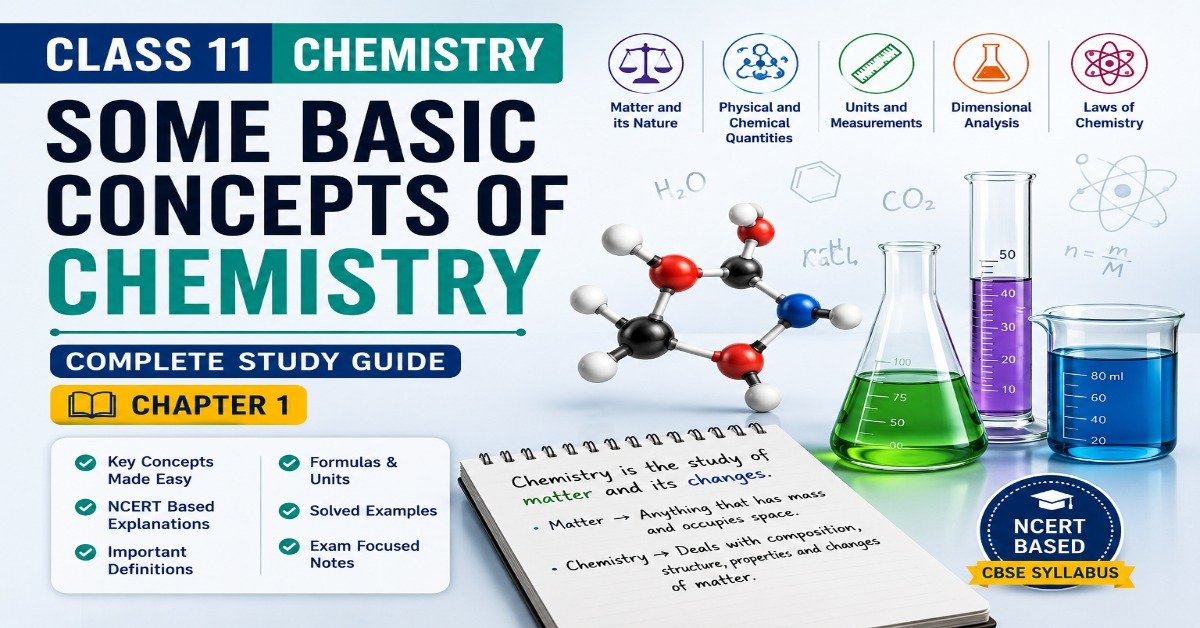
Welcome to the most detailed and student-friendly guide on Some Basic Concepts of Chemistry — Chapter 1 of Class 11 Chemistry (NCERT). This chapter is the absolute foundation of all chemistry. Whether you are studying for CBSE Board exams, JEE, or NEET, you will use the concepts from this chapter in every single topic that follows.
This article covers every concept from scratch — with simple language, real-life examples, solved problems, common mistakes, and exam tips — so that you build an unshakeable base in Chemistry from Day 1.
Why This Chapter is Important
- CBSE Board exams ask 5–8 marks worth of questions directly from this chapter every year.
- JEE Main asks 1–2 questions on mole concept and stoichiometry almost every year.
- NEET regularly tests molar mass, empirical formula, and limiting reagent concepts.
- The mole concept, stoichiometry, and concentration calculations appear in almost every chapter of Chemistry (Equilibrium, Electrochemistry, Solutions, etc.).
- Without understanding this chapter, you cannot solve any quantitative chemistry problem.
Section 1: What is Chemistry?
Chemistry is the branch of science that deals with the study of matter — its composition, properties, structure, and the changes it undergoes during chemical and physical processes.
Chemistry is often called the “central science” because it connects physics (at the atomic level) to biology (life processes), geology (minerals), and environmental science. Without chemistry, there would be no medicines, no fertilisers, no plastics, no fuels, and no materials science.
Branches of Chemistry:
- Organic Chemistry — study of carbon compounds (life, medicines, polymers)
- Inorganic Chemistry — study of all non-carbon compounds and metals
- Physical Chemistry — study of energy changes, rates, and equilibrium in chemical reactions
- Analytical Chemistry — study of composition and detection of substances
- Biochemistry — chemistry of living systems
Section 2: Nature of Matter
Matter is anything that has mass and occupies space. A stone, water, air, heat (No — heat is energy, not matter), light (No — light is electromagnetic radiation) — only the first two are matter.
2.1 States of Matter
Matter exists in three main physical states:
a) Solid
- Definite shape and definite volume
- Particles are very closely packed, held by strong intermolecular forces
- Particles vibrate in fixed positions — they don’t move freely
- Incompressible
- Examples: iron, ice, wood, salt
b) Liquid
- No definite shape (takes the shape of the container) but definite volume
- Particles are close but can move past each other
- Intermolecular forces are weaker than solids
- Slightly compressible
- Examples: water, milk, mercury, alcohol
c) Gas
- No definite shape and no definite volume (fills the entire container)
- Particles are far apart, moving randomly at high speed
- Intermolecular forces are negligible
- Highly compressible
- Examples: oxygen, nitrogen, steam, LPG
There are also two more states of matter — plasma (found in stars, very high temperatures) and Bose-Einstein condensate (near absolute zero temperature) — but these are beyond the Class 11 syllabus.
2.2 Classification of Matter
Matter is classified at two levels:
Level 1: Based on Physical State
Solid, Liquid, Gas (as discussed above)
Level 2: Based on Chemical Composition
Pure Substances — have fixed, uniform composition throughout.
- Elements — cannot be broken down into simpler substances by any chemical process. Made of only one type of atom. Examples: gold (Au), oxygen (O), carbon (C), iron (Fe). There are 118 known elements.
- Compounds — made of two or more elements chemically combined in a fixed ratio. Can be broken down into elements by chemical methods. Examples: water (H₂O), salt (NaCl), carbon dioxide (CO₂), glucose (C₆H₁₂O₆).
Mixtures — two or more substances mixed together in any ratio, without chemical bonding. Each substance retains its own properties.
- Homogeneous Mixture (Solution) — uniform composition throughout. You cannot see the individual components. Examples: salt water, air, alloys like brass.
- Heterogeneous Mixture — non-uniform composition. Individual components are visible or distinguishable. Examples: sand and water, oil and water, soil.
Key Differences — Compound vs Mixture:
- Compounds have fixed composition; mixtures have variable composition.
- Compounds have properties different from their components; mixtures retain individual properties.
- Compounds are separated by chemical methods; mixtures by physical methods (filtration, distillation, etc.).
- Formation of a compound involves a chemical change with energy exchange; mixing usually involves no energy change.
Section 3: Properties of Matter
3.1 Physical Properties
Properties that can be observed or measured without changing the chemical composition of the substance.
Examples: colour, odour, melting point, boiling point, density, hardness, electrical conductivity, solubility.
3.2 Chemical Properties
Properties that describe how a substance reacts chemically and transforms into a different substance.
Examples: flammability, acidity, reactivity with water, oxidation, corrosion.
3.3 Physical Change
A change in which the chemical composition of the substance remains unchanged. Only physical state or form changes. The change is usually reversible.
Examples: melting of ice, boiling of water, tearing paper, dissolving sugar in water.
3.4 Chemical Change
A change in which new substances with different chemical compositions are formed. Usually irreversible.
Examples: burning of wood, rusting of iron, cooking food, fermentation, digestion.
How to identify a chemical change:
- New substance is formed
- Change in colour, odour, temperature, or evolution of gas
- Formation of precipitate
- Emission of light
Section 4: Measurement in Chemistry — SI Units
Chemistry involves precise measurements. The SI system (International System of Units) is used worldwide.
Important SI Units in Chemistry:
- Mass — kilogram (kg); in lab: gram (g), milligram (mg)
- Length — metre (m); in chemistry: nanometre (nm = 10⁻⁹ m) for atomic sizes, picometer (pm = 10⁻¹² m) for bond lengths
- Volume — cubic metre (m³); in lab: litre (L) or millilitre (mL). 1 L = 1 dm³ = 1000 mL
- Temperature — kelvin (K). In lab: Celsius (°C). Conversion: K = °C + 273.15
- Amount of Substance — mole (mol)
- Pressure — pascal (Pa). Also: atmosphere (atm), bar. 1 atm = 101325 Pa
Important Conversions:
- 1 kg = 1000 g
- 1 g = 1000 mg
- 1 L = 1000 mL = 1 dm³
- 1 m³ = 1000 L
- 1 nm = 10⁻⁹ m
- 1 pm = 10⁻¹² m
- 1 Å (Angstrom) = 10⁻¹⁰ m = 100 pm
- °C to K: add 273.15
- 1 atm = 1.013 bar = 101325 Pa = 760 mmHg
Scientific Notation:
In chemistry, we deal with very large numbers (like Avogadro’s number = 6.022 × 10²³) and very small numbers (like mass of an electron = 9.11 × 10⁻³¹ kg). We express these in scientific notation: a × 10ⁿ where 1 ≤ a < 10.
Significant Figures in Chemistry:
The rules for significant figures in chemistry are the same as in Physics (Chapter 1). Key points:
- All non-zero digits are significant.
- Zeros between non-zero digits are significant.
- Leading zeros are NOT significant.
- Trailing zeros after decimal are significant.
- For multiplication/division: answer has same SF as the least precise number.
- For addition/subtraction: answer has same decimal places as the least precise number.
Section 5: Laws of Chemical Combination
Before atoms and molecules were understood, scientists discovered important patterns in how substances combine chemically. These are called the Laws of Chemical Combination.
5.1 Law of Conservation of Mass (Lavoisier, 1774)
Statement: Matter can neither be created nor destroyed in a chemical reaction. The total mass of reactants equals the total mass of products.
Example: CaCO₃ → CaO + CO₂
100 g of CaCO₃ → 56 g CaO + 44 g CO₂ (Total = 100 g) ✓
This law is the basis for balancing chemical equations.
5.2 Law of Definite Proportions (Proust, 1799)
Statement: A pure chemical compound always contains the same elements combined in the same definite proportion by mass, regardless of the source or method of preparation.
Example: Water (H₂O) always contains hydrogen and oxygen in the mass ratio 1:8, whether obtained from a river, laboratory, or rain.
H : O = 2 × 1 : 1 × 16 = 2 : 16 = 1 : 8
5.3 Law of Multiple Proportions (Dalton, 1803)
Statement: When two elements combine to form more than one compound, the masses of one element that combine with a fixed mass of the other element are in the ratio of small whole numbers.
Example: Carbon and oxygen form two compounds — CO and CO₂.
- In CO: 12 g C combines with 16 g O
- In CO₂: 12 g C combines with 32 g O
- Ratio of oxygen (with same carbon): 16 : 32 = 1 : 2 (small whole numbers ✓)
5.4 Gay-Lussac’s Law of Gaseous Volumes (1808)
Statement: When gases react together, the volumes of reacting gases and gaseous products (at constant temperature and pressure) bear a simple whole number ratio.
Example: H₂ + Cl₂ → 2HCl
1 volume : 1 volume → 2 volumes (ratio 1:1:2 ✓)
Also: 2H₂ + O₂ → 2H₂O
2 volumes : 1 volume → 2 volumes (ratio 2:1:2 ✓)
5.5 Avogadro’s Law (1811)
Statement: Equal volumes of all gases, at the same temperature and pressure, contain equal numbers of molecules.
This explained Gay-Lussac’s law and cleared up confusion about whether elements like oxygen and hydrogen exist as atoms or molecules (they exist as diatomic molecules — O₂, H₂).
Avogadro’s Number: N_A = 6.022 × 10²³ mol⁻¹ — the number of particles in one mole of any substance.
Section 6: Dalton’s Atomic Theory
John Dalton (1808) proposed the first scientific atomic theory to explain the laws of chemical combination:
- All matter is made of tiny, indivisible particles called atoms.
- Atoms of the same element are identical (same mass and properties). Atoms of different elements differ in mass and properties.
- Atoms cannot be created or destroyed in chemical reactions.
- Compounds are formed when atoms of different elements combine in fixed, simple whole-number ratios.
- Chemical reactions involve rearrangement of atoms.
Successes of Dalton’s Theory:
- Explained Law of Conservation of Mass (atoms are not created or destroyed)
- Explained Law of Definite Proportions (atoms combine in fixed ratios)
- Explained Law of Multiple Proportions
Limitations of Dalton’s Theory:
- Atoms are NOT indivisible — they have substructure (protons, neutrons, electrons).
- Atoms of the same element CAN have different masses (isotopes).
- The ratio of combination is not always a simple whole number (e.g., sucrose: C₁₂H₂₂O₁₁).
- It did not explain the nature of bonding between atoms.
Section 7: Atomic and Molecular Masses
7.1 Atomic Mass
The actual mass of an atom is extremely small — the mass of one hydrogen atom is about 1.67 × 10⁻²⁷ kg. To make calculations easier, we use a relative scale.
Atomic Mass Unit (amu or u):
1 amu = 1/12 of the mass of one carbon-12 (¹²C) atom = 1.66054 × 10⁻²⁷ kg
The relative atomic mass of an element is the mass of one atom of that element relative to 1/12 of the mass of a ¹²C atom.
Examples of atomic masses (approximate):
- H = 1 u
- C = 12 u
- N = 14 u
- O = 16 u
- Na = 23 u
- Mg = 24 u
- Al = 27 u
- S = 32 u
- Cl = 35.5 u
- K = 39 u
- Ca = 40 u
- Fe = 56 u
- Cu = 63.5 u
- Zn = 65 u
- Ag = 108 u
- I = 127 u
- Ba = 137 u
- Pb = 207 u
Note: Chlorine has atomic mass 35.5 because it exists as two isotopes — ³⁵Cl (75%) and ³⁷Cl (25%). Average mass = 0.75 × 35 + 0.25 × 37 = 35.5 u.
7.2 Molecular Mass
The molecular mass of a substance is the sum of atomic masses of all atoms in one molecule of that substance.
Examples:
- H₂O: 2(1) + 16 = 18 u
- CO₂: 12 + 2(16) = 44 u
- H₂SO₄: 2(1) + 32 + 4(16) = 2 + 32 + 64 = 98 u
- NaOH: 23 + 16 + 1 = 40 u
- HCl: 1 + 35.5 = 36.5 u
- NH₃: 14 + 3(1) = 17 u
- CaCO₃: 40 + 12 + 3(16) = 40 + 12 + 48 = 100 u
- H₂SO₄: 2 + 32 + 64 = 98 u
- Glucose C₆H₁₂O₆: 6(12) + 12(1) + 6(16) = 72 + 12 + 96 = 180 u
- NaCl: 23 + 35.5 = 58.5 u
7.3 Formula Mass (for Ionic Compounds)
Ionic compounds (like NaCl) do not exist as individual molecules but as a lattice of ions. So we use formula mass — the sum of atomic masses of all atoms in the formula unit.
Example: NaCl formula mass = 23 + 35.5 = 58.5 u
Section 8: The Mole Concept — The Heart of Chemistry
The mole concept is the most important concept in all of quantitative chemistry. If you master this, you can solve almost any stoichiometry problem.
8.1 Why Do We Need the Mole?
Atoms and molecules are incredibly tiny. Even a small grain of salt (NaCl) contains about 10¹⁸ formula units — an unimaginably large number. Chemists need a convenient counting unit for this scale, just like we use “dozen” for 12 or “gross” for 144.
The mole is the chemist’s counting unit for atoms, molecules, and ions.
8.2 Definition of Mole
One mole is the amount of substance that contains as many elementary entities (atoms, molecules, ions, electrons, etc.) as there are atoms in exactly 12 grams of carbon-12.
This number is Avogadro’s Number: N_A = 6.022 × 10²³
So: 1 mole = 6.022 × 10²³ particles
8.3 Molar Mass
The molar mass of a substance is the mass of 1 mole of that substance. It is numerically equal to the molecular mass (or atomic mass) but the unit changes from u to g/mol.
Atomic mass of O = 16 u → Molar mass of O = 16 g/mol
Molecular mass of H₂O = 18 u → Molar mass of H₂O = 18 g/mol
Molecular mass of CO₂ = 44 u → Molar mass of CO₂ = 44 g/mol
The Golden Formula:
Number of moles (n) = Given mass (m) / Molar mass (M)
n = m / M
From moles to number of particles:
Number of particles = n × N_A = (m/M) × 6.022 × 10²³
8.4 Molar Volume of Gas
At Standard Temperature and Pressure (STP):
- Old STP (used in older NCERT): 0°C (273.15 K) and 1 atm pressure
- New STP (IUPAC): 0°C (273.15 K) and 1 bar pressure
At old STP (0°C, 1 atm): 1 mole of any gas occupies 22.4 litres
At new STP (0°C, 1 bar): 1 mole of any gas occupies 22.7 litres
NCERT Class 11 uses 22.4 L/mol. Use this in exams unless told otherwise.
So: n = Volume at STP / 22.4 L/mol
8.5 The Mole Triangle (Three Conversions)
Everything connects through moles:
- Mass ↔ Moles: n = m/M (or m = n × M)
- Number of particles ↔ Moles: N = n × N_A (or n = N/N_A)
- Volume of gas ↔ Moles (at STP): V = n × 22.4 L (or n = V/22.4)
Master these three relationships and you can solve any mole concept problem.
8.6 Solved Examples on Mole Concept
Example 1: How many moles are in 44 g of CO₂?
Molar mass of CO₂ = 44 g/mol
n = 44/44 = 1 mole
Example 2: How many molecules are in 18 g of water?
n = 18/18 = 1 mole
Molecules = 1 × 6.022 × 10²³ = 6.022 × 10²³ molecules
Example 3: What is the mass of 3 moles of glucose (C₆H₁₂O₆)?
Molar mass of glucose = 6(12) + 12(1) + 6(16) = 72 + 12 + 96 = 180 g/mol
Mass = 3 × 180 = 540 g
Example 4: How many atoms are in 0.5 moles of sulphur?
Atoms = 0.5 × 6.022 × 10²³ = 3.011 × 10²³ atoms
Example 5: What volume does 4 moles of CO₂ occupy at STP?
V = 4 × 22.4 = 89.6 L
Example 6: How many moles are in 3.011 × 10²³ atoms of carbon?
n = 3.011 × 10²³ / 6.022 × 10²³ = 0.5 moles
Section 9: Percentage Composition
The percentage composition of a compound tells us the percentage by mass of each element present in the compound.
Formula:
% of element = (Mass of element in 1 mole of compound / Molar mass of compound) × 100
Example: Find the percentage composition of water (H₂O).
Molar mass of H₂O = 18 g/mol
Mass of H in 1 mole = 2 × 1 = 2 g
Mass of O in 1 mole = 1 × 16 = 16 g
- % H = (2/18) × 100 = 11.11%
- % O = (16/18) × 100 = 88.89%
- Total = 100% ✓
Example: Find % composition of CO₂.
Molar mass = 44 g/mol
- % C = (12/44) × 100 = 27.27%
- % O = (32/44) × 100 = 72.73%
Example: Find % nitrogen in urea CO(NH₂)₂.
Molar mass of urea = 12 + 16 + 2(14 + 2) = 12 + 16 + 2(16) = 12 + 16 + 32 = 60 g/mol
Mass of N = 2 × 14 = 28 g
% N = (28/60) × 100 = 46.67%
Section 10: Empirical and Molecular Formulas
10.1 Empirical Formula
The empirical formula gives the simplest whole number ratio of atoms of each element present in a compound.
Example: Glucose C₆H₁₂O₆ → empirical formula is CH₂O (ratio C:H:O = 1:2:1)
10.2 Molecular Formula
The molecular formula gives the actual number of atoms of each element in one molecule of the compound.
Example: Glucose = C₆H₁₂O₆
10.3 Relationship Between Empirical and Molecular Formula
Molecular formula = n × Empirical formula
where n = Molecular mass / Empirical formula mass (n is a whole number)
Examples:
- Empirical CH₂O, Molecular mass = 180 → n = 180/30 = 6 → Molecular formula = C₆H₁₂O₆
- Empirical CH₂, Molecular mass = 56 → n = 56/14 = 4 → Molecular formula = C₄H₈
- Empirical HO, Molecular mass = 34 → n = 34/17 = 2 → Molecular formula = H₂O₂
10.4 How to Find Empirical Formula from Percentage Composition (Step-by-Step Method)
Step 1: Write the percentage of each element (if percentages are given) or convert masses to percentages.
Step 2: Divide each percentage by the atomic mass of that element → gives relative moles.
Step 3: Divide all values by the smallest value → gives simplest ratio.
Step 4: If the ratio is not a whole number, multiply by appropriate factor to get whole numbers.
Step 5: Write the empirical formula.
Worked Example: A compound contains C = 40%, H = 6.67%, O = 53.33%. Find empirical and molecular formula if molecular mass = 60 g/mol.
Step 2 — Divide by atomic mass:
- C: 40/12 = 3.33
- H: 6.67/1 = 6.67
- O: 53.33/16 = 3.33
Step 3 — Divide by smallest (3.33):
- C: 3.33/3.33 = 1
- H: 6.67/3.33 = 2
- O: 3.33/3.33 = 1
Empirical formula = CH₂O (Empirical formula mass = 12 + 2 + 16 = 30)
n = 60/30 = 2
Molecular formula = C₂H₄O₂ (acetic acid structure)
Tip: If after dividing by smallest you get values like 1.5, 2.5, 3.5 — multiply all by 2. If you get 1.33 or 1.67 — multiply all by 3.
Section 11: Chemical Reactions and Chemical Equations
11.1 Chemical Reaction
A process in which one or more substances (reactants) are converted into one or more new substances (products) with different properties.
11.2 Chemical Equation
A symbolic representation of a chemical reaction using chemical formulas.
Example: C + O₂ → CO₂
Reactants are on the left, products on the right, separated by an arrow.
11.3 Balancing Chemical Equations
By the Law of Conservation of Mass, the number of atoms of each element must be the same on both sides of the equation. This is called a balanced equation.
Steps to Balance by Hit and Trial (Inspection) Method:
- Write the unbalanced equation.
- Count atoms of each element on both sides.
- Start balancing with elements that appear in the fewest compounds.
- Balance metals first, then non-metals, then hydrogen, and oxygen last.
- Verify the final count.
Example: Balance Fe + O₂ → Fe₂O₃
- Unbalanced: Fe + O₂ → Fe₂O₃
- Balance Fe: 4Fe + O₂ → 2Fe₂O₃ (now 4 Fe on each side)
- Balance O: 4Fe + 3O₂ → 2Fe₂O₃ (6 O on each side ✓)
- Final: 4Fe + 3O₂ → 2Fe₂O₃
State Symbols used in equations:
- (s) — solid
- (l) — liquid
- (g) — gas
- (aq) — aqueous (dissolved in water)
- ↑ — gas evolved
- ↓ — precipitate formed
- Δ (or heat arrow) — heat applied
Section 12: Stoichiometry and Stoichiometric Calculations
Stoichiometry (from Greek: stoicheion = element, metron = measure) is the calculation of the quantities of reactants and products in chemical reactions, based on the balanced equation.
The coefficients in a balanced equation give the molar ratios in which substances react and are produced.
Example: N₂ + 3H₂ → 2NH₃
- 1 mole N₂ reacts with 3 moles H₂ to give 2 moles NH₃
- 28 g N₂ reacts with 6 g H₂ to give 34 g NH₃
- OR: 1 volume N₂ : 3 volumes H₂ : 2 volumes NH₃ (for gases at same T, P)
12.1 Stoichiometric Calculations — Method
The standard method for stoichiometry problems:
- Write and balance the chemical equation.
- Convert given quantity to moles (using n = m/M or n = V/22.4).
- Use molar ratio from balanced equation to find moles of desired substance.
- Convert moles back to required unit (mass, volume, number of particles).
Example: How many grams of CO₂ are produced when 24 g of carbon burns completely?
C + O₂ → CO₂
Moles of C = 24/12 = 2 moles
From equation: 1 mol C → 1 mol CO₂
So 2 mol C → 2 mol CO₂
Mass of CO₂ = 2 × 44 = 88 g
Example: How many litres of H₂ at STP are needed to produce 2 moles of NH₃?
N₂ + 3H₂ → 2NH₃
2 moles NH₃ requires 3 moles H₂
Volume of H₂ = 3 × 22.4 = 67.2 L
12.2 Limiting Reagent (Limiting Reactant)
In most real reactions, reactants are not taken in exact stoichiometric ratios. One reactant gets used up completely before the others — this is the limiting reagent. It limits (controls) how much product can be formed.
The other reactants are in excess — they are called excess reagents.
How to find the limiting reagent:
- Convert masses of all reactants to moles.
- Divide each by the stoichiometric coefficient in the balanced equation.
- The reactant with the smallest value is the limiting reagent.
Example: 3 g of H₂ and 28 g of N₂ are mixed. How much NH₃ is formed?
N₂ + 3H₂ → 2NH₃
Moles of N₂ = 28/28 = 1 mol
Moles of H₂ = 3/2 = 1.5 mol
Divide by coefficient:
N₂: 1/1 = 1
H��: 1.5/3 = 0.5 ← Smaller, so H₂ is limiting reagent
From H₂: 1.5 mol H₂ produces (2/3) × 1.5 = 1 mol NH₃
Mass of NH₃ = 1 × 17 = 17 g
12.3 Theoretical Yield, Actual Yield, and Percentage Yield
Theoretical yield = maximum amount of product calculated from stoichiometry (assuming 100% conversion).
Actual yield = amount of product actually obtained in the experiment (always less than or equal to theoretical yield, due to side reactions, incomplete reactions, losses).
Percentage yield = (Actual yield / Theoretical yield) × 100%
Example: If 17 g of NH₃ is theoretically expected but only 15 g is obtained:
% yield = (15/17) × 100 = 88.2%
Section 13: Concentration of Solutions
When we dissolve a substance (solute) in a liquid (solvent), we get a solution. The amount of solute dissolved in a given amount of solution or solvent is called the concentration.
13.1 Mass Percentage (w/w %)
Mass % = (Mass of solute / Mass of solution) × 100
Example: 10 g NaCl dissolved in 90 g water:
Mass % NaCl = (10/100) × 100 = 10%
13.2 Volume Percentage (v/v %)
Volume % = (Volume of solute / Volume of solution) × 100
Used when both solute and solvent are liquids.
Example: 40 mL ethanol in 100 mL solution = 40% v/v ethanol (like alcohol percentage in drinks)
13.3 Mass by Volume Percentage (w/v %)
w/v % = (Mass of solute in g / Volume of solution in mL) × 100
Example: 5 g glucose in 100 mL solution = 5% w/v (used in medical saline solutions)
13.4 Parts Per Million (ppm)
Used for very dilute solutions (trace amounts of contaminants).
ppm = (Mass of solute / Mass of solution) × 10⁶
Example: 0.002 g of arsenic in 1 kg water = 2 ppm arsenic
Also: ppb (parts per billion) = × 10⁹; used for even more dilute solutions.
13.5 Mole Fraction (χ)
Mole fraction of a component = Moles of that component / Total moles of all components
χ_A = n_A / (n_A + n_B)
The sum of mole fractions of all components = 1.
χ_A + χ_B = 1
Example: 18 g of water and 46 g of ethanol (C₂H₅OH, molar mass 46) are mixed.
n(water) = 18/18 = 1 mol
n(ethanol) = 46/46 = 1 mol
χ(water) = 1/(1+1) = 0.5
χ(ethanol) = 1/(1+1) = 0.5
13.6 Molarity (M) — Most Important Concentration Unit
Molarity = Number of moles of solute / Volume of solution in litres
M = n / V(L) or M = (mass in g / molar mass) / V(L)
Unit: mol/L or mol L⁻¹ (also written as M)
Example: 4 g of NaOH (molar mass 40) dissolved in 500 mL solution. Find molarity.
n = 4/40 = 0.1 mol
V = 500 mL = 0.5 L
M = 0.1 / 0.5 = 0.2 mol/L (0.2 M)
Important Note: Molarity changes with temperature because volume of solution changes with temperature. It is the most widely used concentration unit in Chemistry labs.
13.7 Molality (m)
Molality = Number of moles of solute / Mass of solvent in kg
m = n / W(kg)
Unit: mol/kg or mol kg⁻¹
Example: 0.1 mol of glucose in 200 g of water.
m = 0.1 / 0.2 = 0.5 mol/kg (0.5 m)
Advantage of molality over molarity: Molality does NOT change with temperature (mass doesn’t change with T, unlike volume). So it is preferred for colligative property calculations.
Quick Comparison of Concentration Units:
- Mass % — mass of solute per 100 g of solution
- Mole fraction — moles of component per total moles
- Molarity (M) — moles of solute per litre of solution (changes with T)
- Molality (m) — moles of solute per kg of solvent (does NOT change with T)
- ppm — mass of solute per 10⁶ parts of solution
Section 14: Important Solved Numericals
Numerical 1 — Mole Concept
Q: Calculate the number of molecules and atoms in 5.6 L of N₂ at STP.
Moles of N₂ = 5.6 / 22.4 = 0.25 mol
Molecules of N₂ = 0.25 × 6.022 × 10²³ = 1.505 × 10²³ molecules
Atoms of N = 2 × 1.505 × 10²³ = 3.011 × 10²³ atoms (N₂ is diatomic)
Numerical 2 — Percentage Composition
Q: Find the percentage composition of H₂SO₄ (Molar mass = 98 g/mol).
- Mass of H = 2 × 1 = 2 g → % H = (2/98) × 100 = 2.04%
- Mass of S = 32 g → % S = (32/98) × 100 = 32.65%
- Mass of O = 64 g → % O = (64/98) × 100 = 65.31%
- Total = 100% ✓
Numerical 3 — Empirical Formula
Q: A compound has C = 75%, H = 25%. Find empirical and molecular formula if molar mass = 16 g/mol.
C: 75/12 = 6.25 | H: 25/1 = 25
Divide by 6.25: C: 1 | H: 4
Empirical formula: CH₄ (emp. formula mass = 16)
n = 16/16 = 1
Molecular formula: CH₄ (methane)
Numerical 4 — Limiting Reagent
Q: 6 g of H₂ reacts with 48 g of O₂. Find the mass of water formed and the excess reactant remaining.
2H₂ + O₂ → 2H₂O
n(H₂) = 6/2 = 3 mol
n(O₂) = 48/32 = 1.5 mol
Divide by coefficient:
H��: 3/2 = 1.5
O₂: 1.5/1 = 1.5
Both give equal value → both are used up completely → no excess reactant
From equation: 2 mol H₂ → 2 mol H₂O
3 mol H₂ → 3 mol H₂O
Mass of H₂O = 3 × 18 = 54 g
Numerical 5 — Molarity
Q: What mass of KOH is required to prepare 250 mL of 0.5 M solution? (Molar mass of KOH = 56 g/mol)
n = M × V(L) = 0.5 × 0.25 = 0.125 mol
Mass = n × M = 0.125 × 56 = 7 g
Numerical 6 — Mole Fraction
Q: Calculate the mole fraction of each component in a mixture of 36 g of water and 46 g of ethanol (C₂H₅OH).
n(H₂O) = 36/18 = 2 mol
n(C₂H₅OH) = 46/46 = 1 mol
Total moles = 3 mol
χ(H₂O) = 2/3 = 0.667
χ(C₂H₅OH) = 1/3 = 0.333
Sum = 0.667 + 0.333 = 1.000 ✓
Numerical 7 — Stoichiometry
Q: How many grams of oxygen are required to completely burn 16 g of methane (CH₄)?
CH₄ + 2O₂ → CO₂ + 2H₂O
n(CH₄) = 16/16 = 1 mol
From equation: 1 mol CH₄ needs 2 mol O₂
Mass of O₂ = 2 × 32 = 64 g
Section 15: Common Mistakes Students Make
- Forgetting to balance the equation before doing stoichiometry. An unbalanced equation gives wrong molar ratios and wrong answers every time.
- Using atomic mass instead of molar mass. Atomic mass is in u; molar mass is in g/mol. Numerically they are the same, but the unit matters in calculations.
- Confusing molecular formula with empirical formula. CH₂O and C₆H₁₂O₆ are not the same compound even though the latter is a multiple of the former.
- Adding percentages wrong. When finding empirical formula, the percentages should add to exactly 100%. If the total is not 100%, the missing % is oxygen.
- Dividing by molar mass instead of atomic mass in empirical formula. In step 2 of empirical formula, divide each element’s % by its atomic mass (not molecular/molar mass).
- Using mass of solution instead of mass of solvent in molality. Molality uses mass of SOLVENT, not total solution. Molarity uses volume of total SOLUTION.
- Forgetting that diatomic molecules count as 2 atoms per molecule. N₂, O₂, H₂, Cl₂, Br₂, I₂, F₂ are all diatomic — 1 mole of N₂ has 2 × 6.022 × 10²³ atoms of N.
- Confusing the limiting reagent concept. The limiting reagent is NOT the one with less mass or fewer moles — it is the one with the smallest (moles/coefficient) ratio.
- Using 22.4 L/mol for gases not at STP. 22.4 L/mol is ONLY at STP (0°C, 1 atm). At other conditions, use the ideal gas law: PV = nRT.
- Confusing ppm and percentage. ppm = parts per million = mg/kg = μg/g. 1 ppm = 0.0001% = 10⁻⁴%.
Section 16: Quick Revision — All Formulas at a Glance
Mole Concept:
- n = m / M (moles = mass / molar mass)
- N = n × N_A (number of particles = moles × Avogadro’s number)
- V(STP) = n × 22.4 L (volume of gas at STP)
- N_A = 6.022 × 10²³ mol⁻¹
Percentage Composition:
- % element = (mass of element in 1 mole / molar mass of compound) × 100
Empirical and Molecular Formula:
- Step: % → divide by atomic mass → divide by smallest → multiply to get whole numbers
- n = Molecular mass / Empirical formula mass
- Molecular formula = n × Empirical formula
Concentration Units:
- Mass % = (mass of solute / mass of solution) × 100
- Mole fraction χ_A = n_A / (n_A + n_B)
- Molarity M = n (mol) / V (L)
- Molality m = n (mol) / W_solvent (kg)
- ppm = (mass of solute / mass of solution) × 10⁶
- % yield = (actual yield / theoretical yield) × 100
Laws of Chemical Combination — One-Line Summary:
- Conservation of Mass: mass of reactants = mass of products
- Definite Proportions: fixed mass ratio in a compound always
- Multiple Proportions: masses of one element in different compounds with same partner → simple ratio
- Gay-Lussac’s: volumes of gases at same T, P → simple ratio
- Avogadro’s: equal volumes of gases at same T, P have equal molecules
Section 17: Previous Year Exam Questions
- Q1 (1 mark): Define one mole.
- Q2 (1 mark): What is the SI unit of amount of substance?
- Q3 (1 mark): How many atoms are present in 1 molecule of H₂SO₄?
- Q4 (2 marks): Calculate the number of moles in 22 g of CO₂. Also find the number of molecules.
- Q5 (2 marks): Differentiate between empirical formula and molecular formula with an example.
- Q6 (3 marks): State and explain the Law of Conservation of Mass with an example.
- Q7 (3 marks): A compound on analysis gives C = 92.3% and H = 7.7%. If the molecular mass is 78 g/mol, find the molecular formula.
- Q8 (3 marks): 10 g of CaCO₃ is heated strongly. Calculate the mass of CaO produced and volume of CO₂ evolved at STP. (CaCO₃ → CaO + CO₂)
Answer to Q3: H₂SO₄ has 2H + 1S + 4O = 7 atoms per molecule.
Answer to Q4: n = 22/44 = 0.5 mol; Molecules = 0.5 × 6.022 × 10²³ = 3.011 × 10²³.
Answer to Q7:
C: 92.3/12 = 7.69 | H: 7.7/1 = 7.7
Divide by 7.69: C = 1, H = 1.001 ≈ 1
Empirical formula = CH (mass = 13)
n = 78/13 = 6
Molecular formula = C₆H₆ (benzene)
Answer to Q8:
CaCO₃ → CaO + CO₂ (molar mass: 100 → 56 + 44)
n(CaCO₃) = 10/100 = 0.1 mol
n(CaO) = 0.1 mol → mass = 0.1 × 56 = 5.6 g
n(CO₂) = 0.1 mol → volume at STP = 0.1 × 22.4 = 2.24 L
Section 18: Real-Life Applications of This Chapter
- Medicines: Drug dosages are calculated using molar masses and concentration. “250 mg tablet” = 250/molar mass moles of medicine.
- Fertilisers: The “NPK” ratio (Nitrogen-Phosphorus-Potassium) on fertiliser bags is a percentage composition by mass.
- Water purification: Chlorine levels in drinking water are measured in ppm (usually 0.5–1 ppm for safe drinking water).
- Cooking: A recipe for baking is like a chemical equation — amounts matter. Too much or too little of one ingredient (limiting reagent) ruins the outcome.
- Industry: In chemical manufacturing, limiting reagent calculations determine efficiency and cost. Maximising yield = maximising profit.
- Blood tests: Blood glucose is reported in mg/dL — a mass/volume concentration. Normal = 70–100 mg/dL.
- Air quality: Pollutants like CO, SO₂, NO₂ in air are measured in ppm or ppb.
Conclusion: The Language of Chemistry
Some Basic Concepts of Chemistry is not just Chapter 1 — it is the language and grammar of all chemistry. Every topic you study from Chapter 2 onwards — atomic structure, bonding, thermodynamics, equilibrium, electrochemistry — requires you to calculate moles, use stoichiometry, and understand concentrations.
The three pillars of this chapter are:
- The Mole Concept — your bridge between the world of atoms (too small to see) and the world of grams and litres (what you can measure in a lab).
- Stoichiometry — the mathematics of chemical reactions. Master this and you can calculate anything about any reaction.
- Concentration — the language of solutions, used in labs, medicine, and everyday life.
Do not rush through this chapter. Spend time on each concept, solve every NCERT exercise, and then do past year questions. Build the habit of always writing balanced equations before starting any calculation — it will save you from errors and give you a clear method.
Chemistry is logical, beautiful, and extremely applicable to real life. This chapter is your first step into that world.
Best of luck with your studies!